

Cheap Digital Nomad Retirement: Can You Retire Abroad Without Being Rich?
For years, digital nomad culture has been obsessed with movement. Entire communities have been built around finding the next destination, comparing visa options, chasing lower living costs, and discovering the latest remote-work hotspot before it becomes expensive. Social media celebrates mobility. Travel blogs celebrate freedom. YouTube channels celebrate the ability to wake up in one country and fall asleep in another.
What rarely gets discussed is what happens after twenty years of doing that.
A surprising number of remote workers eventually reach a point where the excitement of constant movement begins to compete with something else: stability. Airports become less exciting. Visa runs become less appealing. Packing and unpacking every few months starts to feel more like administration than adventure. Questions that seemed irrelevant at thirty suddenly become important at fifty. Where will healthcare come from? What happens if mobility decreases? What kind of community exists beyond short-term friendships in coworking spaces? More importantly, where do long-term digital nomads settle down when they no longer want to live out of a suitcase?
These questions have created growing interest in cheap digital nomad retirement. Unlike traditional retirement planning, this approach is built around people who already have international experience. They understand global cost-of-living differences. They know how to adapt to new cultures. They often have remote income streams, freelance businesses, consulting work, investments, or online projects that continue generating revenue long after traditional retirement age.
The result is that many location-independent workers are discovering that it may be possible to retire abroad without being rich. The key is understanding where affordability meets quality of life and planning long before retirement actually arrives.
What Happens When Digital Nomads Get Older?
One of the most interesting questions in modern mobility is surprisingly simple: what happens when digital nomads get older?
The popular image of nomad life usually involves people in their twenties and thirties working from cafés in Bali, Chiang Mai, Lisbon, or Mexico City. Yet the first generation of digital nomads is now approaching middle age. Thousands of people who spent years travelling between countries are beginning to think less about the next destination and more about long-term sustainability.
Age changes priorities in subtle ways. At thirty, a three-hour bus ride to save twenty dollars on accommodation might seem perfectly reasonable. At fifty-five, convenience often becomes more valuable than saving every possible dollar. Healthcare becomes more important. Reliable infrastructure matters more. Long-term friendships become harder to replace with short-term social events.
Housing preferences also change. Constantly moving between Airbnbs eventually loses its appeal for many people. A growing number of remote workers begin searching for permanent apartments, retirement visas, residency programmes, or communities where they can establish roots without giving up the international lifestyle they spent years building.
Community becomes another major factor. During the early nomad years, meeting new people feels effortless because novelty itself creates social opportunities. Over time, however, constantly rebuilding a social circle can become exhausting. Many older nomads discover that happiness depends less on exotic locations and more on familiarity, friendships, routines, and a sense of belonging.
This is one reason conversations about cheap retirement destinations for expats have become increasingly relevant among experienced remote workers. The goal is no longer simply to travel cheaply. The goal is to create a sustainable lifestyle that can continue for decades, much like the growing trend of retirees embracing life on the road.
Can Digital Nomads Retire Abroad?
The short answer is yes. In fact, digital nomads may be better positioned than traditional retirees because they already possess many of the skills required to live internationally.
The question is not whether can digital nomads retire abroad. The question is how they can do it sustainably.
The first challenge is residency. Tourist visas that worked perfectly for short-term travel are often unsuitable for retirement. Most countries require retirees to explore residency pathways, retirement visas, investment programmes, or long-term residence permits. Understanding available digital nomad visa options can provide a useful foundation before transitioning into retirement residency strategies.
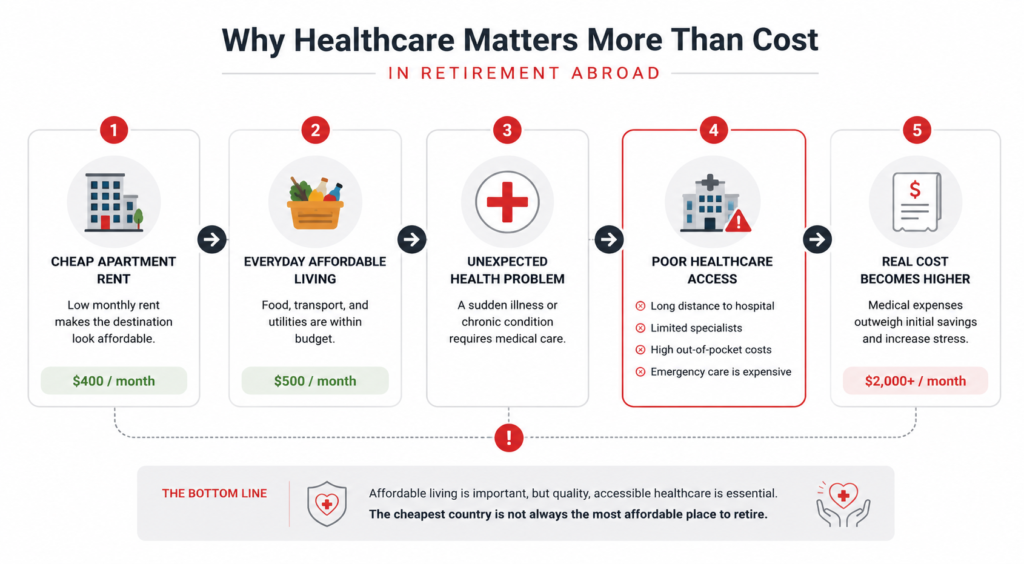
Healthcare represents another major consideration. Younger nomads often treat healthcare as an afterthought because serious medical issues are relatively rare. Retirement changes that calculation. Access to hospitals, specialists, insurance, and emergency care becomes increasingly important. An affordable destination that lacks quality healthcare can become expensive very quickly.
Tax planning is equally important. Many people assume moving abroad automatically reduces taxes. Reality is usually more complicated. Citizenship, tax residency rules, reporting obligations, pensions, investment income, and business structures all influence the final outcome. Professional tax advice is often one of the best investments future retirees can make.
Perhaps the biggest advantage digital nomads possess is flexibility. Someone who has already lived in five or ten countries understands firsthand what works for them. They know whether they prefer cities or smaller towns. They know how much infrastructure they need. They understand climate preferences and cultural compatibility. Traditional retirees often discover these preferences only after moving abroad. Nomads usually arrive with years of practical experience.
How Much Money Do You Need to Retire Abroad?
One of the most common questions people ask is straightforward: how much money do you need to retire abroad?
The answer depends heavily on destination, lifestyle expectations, healthcare requirements, and housing choices. Nevertheless, practical ranges can provide a useful starting point.
Around $1,000 Per Month
At approximately $1,000 per month, retirement abroad is possible in certain destinations, although compromises are unavoidable. Smaller cities in Vietnam, parts of Indonesia, provincial areas of the Philippines, and certain regions of Latin America can support a modest lifestyle at this level.
Housing typically needs to be affordable. Entertainment budgets remain limited. Frequent international travel becomes difficult. Healthcare costs require careful planning.
This budget works best for people who already have a paid-off property, additional savings, or supplemental income streams.
Around $1,500 Per Month
For many experienced travellers, $1,500 per month represents a realistic entry point into affordable international retirement.
At this level, a retiree can often rent a comfortable apartment, eat out occasionally, maintain health insurance, and enjoy a reasonable quality of life in destinations such as Thailand, Vietnam, Malaysia, Indonesia, or parts of Mexico.
This budget begins to answer the question can you retire abroad for less money with a practical yes. The experience may not be luxurious, but it can be comfortable and sustainable.
Around $2,000 Per Month
A budget of $2,000 per month opens considerably more options.
This level supports comfortable living in many of the best countries for affordable retirement. Housing quality improves significantly. Healthcare options become easier to manage. Social activities, domestic travel, and occasional international trips become realistic.
Many retirees find this range provides one of the strongest balances between affordability and quality of life.
Around $3,000 Per Month
At $3,000 per month, international retirement becomes remarkably comfortable across much of the world.
A retiree can enjoy high-quality housing, private healthcare, regular travel, restaurant meals, and a generally relaxed lifestyle in destinations that would cost significantly more in North America, Australia, or Western Europe.
This is where geo-arbitrage begins producing dramatic results. Someone earning a modest retirement income by Western standards can often enjoy a lifestyle that would require far more money in their home country.
The reality is that there is no universal number. Asking how much money do you need to retire abroad is similar to asking how much money is needed to live anywhere. The answer depends on expectations. Nevertheless, experienced travellers consistently discover that international retirement costs far less than many people assume.
One reason interest in low-cost countries for digital nomads continues to grow is that many of those same destinations later become retirement candidates. Locations initially chosen for remote work often evolve into long-term homes because they combine affordability, infrastructure, healthcare, and established expat communities.
The challenge is not simply finding somewhere cheap. The challenge is finding somewhere that remains enjoyable after the novelty disappears. That distinction often determines whether someone thrives abroad or spends years moving from country to country searching for a place that truly feels like home.
Best Countries for Affordable Retirement
The search for the best countries for affordable retirement often begins with a simple comparison of living costs. Rent, groceries, healthcare, and utilities are easy to calculate. The harder part is evaluating what daily life actually feels like after the honeymoon period ends.
Retirement abroad is not a two-week vacation. It is ordinary life taking place in a different country. The places that work best are rarely those that appear cheapest on paper. They are the places where affordability, healthcare, infrastructure, social opportunities, and long-term stability exist together.
Thailand
Thailand continues to attract retirees for many of the same reasons it attracted digital nomads twenty years ago. Housing remains relatively affordable outside Bangkok and Phuket. Healthcare is among the strongest in Southeast Asia. Infrastructure is reliable, airports are plentiful, and large expat communities exist across the country.
Chiang Mai remains popular among retirees who enjoy a slower pace and lower costs. Bangkok appeals to those who prioritise healthcare and urban convenience, especially in the most popular districts among foreigners. Coastal locations such as Hua Hin attract older expats looking for beach access without the crowds found in major tourist destinations.
The main disadvantages include periodic visa changes, air pollution in northern regions during burning season, and increasing costs in the most popular expat areas.
Vietnam
Vietnam has quietly become one of the most attractive answers to the question where can I retire abroad cheaply.
Living costs remain lower than many neighbouring countries, especially outside Ho Chi Minh City. Food is affordable, apartments can be surprisingly inexpensive, and the country’s infrastructure continues improving rapidly.
Da Nang has become particularly popular among former digital nomads. The city combines beaches, modern amenities, international airport access, and a growing international community without the price levels seen in more established retirement destinations.
Healthcare remains the primary concern for some retirees, although private hospitals in larger cities continue improving.
Malaysia
Malaysia frequently appears on lists of cheap retirement destinations for expats because it offers something increasingly rare: affordability combined with exceptional infrastructure.
Kuala Lumpur provides world-class shopping, modern healthcare, excellent internet, efficient transportation, and diverse international communities. English is widely spoken, which significantly reduces the adaptation challenges faced by many retirees.
The climate is hot and humid year-round, which appeals to some people and discourages others. Nevertheless, Malaysia remains one of the most practical long-term options for retirees seeking stability without excessive costs.
Indonesia
Indonesia is often viewed through the lens of Bali, but retirement opportunities extend far beyond the island.
For years Bali attracted remote workers searching for affordable tropical living. As prices increased, many people began exploring affordable alternatives to Bali throughout Indonesia and Southeast Asia.
Retirees who choose Indonesia usually prioritise climate, lifestyle, and community over pure cost savings. Healthcare quality varies considerably depending on location, which makes careful destination selection particularly important.
Philippines
The Philippines appeals to many retirees because English is widely spoken and the cultural environment feels familiar to many Western expats.
Costs remain relatively low, especially outside Manila. Island living, warm weather, and established retirement communities continue attracting long-term residents.
Infrastructure inconsistencies and healthcare access outside major cities remain the primary tradeoffs.
Mexico
Mexico occupies a unique position among retirement destinations because it offers geographic proximity to North America while maintaining significantly lower living costs.
Cities such as Mérida, Puerto Vallarta, San Miguel de Allende, and Querétaro have become retirement hubs. Access to private healthcare is generally good, and established expat communities help ease the transition.
The biggest advantage is convenience. Family visits, banking, property management, and international travel often feel simpler than they do in more distant destinations. Mexico is also increasingly popular with remote workers, although the best location can change with the season, particularly when comparing where to base yourself in Latin America in September based on weather and everyday practicality.
Panama
Panama has spent years actively attracting international retirees through residency programmes and retirement incentives.
Healthcare is strong, infrastructure is modern, and the country uses the US dollar. Panama City offers cosmopolitan living, while smaller towns provide lower costs and slower lifestyles.
Although no longer among the absolute cheapest options, Panama remains one of the most retirement-friendly destinations in Latin America.
Portugal
Portugal’s popularity has exploded during the past decade. The country offers safety, quality healthcare, excellent infrastructure, and straightforward access to the broader European Union.
The challenge is cost. Portugal remains attractive, but it is no longer the bargain destination it once was. Housing prices have risen significantly in Lisbon, Porto, and many coastal areas.
Nevertheless, retirees seeking European residency often continue viewing Portugal as one of the best places to retire overseas in your 50s.
Bulgaria
Bulgaria remains one of Europe’s most underrated retirement destinations.
Living costs remain substantially lower than in Western Europe. Healthcare is accessible. Property prices are relatively affordable. The country offers European Union membership without Western European price levels.
The tradeoff is that infrastructure and public services can vary significantly depending on location.
Geo Arbitrage Retirement Countries
The concept of geo arbitrage has shaped digital nomad culture for years. Retirement simply represents the long-term version of the same idea.
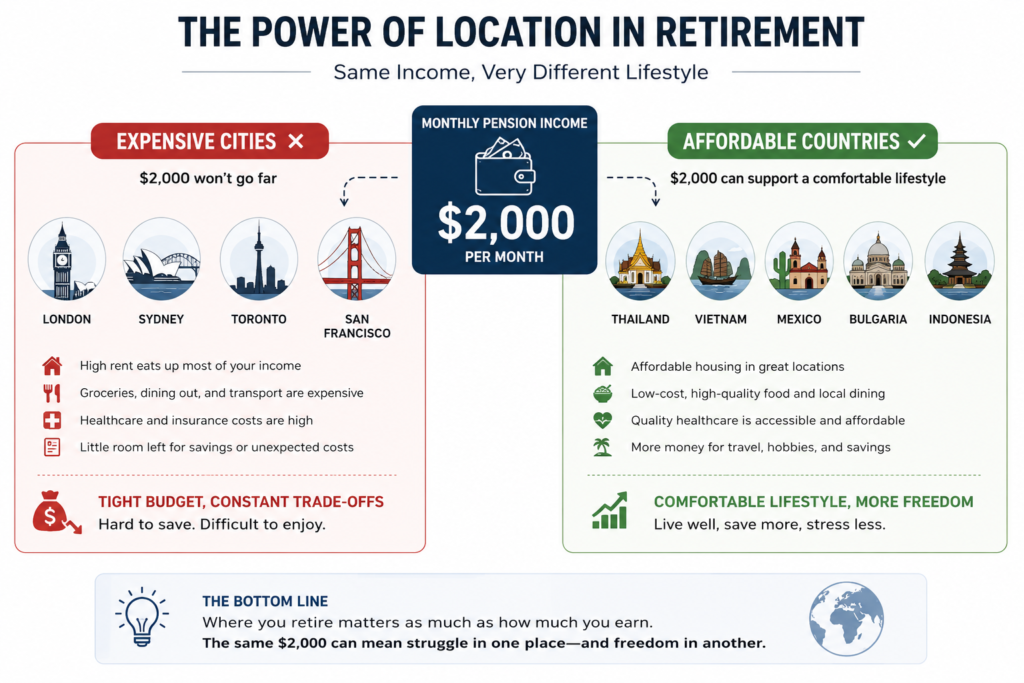
Geo arbitrage retirement countries allow retirees to benefit from differences in global costs of living. Income generated in a high-income country can support a significantly higher standard of living in a lower-cost destination.
A retiree receiving $2,000 per month in pension income may struggle in cities such as London, Sydney, Toronto, or San Francisco. The same income can support a comfortable lifestyle in parts of Thailand, Vietnam, Mexico, Bulgaria, or Indonesia.
Yet successful geo arbitrage involves much more than chasing cheap rent.
Healthcare quality matters. Political stability matters. Safety matters. Access to international airports matters. Reliable internet may still matter for consulting work or online income streams. Community becomes increasingly important as people age.
This explains why the most successful geo arbitrage retirement countries are rarely the absolute cheapest. They occupy a middle ground where affordability combines with long-term livability.
The most common mistake is choosing a country solely because a YouTube video claimed it was possible to live there for $700 per month. While technically true in some places, most retirees eventually prioritise comfort, healthcare, convenience, and social opportunities over squeezing every possible dollar from their budget.
Geo arbitrage works best when quality of life improves alongside affordability.
Where Do Long-Term Digital Nomads Settle Down?
This question sits at the centre of modern nomad retirement planning: where do long-term digital nomads settle down?
After years of movement, destination selection changes dramatically. The factors that mattered during short-term travel often become secondary.
Fast internet remains useful, but healthcare becomes more important.
Cheap accommodation matters less than long-term housing security.
Tourist attractions lose relevance compared with community, friendships, and daily routines.
Interestingly, many experienced nomads do not settle in the countries they initially expected. The destination that feels exciting at thirty may not feel practical at sixty.
Patterns begin emerging among people who successfully transition from mobility to stability.
They often choose locations with established international communities. Isolation becomes increasingly difficult to ignore with age. A strong social network helps create a sense of belonging that many retirees underestimate during planning.
They prioritise airport access. Retirement does not necessarily mean staying in one place forever. Being able to visit family, receive visitors, or travel occasionally remains valuable.
They choose climates they genuinely enjoy. Living somewhere permanently is very different from spending three months there during ideal weather conditions.
Many former nomads also place increasing importance on building a social life in a new country. Retirement abroad succeeds when people become part of a community rather than remaining permanent outsiders.
Relationships frequently influence settlement decisions as well. Partners, spouses, children, grandchildren, and close friendships often play larger roles in retirement location choices than cost-of-living calculations.
Some retirees continue experimenting with alternative long-term living arrangements, including serviced apartments, long-stay hotels, and seasonal migration between multiple countries. Others eventually purchase property and establish a permanent base.
The answer varies from person to person, but one trend appears repeatedly: successful retirees stop thinking like tourists. They start thinking like residents.
That shift often determines whether retiring as a digital nomad becomes a sustainable long-term lifestyle or simply an extension of perpetual travel.
The people who thrive are rarely those chasing the lowest possible costs. They are the people who successfully balance affordability, healthcare, community, climate, infrastructure, and personal happiness.
For many, that balance becomes the true definition of cheap digital nomad retirement.
Living Abroad After Remote Work
The transition from digital nomad life to retirement abroad is rarely as dramatic as people imagine. In most cases, it happens gradually. A person who once moved every month starts staying three months in one place. Then six months. Eventually, a city that was originally a temporary base begins to feel more comfortable than the constant movement that once defined their lifestyle.
Living abroad after remote work often feels surprisingly familiar because many retirees have already spent years learning the practical skills required for international life. They know how to rent apartments, open local bank accounts, navigate healthcare systems, and adapt to cultural differences. The challenge is no longer mobility. The challenge is creating permanence.
This stage frequently involves a shift in mindset. During the early years of location independence, novelty often drives decision-making. Retirement tends to reward stability instead. Rather than asking which country is trending on social media, retirees begin asking where they can imagine living for the next decade. Questions about healthcare quality and access, friendships, climate, safety, and housing become more important than finding the cheapest apartment or fastest Wi-Fi.
The people who make this transition successfully usually build routines. They join local communities. They establish friendships beyond expat circles. They develop hobbies that are not connected to travel. In many ways, retirement abroad becomes less about escaping somewhere and more about creating a meaningful everyday life somewhere new.
The Biggest Mistakes People Make
One of the most common mistakes is choosing a country based entirely on cost.
The internet is full of articles promising that somebody can live comfortably on $800 or $1,000 per month. While these figures may technically be possible, they rarely tell the whole story. A destination that saves a few hundred dollars per month can become expensive if healthcare is poor, visa options are unstable, or daily life becomes frustrating.
Healthcare is probably the most underestimated factor in retirement planning. Younger travellers can often tolerate inconvenience. Retirees generally cannot. Access to quality hospitals, specialists, emergency care, and insurance matters far more than most people realise before moving abroad.
Loneliness represents another major risk. One reason people frequently ask where do long-term digital nomads settle down is because constant movement eventually creates social challenges. Building meaningful friendships becomes harder when everyone around you is passing through. Retirees who focus only on affordability often discover that isolation can become a much larger problem than cost of living.
Poor visa planning causes problems as well. Some people spend years living on tourist visas without considering long-term residency pathways. Eventually regulations change, immigration policies tighten, or frequent border runs become impractical. Long-term planning should begin years before retirement rather than after arriving in a new country.
Cultural integration is often overlooked. A surprisingly large number of expats spend years abroad without learning local customs, understanding local politics, or building local relationships. The result is a lifestyle that feels permanently temporary. Successful retirees usually become part of the places where they live rather than remaining observers.
A Practical Digital Nomad Retirement Plan
Retirement abroad becomes significantly easier when planning begins early. A practical digital nomad retirement plan does not require wealth. It requires preparation.
Five Years Before Retirement
Five years before retirement, focus on exploration rather than commitment.
This is the ideal period for testing potential destinations. Spend several months in places that genuinely interest you. Pay attention to healthcare, infrastructure, weather patterns, transportation, and community rather than tourist attractions.
This is also a good time to analyse finances honestly. Calculate expected retirement income, pensions, investments, rental income, or business revenue. Determine whether the numbers support the lifestyle you want rather than the lifestyle social media promotes.
Three Years Before Retirement
Three years before retirement, narrow the list.
Instead of ten possible destinations, identify two or three realistic options. Research residency requirements, healthcare systems, tax implications, and property markets.
This period is also useful for evaluating social factors. Can you imagine building a life there? Would you enjoy the culture after five years? Are there opportunities for friendships, hobbies, and community involvement?
One Year Before Retirement
One year before retirement, begin practical implementation.
Apply for residency programmes where possible. Consult tax professionals. Arrange international health insurance. Establish banking solutions and emergency savings.
Consider spending extended periods in your preferred destination before making a final commitment. Living somewhere for a month and living somewhere for a year are completely different experiences.
The First Year Abroad
The first year should focus on adjustment rather than optimisation.
Avoid rushing into property purchases. Build routines first. Learn how daily life actually works. Meet people. Explore neighbourhoods. Test healthcare providers. Understand local bureaucracy.
The retirees who succeed long-term are rarely those who make dramatic decisions immediately after arriving. They allow themselves time to adapt.
Most importantly, remember that retirement abroad is not a permanent contract. The flexibility that defined your nomad years can still exist. You are choosing a base, not a prison.
FAQ
Can digital nomads retire abroad?
Yes. In many cases, digital nomads are better prepared for international retirement than traditional retirees because they already have experience living abroad, managing visas, adapting to new cultures, and navigating different healthcare systems.
What happens when digital nomads get older?
Priorities often shift from constant travel toward stability, healthcare, community, and long-term housing. Many experienced nomads eventually establish a permanent base while continuing to travel occasionally.
Where can I retire abroad cheaply?
Popular affordable retirement destinations include Thailand, Vietnam, Malaysia, Indonesia, the Philippines, Mexico, Panama, and Bulgaria. The best option depends on healthcare needs, climate preferences, visa availability, and lifestyle expectations.
Can you retire abroad for less money?
Yes. Many retirees discover that the same retirement income provides a significantly higher standard of living abroad due to lower housing, food, transportation, and healthcare costs.
How much money do you need to retire abroad?
A modest retirement may be possible on around $1,000–$1,500 per month in certain countries. More comfortable lifestyles typically begin around $2,000–$3,000 per month depending on location and personal expectations.
What are geo arbitrage retirement countries?
Geo arbitrage retirement countries are destinations where living costs are substantially lower than in the retiree’s home country. They allow retirees to stretch pensions, investments, or retirement savings much further.
What are the best countries for remote workers to retire?
Thailand, Malaysia, Portugal, Mexico, Vietnam, and Panama consistently rank among the best countries for remote workers to retire because they combine affordability, infrastructure, healthcare, and established international communities.
Where do long-term digital nomads settle down?
Most long-term nomads settle in locations that offer a combination of healthcare, community, airport access, affordable housing, social opportunities, and a climate they enjoy year-round.
Can you retire abroad without being rich?
Absolutely. One of the main principles behind cheap digital nomad retirement is that international cost-of-living differences allow retirees to enjoy a comfortable lifestyle without needing extraordinary wealth.
What are the biggest mistakes people make when retiring abroad?
The most common mistakes include chasing the cheapest country, ignoring healthcare quality, underestimating loneliness, failing to plan visas properly, and making major financial commitments before fully understanding local life.
Explore the Digital Nomad Life Hub
Discover more practical guides about digital nomad costs, visas, destinations, coworking spaces and the everyday reality of building a location-independent life.
Explore the Digital Nomad Life Hub →This article combines independent editorial research, observations from years of digital nomad and expat reporting, and discussions from long-term travellers, remote workers, and retirees who have explored living abroad after a location-independent career.
Research sources included:
- Cost-of-living comparisons and destination affordability data from Numbeo.
- Healthcare information, international health guidance, and public health resources published by the World Health Organization (WHO).
- Community discussions and first-hand experiences shared on Reddit, including conversations from r/digitalnomad, r/expats, r/retirement, and r/financialindependence.
- International retirement, expat lifestyle, and relocation research from retirement-abroad publications and global mobility resources.
- Travel observations, destination analysis, and long-term living insights gathered from digital nomad and expat communities across Southeast Asia, Latin America, and Europe.
The goal is to provide a realistic look at affordable retirement abroad for former digital nomads and remote workers, including practical considerations such as cost of living, healthcare, residency options, community, and long-term quality of life.

Founder & Editor
Founder of The City Theory, writing about digital nomad lifestyle, modern city culture, remote work, travel experiences, psychology and human behaviour around the world.