How Not to Get Fat While Working From Home
When people imagine working from home, they usually focus on the obvious advantages. There is no commute, no crowded public transport, and no need to spend hours every week travelling between home and the office. The arrangement often promises more flexibility, more freedom, and more control over daily life. What rarely appears in those early conversations is the possibility of gaining weight. Yet after a few months of remote work, an astonishing number of people find themselves standing in front of a mirror wondering why their clothes fit differently than they did before.
The strange part is that weight gain often arrives quietly. Nobody wakes up one morning ten kilograms heavier. Instead, the process unfolds through dozens of small changes that barely seem important when viewed individually. Lunch becomes less structured. Movement disappears from the day. The refrigerator becomes a permanent background presence. Stress develops new forms. A quick snack becomes a routine. Then another. Researchers have long observed that seemingly minor daily behaviours can accumulate into meaningful health outcomes, a concept reflected in guidance on healthy eating patterns published by the World Health Organization (WHO). Eventually, people start searching for answers to questions such as why am I gaining weight working from home or why am I gaining weight while working from home, convinced that they must be doing something dramatically wrong.
The reality is usually less dramatic and more interesting. Most discussions about working from home weight gain focus almost entirely on exercise, yet exercise is often only one piece of a much larger puzzle. Food accessibility, boredom, emotional eating, isolation, anxiety, burnout, and job satisfaction frequently play a much bigger role than people expect. Even losing motivation at home can affect the way your entire day is structured, from how often you leave the house to whether boredom turns into constant snacking. Understanding those factors is often the difference between continuing to gain weight and finally understanding how not to get fat while working from home.
Why Remote Workers Gain Weight Without Realising It
One of the most common misconceptions about remote work weight gain is that it happens because people stop exercising. While reduced activity certainly contributes, the explanation becomes less convincing when you look closely at how office workers actually spend their days. Plenty of office employees are not particularly active. Many sit at desks for eight or nine hours, attend meetings, stare at screens, and drive home afterwards. Yet moving from an office to a home environment still causes noticeable changes for many people.
The difference lies in the countless small movements that disappear when work and home occupy the same space. Walking to public transport vanishes. Walking to lunch disappears. Casual trips to a colleague’s desk no longer exist. Even routine activities such as leaving the building for coffee become less frequent. None of those actions feel like exercise, yet together they create meaningful movement throughout the day. Once those activities disappear, a sedentary lifestyle remote work pattern can emerge almost without notice.
Movement, however, is only part of the story. A deeper explanation for remote work and weight gain often involves psychology rather than physical activity. Human beings rarely eat only because they are hungry. Food also serves as entertainment, comfort, distraction, stress relief, and procrastination. Remote work changes the environment in which those impulses operate. An office places barriers between a stressful moment and a snack. Home removes most of those barriers entirely.
That change may sound insignificant, yet it alters daily behaviour in surprisingly powerful ways. A difficult email arrives. The kitchen is nearby. A boring task appears on the schedule. The refrigerator is nearby. A stressful meeting ends. Food delivery applications are one tap away. Over time, these responses become automatic. The result is not necessarily overeating in the traditional sense. Instead, calories quietly accumulate through dozens of decisions that barely register as eating.
Questions about why remote workers gain weight therefore cannot be answered by counting steps alone. The issue often reflects an entire lifestyle shift in which movement decreases, food becomes more accessible, and emotional regulation becomes increasingly connected to eating.
The Hidden Habits That Cause Weight Gain While Working From Home
People tend to imagine unhealthy eating as something obvious. Fast food every day. Endless desserts. Massive portions. In reality, the habits that drive weight gain during remote work are usually far more subtle. They are woven into the workday itself and become so normal that they stop attracting attention.
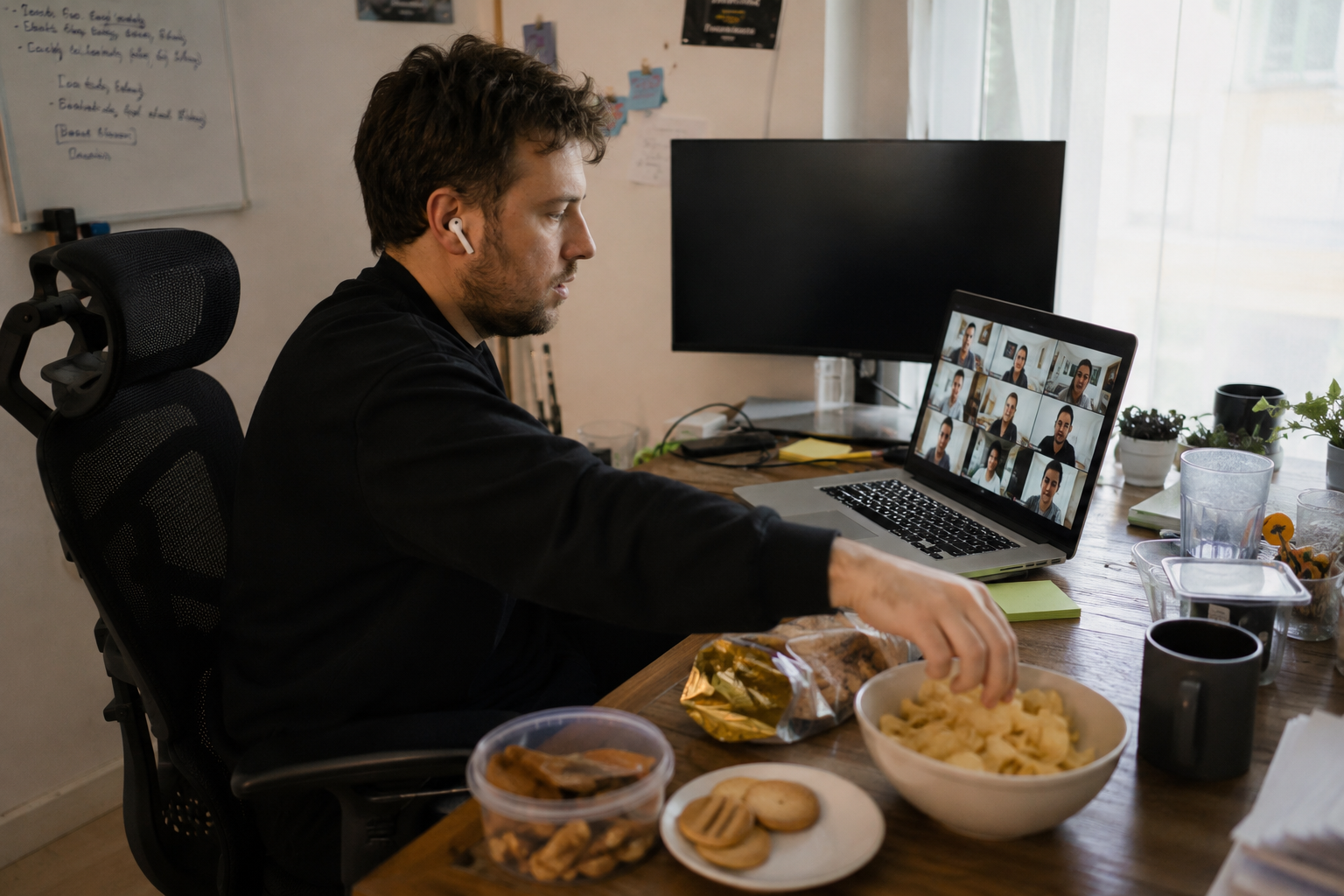
One of the strongest examples is working from home and constant snacking. The behaviour rarely begins intentionally. It often starts with small breaks between tasks. Someone walks into the kitchen while waiting for an email. A handful of nuts becomes a biscuit. A biscuit becomes a piece of chocolate. None of these choices feel important because each one appears tiny in isolation. Yet when repeated five or six times a day for months, they create a meaningful increase in calorie intake.
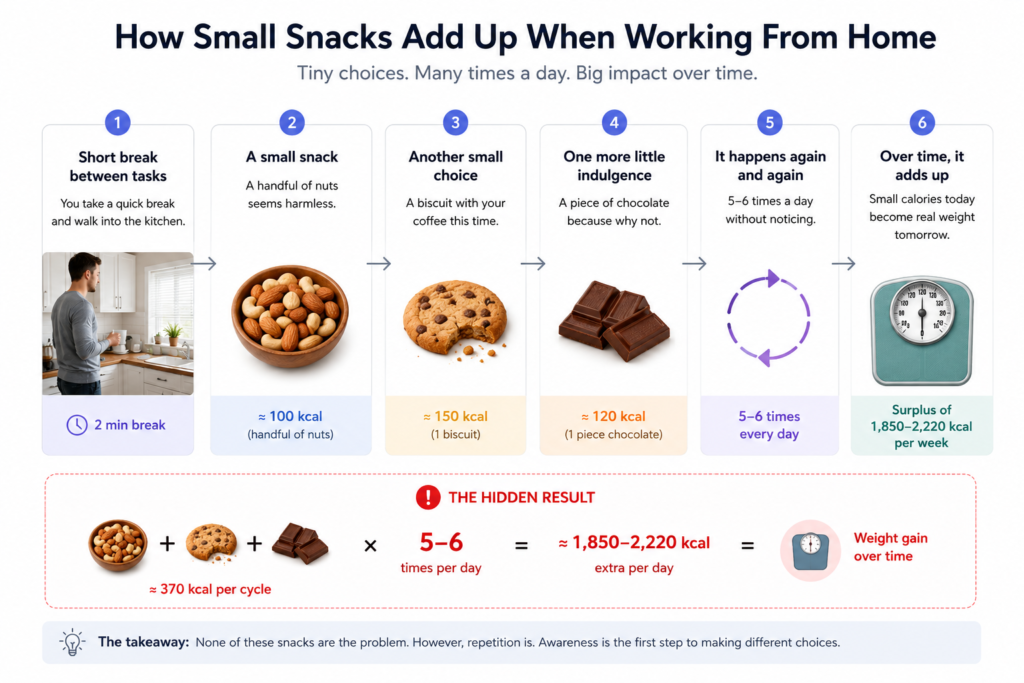
The environment encourages the habit. Offices create friction around food. At home, food exists within immediate reach throughout the entire day. That accessibility changes the way people respond to emotions. Frustration, boredom, uncertainty, and stress all gain a convenient outlet. Instead of standing up and talking to a colleague, people walk to the kitchen. Instead of taking a short walk outside, they open a delivery application. Instead of changing activities, they snack.
The problem becomes even more noticeable when examining remote work eating habits. Traditional office schedules impose structure. Lunch usually happens at roughly the same time. Breaks occur at predictable intervals. Remote work often dissolves those boundaries. Breakfast gets skipped because there is no commute. Lunch happens whenever meetings allow. Evening meals become larger because eating during the day has been inconsistent. Over time, those irregular patterns create an environment where appetite cues become harder to recognise and portion sizes become easier to ignore.
Food delivery has amplified the effect. A decade ago, ordering lunch required effort. Today it requires seconds. That convenience can be useful on busy days, yet it also encourages decisions driven by stress and impulse rather than hunger. Combined with boredom and isolation, the result can feel almost inevitable. People start noticing working from home and gaining belly fat despite making no conscious decision to change their lifestyle.
The challenge is that these habits rarely feel unhealthy while they are happening. Each individual choice appears harmless. The cumulative effect only becomes visible months later, when someone starts searching for working from home weight gain tips and wondering how a lifestyle that seemed more comfortable somehow became less healthy.
Why I Gained 7 Kilograms While Working Remotely
For a long time, I believed I knew exactly why I was gaining weight.
The explanation seemed obvious. I was working from home, sitting more than before, and moving less. Every article I found pointed toward exercise. Every discussion about remote work seemed to assume that physical inactivity was the main culprit. As a result, I treated the situation like a fitness problem. If I exercised more, I assumed the weight would disappear.
It didn’t.
When I started working remotely in a traditional nine-hour workday, I gained approximately seven kilograms within a year. Looking back, I can see why the process happened so gradually. Nothing about my routine seemed extreme. I wasn’t eating takeaway every day. I wasn’t spending evenings consuming junk food. On paper, my habits looked relatively normal.
The problem was everything happening between the obvious moments.
The refrigerator was always nearby. I was spending long hours sitting at home. The days felt repetitive. Every morning looked almost identical to the day before. There was no commute to create a psychological transition between work and personal life. There were no spontaneous conversations. There were no colleagues nearby. Over time, I started experiencing what I later described in another article as feeling isolated working from home. The isolation was not dramatic enough to feel alarming, yet it quietly influenced almost every part of my daily routine.
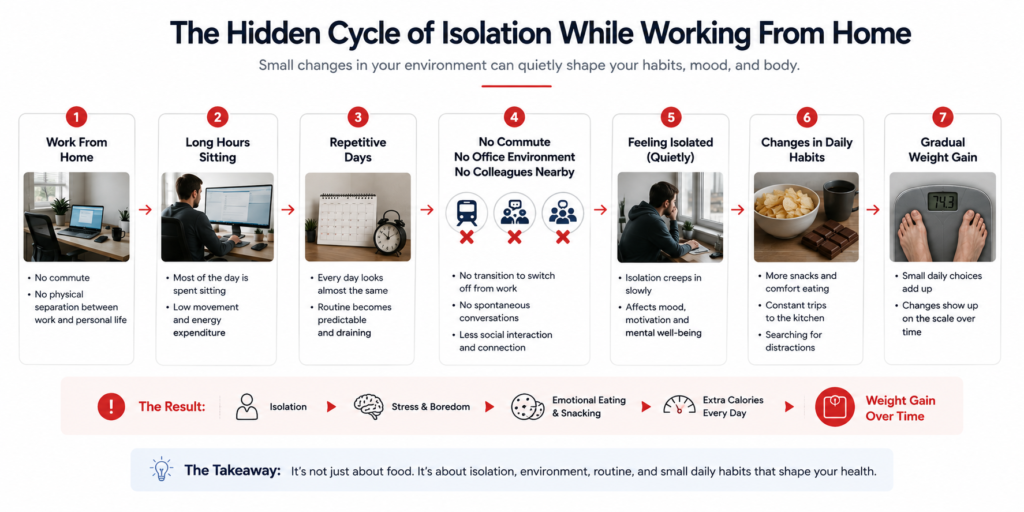
At the same time, the company culture created a different kind of pressure. Activity was closely monitored. Response times mattered. Online visibility mattered. I constantly worried about appearing inactive, even when I was genuinely working. Looking back, I recognise that I was experiencing what many remote workers now call Slack status anxiety. The strange part was that the anxiety rarely felt severe. Instead, it appeared as a low-level tension that remained present throughout the day. Whenever I felt frustrated, restless, or mentally exhausted, food became a convenient distraction.
The work itself was also part of the problem. I simply did not enjoy it anymore. The projects felt repetitive. The monitoring felt exhausting. The hours felt longer than they should have. What I later recognised as job burnout was already developing long before I understood what was happening. Because the work was unfulfilling, my brain constantly searched for alternative sources of stimulation. Food happened to be the easiest one available.
Even regular exercise failed to solve the issue because exercise was never the true cause of the problem. I could go for a run in the morning and still spend the rest of the day stress-eating. I could complete a workout and still find myself standing in front of the refrigerator several times before lunch. The weight gain wasn’t being driven by a lack of movement alone. It was being driven by boredom, stress, isolation, and dissatisfaction.
The situation only started improving after something unexpected happened. I changed jobs and began doing work that genuinely interested me. The tasks became more engaging. The projects became more meaningful. Instead of constantly looking for distractions, I found myself absorbed in what I was doing. Without consciously trying, I stopped making as many unnecessary trips to the kitchen. Food lost its role as entertainment because work itself became mentally stimulating. That experience completely changed my understanding of why I gained weight after switching to remote work. The issue was never simply about calories or exercise. It was about the environment I was spending nine hours a day inside.
Why Exercise Alone Often Doesn’t Solve the Problem
One reason so many people struggle with working from home weight gain is that they focus exclusively on exercise while ignoring everything else. Exercise matters. Walking matters. Movement matters. Yet weight gain frequently continues because the behaviours driving it occur during the other twenty-three hours of the day.
Consider someone who spends forty-five minutes exercising each morning and then spends the rest of the day stressed, bored, sitting down, and snacking. The workout still provides health benefits, but it does not automatically neutralise constant grazing throughout the afternoon. This is why questions about how to lose weight while working remotely often produce disappointing results. People search for a fitness solution when the problem is often behavioural.
Stress plays an enormous role in this equation. Anxiety changes eating patterns. Burnout changes eating patterns. Job dissatisfaction changes eating patterns. A person may technically understand nutrition and still find themselves reaching for snacks because the behaviour has become emotionally rewarding. The connection between stress and eating behaviour is well documented by the Cleveland Clinic’s guide to emotional eating, which explains how people often use food to cope with difficult emotions rather than physical hunger. The food is not solving hunger. It is providing relief from something else.
Burnout deserves particular attention because it often disguises itself as laziness. Someone who feels mentally exhausted may stop cooking, stop walking, and stop paying attention to meal quality. The issue is not a lack of discipline. The issue is depleted mental energy. This is why understanding the signs of job burnout can be surprisingly relevant to managing weight. When people are emotionally drained, healthy habits become harder to maintain.
Exercise also struggles to compensate for modern convenience. A single delivery meal can contain more calories than many people realise. A few snacks spread throughout the day can quietly add hundreds of calories without creating a feeling of fullness. Consequently, someone can remain physically active and still experience remote work weight gain if food intake steadily increases.
The deeper lesson is that exercise works best when it supports an overall lifestyle rather than acting as a rescue strategy. Movement helps. Walking helps. Fitness helps. Yet sustainable results usually emerge when daily habits, stress levels, work satisfaction, and eating behaviours improve at the same time.
How to Avoid Weight Gain While Working From Home
People searching for how to avoid weight gain while working from home often expect a complicated answer. In reality, the most effective changes tend to be surprisingly simple. The challenge is not understanding what to do. The challenge is creating an environment that makes healthy choices easier than unhealthy ones.
The first step is recognising that remote work requires intentional structure. Office environments provide structure automatically. Lunch breaks happen at predictable times. Work has a beginning and an end. Colleagues create interruptions that force movement. At home, those systems disappear. Replacing them deliberately can make an enormous difference.
One practical strategy involves treating meals as scheduled events rather than continuous opportunities. People who eat lunch at a specific time every day often find it easier to recognise genuine hunger. By contrast, eating randomly throughout the day makes it difficult to distinguish hunger from boredom. This single adjustment can significantly reduce unnecessary snacking.
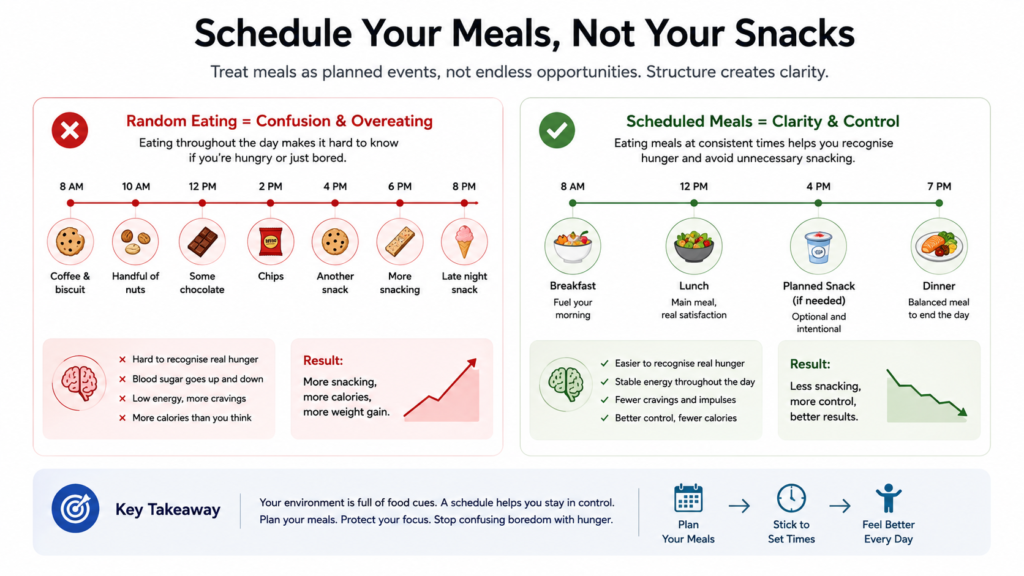
Creating distance between work and food also helps. If possible, avoid working directly beside the kitchen. Even small barriers influence behaviour. Creating a dedicated workspace at home, even if it is only a small desk in the corner of another room, can make that separation much easier. Walking into another room to prepare food encourages conscious decisions rather than automatic ones. Likewise, keeping highly processed snacks out of immediate reach can reduce consumption without requiring willpower.
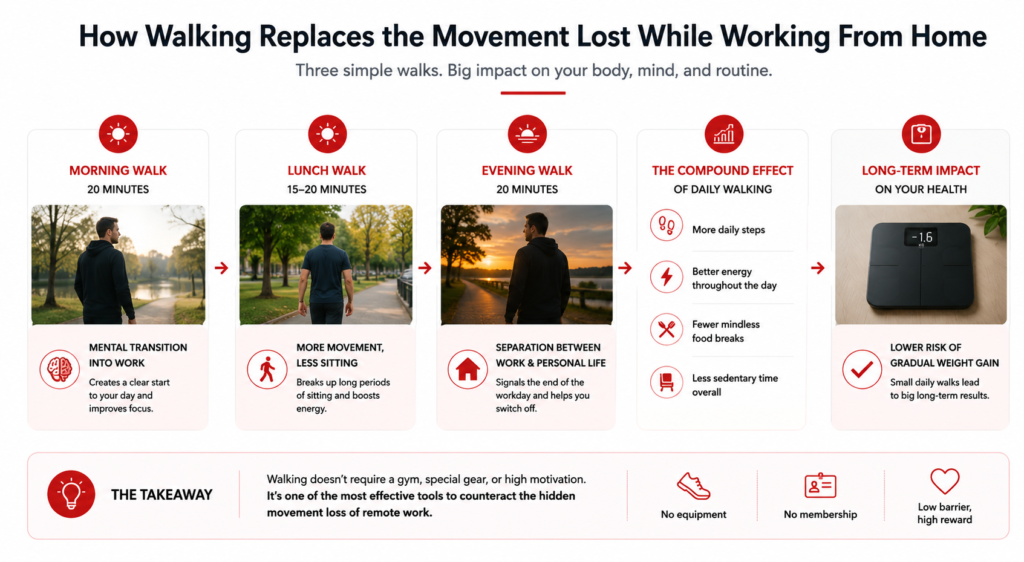
Another useful approach involves increasing movement without framing it as exercise. A short walk before work, a walk after lunch, and a walk at the end of the day often contribute more to long-term health than occasional intense workouts. These habits also help people who are trying to figure out how to stay fit working from home without turning fitness into a second job.
Perhaps most importantly, pay attention to job satisfaction. Weight gain is often treated as a nutrition issue when it can also be a work issue. If boredom, anxiety, and dissatisfaction dominate the workday, food naturally becomes more attractive. Exploring new opportunities, learning new skills, or even researching different remote-friendly careers can sometimes improve health in indirect but surprisingly powerful ways.
The goal is not perfection. The goal is creating conditions that make healthier decisions feel natural rather than exhausting. That approach tends to be far more sustainable than relying on motivation alone.
How to Stop Snacking While Working From Home
Anyone searching for how to stop snacking while working from home has probably already discovered that willpower is not a particularly reliable strategy. The problem with remote work is that temptation never really leaves. The kitchen remains nearby all day. Food delivery applications sit on the phone. Stress appears unexpectedly. Boredom arrives without warning. Trying to resist those impulses every single day quickly becomes exhausting.
A more practical approach is to change the environment rather than constantly fighting it. One of the most effective adjustments is making snacks slightly less convenient. That does not mean banning every treat from the house. It means avoiding situations where highly processed food sits within arm’s reach throughout the workday. People tend to eat what is available. Consequently, changing availability often changes behaviour without requiring constant self-discipline.
Timing also matters. Unstructured eating frequently encourages more eating. Establishing consistent meal times creates natural boundaries between work and food. The body gradually learns what to expect, while the brain becomes less likely to interpret every stressful moment as a reason to visit the kitchen. Combined with regular hydration and occasional movement breaks, this simple change can dramatically reduce working from home and constant snacking.
Another useful strategy involves replacing food-based breaks with other forms of stimulation. A short walk around the block, five minutes on a balcony, stretching, listening to music, or even making tea can provide the same psychological reset that people often seek through food. The goal is not to eliminate pleasure from the day. The goal is to stop using food as the default solution to every uncomfortable emotion.
How to Stay Healthy Working Remotely Without Living in the Gym
A common misconception surrounding weight management is that every solution eventually leads back to intense exercise. Yet most people searching for how to stay healthy working remotely are not looking to train for a marathon. They simply want realistic habits that fit into everyday life.
Walking remains one of the most underrated tools available. Unlike formal workouts, walking requires no equipment, no membership, and very little motivation. A twenty-minute walk before work can create a mental transition into the day. A walk after lunch increases movement and breaks up long periods of sitting. An evening walk provides separation between work and personal life. Together, these small routines often compensate for much of the movement lost through remote work.
Sleep deserves equal attention. Poor sleep influences appetite, mood, concentration, and energy levels. People who are tired often seek stimulation through food because the body is looking for a quick source of energy. Consequently, improving sleep quality frequently improves eating habits without any deliberate dietary changes.
Routine also matters more than people realise. The healthiest remote workers are rarely the most disciplined. They are usually the people whose days contain structure. Meals happen at roughly the same times. Work begins and ends at predictable hours. Breaks occur intentionally rather than accidentally. This consistency makes healthy choices easier because fewer decisions need to be made throughout the day.
These habits also answer a common question: how to stay slim working remotely. The solution is rarely extreme dieting. More often, it involves creating routines that reduce mindless eating while increasing daily movement.
How to Lose Weight Without Exercising While Working From Home
The phrase how to lose weight without exercising while working from home sounds controversial because health advice often treats exercise as mandatory. Yet from a purely practical perspective, weight change is influenced by much more than workouts. Plenty of people successfully improve their health by changing eating habits, sleep patterns, stress levels, and daily routines long before they start exercising regularly.
Reducing unnecessary snacking often has a greater impact than adding another workout. Likewise, eating meals at consistent times can improve awareness of hunger and fullness. A person who eliminates several hundred calories of mindless snacking each day may notice significant changes even if their exercise routine remains unchanged.
Stress management plays a surprisingly important role as well. Emotional eating frequently contributes more calories than people realise. A stressful workday can quietly produce multiple trips to the kitchen, several delivery orders, and an evening spent eating out of boredom. Addressing the stress itself often reduces the eating behaviour attached to it.
This is why people asking how to avoid weight gain without going to the gym should not assume they are looking for shortcuts. In many cases, they are simply recognising that exercise alone is not the issue. Improving routines, reducing food-related boredom, and creating healthier environments often produce meaningful results before fitness enters the picture.
The Unexpected Link Between Burnout, Anxiety and Weight Gain
Conversations about weight rarely include discussions about work satisfaction. Yet after speaking with remote workers and reflecting on my own experience, I have become convinced that the relationship is stronger than most people realise.
A person who enjoys their work experiences the day differently than someone who spends eight or nine hours doing something they dislike. Interesting work creates engagement. Time passes more quickly. Focus becomes easier. The mind remains occupied. By contrast, unfulfilling work often creates a constant search for stimulation. Food becomes one of the easiest sources of that stimulation because it provides immediate reward with very little effort.
Anxiety creates a similar effect. Constant pressure, performance monitoring, and uncertainty increase stress levels throughout the day. In my own case, concerns about online visibility and workplace monitoring contributed heavily to what I now recognise as Slack status anxiety. Instead of concentrating entirely on the work itself, part of my attention remained focused on whether I appeared productive enough. The result was low-level stress that persisted throughout the day.
Isolation compounds the problem. People who are feeling isolated working from home often lose access to the social interactions that naturally break up the day. Conversations disappear. Shared lunches disappear. Casual human contact becomes less frequent. Food sometimes fills part of that emotional gap because it provides comfort, stimulation, and routine.
The relationship between job burnout and weight gain follows the same pattern. Burnout reduces motivation, increases emotional exhaustion, and makes healthy habits harder to maintain. When people feel depleted, convenience tends to win. Cooking becomes less appealing. Walking becomes less appealing. Snacking becomes more appealing. Over time, the cumulative effect becomes visible on the scale.
Practical Ways to Avoid Weight Gain While Working From Home:
• Keep snacks out of sight and away from your desk.
• Eat meals at fixed times instead of grazing throughout the day.
• Take a short walk before work, during lunch, or after finishing work.
• Replace food breaks with coffee, tea, stretching, or fresh air.
• Drink water before deciding whether you are actually hungry.
• Avoid ordering food simply because you feel bored or stressed.
• Keep healthy foods visible and high-calorie snacks less accessible.
• Create a dedicated workspace away from the kitchen if possible.
• Maintain a consistent sleep schedule to reduce cravings and overeating.
• Pay attention to stress, burnout, and boredom before reaching for food.
What Finally Worked For Me
The biggest surprise in my own experience was that the solution did not begin with food.
For months, I treated the situation as a diet problem. I focused on exercise, calorie intake, and routines. While those factors mattered, they never fully addressed the reason I kept turning toward food throughout the day. The real change happened after I found work that genuinely interested me.
Once the projects became engaging, my relationship with food changed naturally. I stopped searching for distractions every hour because I no longer needed constant stimulation. The work itself became mentally rewarding. Trips to the kitchen became less frequent. Stress decreased. Anxiety decreased. The urge to break up the day with snacks became much weaker.
That does not mean everyone needs a new job. It does mean that work satisfaction deserves more attention in conversations about health. Sometimes the answer is improving routines. Sometimes the answer is improving sleep. Sometimes the answer is learning how to avoid gaining weight while working remotely through better eating habits. And sometimes the answer involves finding a better job that does not leave you emotionally exhausted at the end of every day.
Remote work itself is not inherently unhealthy. In fact, it can support a healthier lifestyle when approached intentionally. The challenge is recognising that how to avoid weight gain while working from home rarely has a single solution. Food, movement, boredom, anxiety, isolation, burnout, and work satisfaction all interact with one another.
Understanding those connections is often the first step toward answering bigger questions such as how not to get fat while working from home, how to lose weight while working remotely, and ultimately how to stay healthy working remotely over the long term. The people who succeed are usually not the ones following perfect diets. They are the ones who gradually build routines that make healthy choices easier while reducing the stress, boredom, and emotional triggers that encourage unhealthy ones.
Remote work offers enormous freedom. The challenge is learning how to use that freedom in a way that supports both productivity and health rather than quietly undermining them.
FAQ
Why am I gaining weight working from home?
Most people assume the problem is a lack of exercise, but the reality is often more complicated. Weight gain during remote work is frequently linked to constant access to food, boredom, stress, reduced daily movement, and irregular eating patterns. Small habits repeated every day can gradually increase calorie intake without being obvious.
Why am I gaining weight while working from home even though I exercise?
Exercise helps, but it cannot always compensate for stress eating, frequent snacking, poor sleep, and long periods of sitting. Many people discover that the factors driving weight gain occur throughout the entire workday rather than during the hour they spend exercising.
How to avoid weight gain while working from home?
Creating structure is often more effective than following a strict diet. Consistent meal times, daily walks, fewer food-related breaks, and a dedicated workspace away from the kitchen can significantly reduce the risk of weight gain.
How to stop snacking while working from home?
The most effective strategy is changing the environment rather than relying on willpower. Keeping snacks out of immediate reach, taking non-food breaks, staying hydrated, and identifying stress triggers can reduce mindless eating throughout the day.
How to stay fit working from home without going to the gym?
Daily movement matters more than many people realize. Walking, taking stairs, standing up regularly, and maintaining a consistent routine can help people stay active without following a formal fitness program.
How to lose weight without exercising while working from home?
Weight loss is often possible by improving eating habits, reducing emotional eating, improving sleep, and limiting unnecessary snacking. While movement is beneficial for overall health, many people see results simply by addressing the habits that lead to overeating.
Why do remote workers gain weight?
Remote work changes more than physical activity. It changes routines, social interaction, stress levels, and access to food. These factors combine to create an environment where weight gain can happen gradually and almost unnoticed.
How to stay healthy working remotely long term?
The most sustainable approach involves building routines that support movement, regular meals, good sleep, stress management, and meaningful work. Long-term health usually depends more on consistency than extreme diets or workout plans.
Explore the Remote Work & Careers Hub
Discover more practical guides about remote jobs, hybrid work, career growth, burnout and the realities of building a career outside the traditional office.
Explore the Remote Work & Careers Hub →This article combines personal experience working remotely, independent editorial research, and discussions from remote workers who have experienced weight gain, stress, burnout, emotional eating, and lifestyle changes after transitioning to work-from-home environments.
Research sources included:
- Personal observations and first-hand experience of gaining weight during a traditional remote work schedule and exploring the factors that contributed to it.
- Research and educational resources published by the Cleveland Clinic regarding emotional eating, stress-related eating habits, and behavioural health.
- Health and nutrition guidance published by the World Health Organization (WHO) related to healthy diets, lifestyle habits, and long-term health outcomes.
- Community discussions, personal stories, and real-world experiences shared by remote workers on Reddit, including conversations about remote work weight gain, isolation, burnout, snacking habits, and work-from-home routines.
The goal is to explore why remote workers often gain weight despite good intentions, and to provide practical, realistic strategies for avoiding weight gain while working from home without relying on extreme diets, fitness programmes, or unrealistic lifestyle changes.

Founder & Editor
Founder of The City Theory, writing about digital nomad lifestyle, modern city culture, remote work, travel experiences, psychology and human behaviour around the world.