How to Move On From Travel Romance: Why It Hurts More Than You Think
Moving on from a travel romance is so difficult because you’re rarely grieving only the person. You’re also grieving the city, the freedom, the excitement of travelling and the version of yourself that existed during that trip. Travel removes everyday stress, fills your brain with novelty and creates idealized memories, making even a short relationship feel much bigger than it probably would have in ordinary life. That’s why how to move on from travel romance is less about forgetting someone and more about separating them from the experience your brain has woven around them.
I didn’t understand any of that when I came back from Rome.
I had gone there on my own and, like many solo travellers, used Couchsurfing to meet locals. I wasn’t looking for a relationship. I simply wanted to avoid spending every evening eating pasta alone while everyone around me seemed to be laughing with friends. Through Couchsurfing, I met a handsome Italian guy who offered to show me places that weren’t listed in guidebooks. What started as one afternoon together somehow turned into almost an entire week. We wandered through Trastevere until midnight without paying attention to the time, sat on old stone steps drinking cheap wine from plastic cups, watched sunsets from viewpoints overlooking the city and talked for hours about childhood memories, travel, work and everything in between. Looking back, it was exactly the kind of spontaneous connection people hope for when they’re meeting people while travelling, because nothing about it felt forced or planned.
By the last evening, I genuinely believed I had fallen in love.
When I boarded the plane home, I wasn’t thinking about the Colosseum or the Vatican anymore. I was thinking about him. During the flight I imagined future trips, imagined introducing him to my friends, imagined what would happen when he visited my city. My brain had already written chapters that didn’t exist. Then I landed, switched my phone off airplane mode and waited for the message I was sure would arrive.
It never did.
A day passed.
Then another.
Then a week.
There wasn’t a goodbye that explained anything. There wasn’t an argument or a misunderstanding. There was simply silence. I checked WhatsApp more times than I want to admit. Every notification made my heart jump before disappointment settled in again. For weeks I convinced myself that maybe he was busy, maybe he’d lost his phone, maybe he was travelling somewhere with no signal. None of those explanations were true, but my brain desperately preferred hopeful fantasies to accepting that someone I thought cared about me had quietly disappeared from my life.
I cried far more than seemed reasonable for someone I had known for only a week. That was the part that confused me most. I had been through breakups after relationships that lasted months, yet somehow this one hurt differently. It felt deeper, almost irrationally intense, and I kept asking myself the same question that thousands of people type into Google every month: why am I still thinking about someone I met on vacation?
It took months before I understood what had really happened.
The feelings themselves weren’t fake. I wasn’t pretending to be heartbroken, and I certainly wasn’t imagining the chemistry we shared. But I eventually realised that I hadn’t only fallen in love with him. I had fallen in love with Rome itself. I had fallen in love with waking up every morning excited about what would happen next, with wandering through unfamiliar streets without looking at a clock, with the strange confidence that travelling gives you when every day feels unpredictable. He became part of that experience so completely that, in my memory, separating the person from the city felt almost impossible.
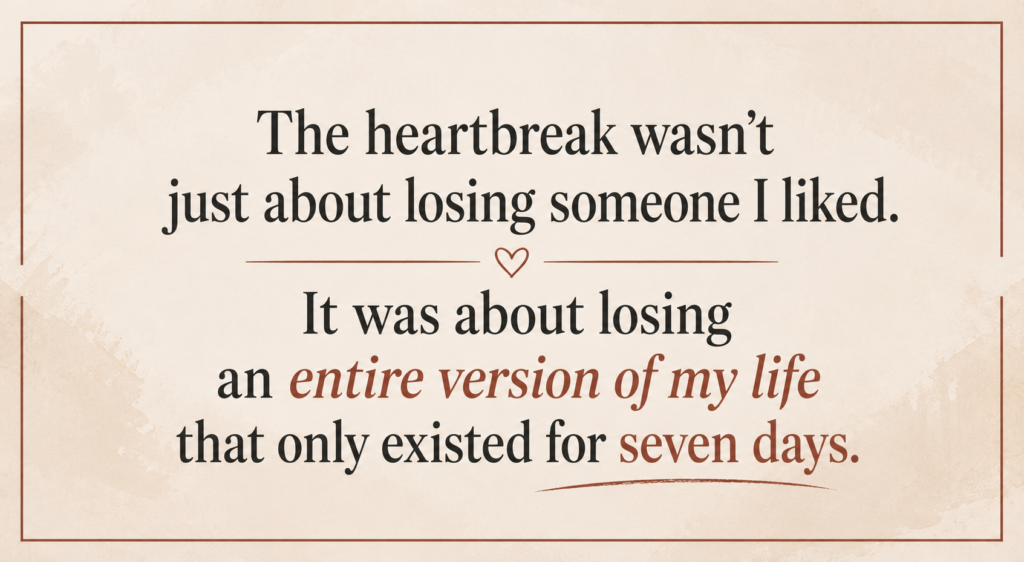
Once I saw it that way, everything else finally started making sense. The heartbreak wasn’t just about losing someone I liked. It was about losing an entire version of my life that only existed for seven days. Understanding that became the first real step in learning how to move on from someone you met while travelling, because I stopped asking why he disappeared and started asking why my brain had turned one beautiful week into something that felt like the greatest love story I’d never actually lived.
Why Travel Romance Feels Stronger Than Normal Relationships
One of the biggest misconceptions about holiday romances is that they feel stronger because the person is somehow more compatible than anyone you’ve met before. Sometimes that’s true, but much more often the intensity comes from the environment rather than the relationship itself. Travelling changes the way your brain processes experiences. Every day is filled with unfamiliar sights, new sounds, different food, unexpected conversations and constant decision-making, which keeps your attention unusually focused on the present. Psychologists have shown that novelty increases dopamine activity, making experiences feel more exciting and emotionally significant than similar events experienced during everyday routines.
Think about what usually happens during the first week of dating at home. You might meet for dinner after work, exchange messages between meetings, postpone plans because someone is tired or busy, and slowly discover each other’s habits over several weeks. Now compare that with travelling. You wake up together, spend ten or twelve uninterrupted hours exploring a city, share every meal, solve little problems together, discover hidden places and finish the evening watching the sunset before doing it all again the next morning. In ordinary life, that amount of shared time might take months to accumulate. While travelling, it happens in less than a week, creating the feeling that you’ve known each other forever when, objectively, you’ve only skipped the slow stages that normally allow people to build relationships gradually.
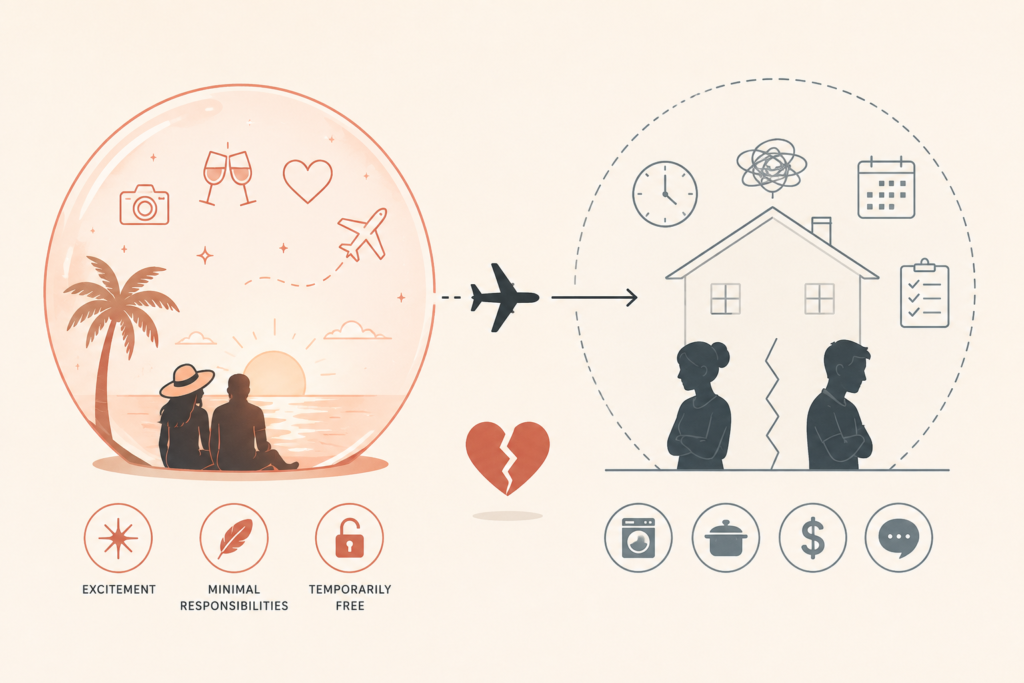
The absence of everyday responsibilities makes this effect even stronger. Nobody is worried about tomorrow’s presentation at work or whether there’s enough milk in the fridge. Conversations naturally become deeper because there’s time for them. Instead of discussing errands and schedules, you’re talking about dreams, childhood memories, future travel plans and the kind of questions people often don’t ask until much later in a relationship. That emotional acceleration feels incredibly intimate, but it’s happening inside an environment that has temporarily removed most of the stress and distractions of real life. You’re not seeing how the other person behaves when they’re exhausted after work, frustrated by bills or dealing with family problems. You’re seeing them at what is often their happiest and most spontaneous.
That’s one reason why travelling creates stronger emotional connections than many people expect. The relationship develops inside a carefully edited version of reality where excitement is constant, responsibilities are minimal and both people are temporarily free from the routines that usually reveal compatibility over time. None of that means the feelings are fake. It simply means they developed under unusually powerful conditions, which explains why saying goodbye at the airport can sometimes hurt more than ending relationships that lasted much longer.
The Psychology Behind Travel Romance
Once I stopped blaming myself for “being too emotional,” I became curious about what had actually happened inside my own head. I started reading psychology books, research papers and travel forums, and I was surprised to discover that my experience wasn’t unusual at all. The combination of travel, novelty and romance creates almost perfect conditions for something psychologists call limerence—an intense state of infatuation where another person occupies your thoughts far more than the reality of the relationship probably justifies. Unlike love, which gradually develops through knowing someone in ordinary circumstances, limerence is largely fuelled by uncertainty, imagination and possibility. In other words, the less you know about someone, the easier it is for your brain to fill in the missing pieces with qualities you hope they have.
That explained why I couldn’t stop replaying moments from Rome. I wasn’t remembering arguments because we never had any. I wasn’t remembering boring evenings because there weren’t any. My brain had almost no negative information to work with, so every memory became polished over time until it looked almost perfect. We tend to think memories behave like photographs stored in a box, but psychologists know they work very differently. Every time you remember something, your brain reconstructs it rather than replaying it exactly as it happened. Each reconstruction tends to preserve the emotional highlights while quietly discarding details that don’t fit the story you’ve begun telling yourself.
This is known as memory bias, and travel romances are especially vulnerable to it. According to the American Psychological Association’s explanation of memory, our brains tend to retain emotionally significant experiences more vividly than ordinary everyday details. Months after coming home, I could vividly remember the way the evening light reflected off the Tiber River and the conversations we had while walking through Trastevere, yet I struggled to remember ordinary details like what we even ate for lunch on most days or whether there were awkward silences. The emotional moments stayed crystal clear because they carried the strongest feelings. Everything else slowly faded into the background, leaving behind a relationship that seemed almost flawless in hindsight.
Another concept that helped me understand my own experience was context-dependent emotion. Research on context-dependent memory shows that our memories become linked to the environments in which they are formed, making places powerful emotional triggers. A song that means nothing at home can suddenly make you cry because you first heard it while driving along the Amalfi Coast or sitting in a café in Paris. Our brains don’t store people separately from places. They connect them. For months after Rome, I couldn’t see a photograph of the city without immediately thinking about him. It wasn’t because the relationship had been extraordinary. It was because my brain had permanently linked one person with one unforgettable place.
The final piece of the puzzle was something psychologists call the scarcity effect. As explained by Dr. Robert Cialdini’s Scarcity Principle, people naturally place greater value on opportunities they believe are limited or about to disappear. When you’re travelling, every day carries an invisible deadline because both of you know someone will eventually board a plane. That awareness changes behaviour. You ask deeper questions sooner, spend more uninterrupted time together and often become emotionally vulnerable much faster than you would at home. Ironically, the fact that the relationship is temporary often makes it feel more meaningful, because both people are trying to make the most of limited time instead of assuming there will always be another weekend together.
Understanding these ideas completely changed the way I looked at my own heartbreak. It didn’t make the feelings disappear overnight, but it helped me stop asking whether I had been “stupid” for falling so hard. The emotions were genuine. They were simply amplified by a set of psychological conditions that make short, intense connections feel unforgettable. That’s the real psychology behind holiday romances, and it’s also why so many people struggle to explain their feelings to friends who have never experienced one.
Why Your Brain Makes Vacation Love Feel Stronger
If psychology explains what we feel, neuroscience helps explain why we feel it so intensely. Travelling places the brain in a state that researchers sometimes describe as being especially receptive to new experiences. Every unfamiliar street, language, smell and conversation requires your brain to pay closer attention than it normally would at home, and that heightened attention is closely linked to dopamine, a neurotransmitter involved in motivation, curiosity and learning. Contrary to popular belief, dopamine isn’t simply the “pleasure chemical.” It’s what makes your brain lean forward and think, This matters. Pay attention.
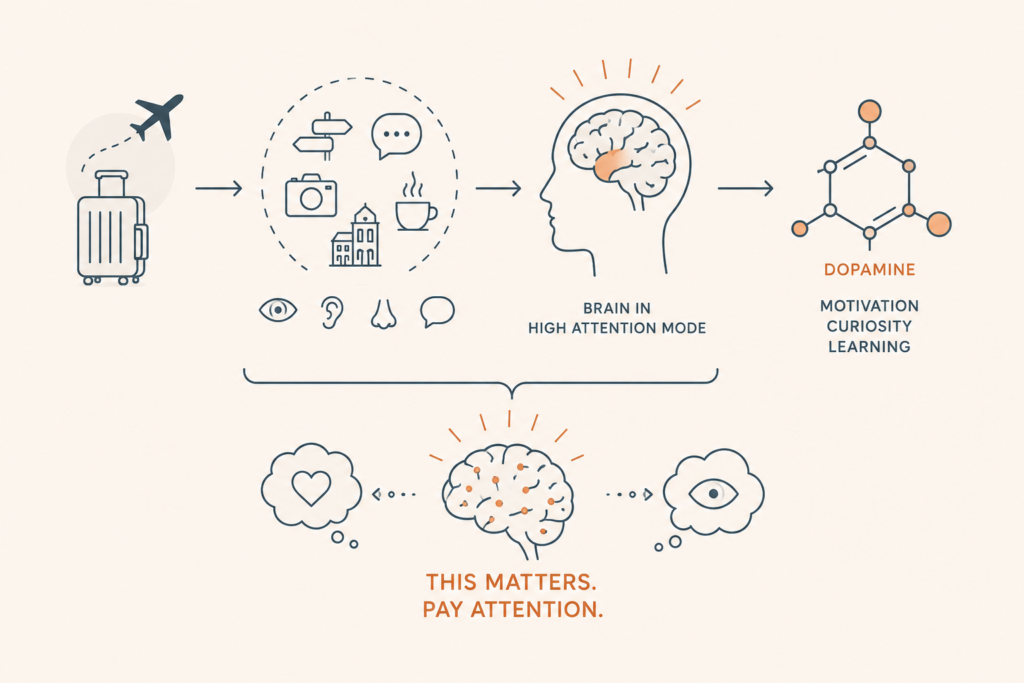
Now imagine meeting someone attractive while your brain is already operating in that heightened state. The attraction isn’t created by dopamine alone, but the emotional significance of every shared experience becomes stronger. Walking through Rome after sunset doesn’t just become another pleasant evening. It becomes a vivid memory attached to excitement, novelty and discovery. Your brain bundles all of those feelings together into one emotional package, making it incredibly difficult later to separate the person from the experience itself.
Novelty also changes attraction in another subtle way. At home, we quickly become accustomed to familiar routines and familiar people. While travelling, almost everything feels fresh, which means the person you’re with benefits from what psychologists sometimes call an emotional “halo effect.” Because the trip itself is exciting, your brain unconsciously transfers some of those positive emotions onto them. It’s similar to how restaurants often seem better when you’re hungry or music sounds more powerful at a live concert than through headphones. The context changes your perception.
Places themselves become emotional triggers. Even now, years later, if someone mentions Trastevere or sends me a photo of a Roman street at sunset, I don’t first remember the architecture. I remember how I felt. That’s because the hippocampus, which helps organise memories, stores experiences together with emotional context. You’re not only remembering a city. You’re remembering who you were in that city, how free you felt and who happened to be standing beside you.
This is also why why do people fall in love while travelling has such a different answer from falling in love at home. You’re not operating under normal emotional conditions. Your brain is flooded with novelty, your attention is unusually focused and your memories are being recorded with exceptional intensity. None of that means the relationship wasn’t real. It simply means the emotional volume was turned up much higher than usual, making the connection feel larger than life.
Why Do Vacation Romances Hurt So Much?
Coming home was harder than I expected, not because my everyday life was terrible, but because it suddenly felt colourless. Rome had been full of movement, conversations, music drifting through open windows and the excitement of not knowing what each day would bring. Back home, my alarm clock rang at the same time every morning, I answered emails, bought groceries and slipped almost automatically into routines that hadn’t changed while I was away. The contrast was so sharp that it was tempting to believe the problem was losing him, when in reality I was grieving an entire emotional environment that had disappeared overnight.
That contrast explains why do vacation romances hurt so much. You’re not simply comparing two people; you’re comparing two versions of your life. One version involved freedom, adventure and constant stimulation. The other involves responsibilities, deadlines and familiar routines. Almost anyone would feel a sense of loss after making that transition, even without a romance involved. When the relationship ends at exactly the same moment the holiday ends, your brain blends those two losses together into one overwhelming emotional experience.
Many travellers also experience a mild form of reverse culture shock after returning home. People usually associate culture shock with arriving somewhere new, but coming back can be surprisingly difficult as well. Friends want to hear about your trip for ten minutes before moving on to other topics. Work continues exactly where it left off. Meanwhile, you’re still emotionally living in another country. That mismatch often creates loneliness because nobody around you fully understands what you’re grieving. They assume you’re upset about someone you knew for a week, while you’re actually mourning an entire chapter of your life that ended the moment the plane landed.
Why Is It Hard to Get Over Someone You Met While Travelling?
One of the cruelest things about travel romances is that they rarely end because the relationship naturally runs its course. Most relationships slowly reveal their weaknesses over time. You discover irritating habits, disagree about important decisions, realise your lifestyles don’t match or simply lose the excitement that existed at the beginning. Holiday romances usually end because geography interrupts them before any of those ordinary tests have a chance to happen. Instead of learning that you’re incompatible, you board separate planes and spend the next few months wondering what might have happened if circumstances had been different.
That’s exactly why why is it hard to get over someone you met while travelling has such a different answer from an ordinary breakup. Your brain doesn’t have evidence that the relationship would have failed. It only has evidence that it felt wonderful while it lasted. The ending wasn’t caused by betrayal, arguments or disappointment. It was caused by distance, and distance leaves behind an unfinished story. Human beings generally dislike unfinished stories because our brains naturally seek closure. When closure doesn’t exist, imagination quickly takes over.
I realised I was doing this without noticing. Every time I remembered Rome, I wasn’t replaying what had actually happened. I was mentally extending the story. I imagined him visiting my country, imagined us travelling together somewhere else, imagined conversations that never took place and decisions that neither of us ever had to make. Looking back, I wasn’t grieving reality anymore.
I was grieving a fictional future that existed only inside my own head.
Social media quietly makes this process much worse. Twenty years ago, travel romances often ended completely once people returned home. Today, someone can disappear from your life while still appearing in your Instagram feed every few days. You see new photos, new cafés, new friends and sometimes even a new relationship. Every update tricks your brain into believing the connection still exists because you’re continuing to receive tiny pieces of information about their life. Instead of allowing emotional distance to develop naturally, social media keeps reopening a chapter that should probably have closed.
This is one reason people often drift into idealizing someone they’ve barely known. The less ordinary life you shared together, the easier it becomes to replace reality with imagination. If you’ve never seen someone stressed, impatient, sick, tired or frustrated, your mind often fills those blank spaces with qualities you hope they possess. Over time, you’re no longer missing the real person. You’re missing the perfect version your imagination quietly created.
Can a Travel Romance Become a Real Relationship?
The answer is yes, but probably less often than people want to believe.
Some couples genuinely meet while travelling and eventually build happy long-term relationships. They move countries, learn each other’s languages, navigate immigration paperwork and slowly replace holiday excitement with ordinary routines. Those relationships succeed not because they met on holiday, but because both people continued investing after the holiday ended. The romance eventually stopped being about sunsets and adventure and became about everyday life—paying bills, making compromises, planning careers and supporting each other through difficult periods.
Most travel romances don’t reach that stage because they were never designed to. One person may see the relationship as a beautiful holiday memory while the other is already imagining a future together. Sometimes both people have genuine feelings, but practical obstacles become overwhelming. Long-distance relationships require money, time, flexibility and a willingness to repeatedly choose each other despite inconvenience. If one person has a career they can’t leave, another has family responsibilities or neither wants to relocate, even strong feelings may not be enough.
Timing matters just as much as chemistry. Two wonderful people can meet at exactly the wrong point in their lives. One might be about to start university, the other preparing for a new job in another country. One may dream of travelling for years, while the other wants stability and children. None of those differences necessarily make either person wrong. They simply mean that attraction alone isn’t always enough to create a shared future.
Whenever someone asks me, can a travel romance become a real relationship, I usually suggest ignoring the holiday itself and looking at what happened afterwards. Did both people continue communicating consistently once real life returned? Did they make realistic plans to meet again instead of talking vaguely about “someday”? Were they curious about each other’s ordinary lives, not just the exciting travel version? Those questions reveal far more about the future of a relationship than how magical the holiday felt.
Some couples also discover that keeping a relationship alive after returning home is much harder than maintaining one while travelling. Video calls, messages and photos can preserve emotional closeness for a while, but eventually the relationship has to exist somewhere beyond a phone screen. That’s the point where genuine commitment becomes much more important than romantic memories.
Should You Text Someone After a Vacation Romance?
This is probably the question I receive most often whenever the topic of travel romances comes up, and unfortunately there isn’t one universal answer. Whether should you text someone after a vacation romance depends much less on dating rules than on what actually happened between the two of you before saying goodbye.
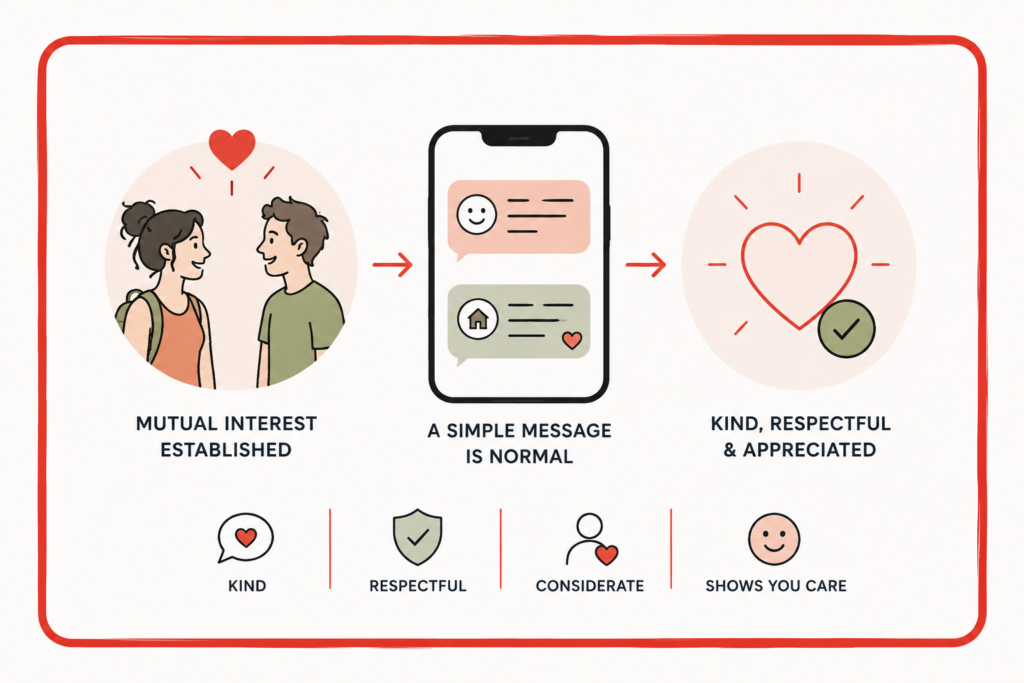
If both of you openly talked about staying in touch, exchanged contact details enthusiastically and continued messaging naturally during the first few days after the trip, then sending a message isn’t strange at all. In fact, pretending not to care simply because you’re afraid of appearing too interested usually creates unnecessary distance. A simple message saying you enjoyed meeting them or asking whether they got home safely feels completely normal when mutual interest has already been established.
The situation changes if you’re the only person keeping the conversation alive. Many people make the mistake of believing that persistence proves sincerity, but relationships almost never become healthier when one person carries all the emotional effort. If you’ve already sent a thoughtful message and received either no response or very short replies, sending five more messages rarely changes the outcome. It usually prolongs your own heartbreak because every unanswered notification reinforces the feeling of rejection.
I also wouldn’t rush into dramatic emotional conversations immediately after returning home. Sometimes people are exhausted from travelling, catching up with work or simply processing their own emotions. Giving each other a few days before deciding what happens next often produces much more honest communication than demanding immediate clarity while both people are still adjusting to everyday life.
The more useful question isn’t whether you should text them. It’s whether the relationship has remained mutual since the trip ended. If both people continue making equal effort, there’s something worth exploring. If only one person keeps reaching out, the silence itself may already be giving you the answer you don’t want to hear.
Signs Your Travel Romance Was Real
One of the biggest mistakes people make is treating travel romances as if they’re either completely fake or destined to become lifelong love stories. Reality is much messier than that. Some holiday romances are nothing more than two people enjoying the same place at the same time, while others become relationships that last for years. The difference usually isn’t found in how passionate the week felt but in what happened once the airports, hotels and sunsets disappeared.
One encouraging sign is that communication continues naturally after the trip without one person constantly carrying the conversation. Neither of you has to invent excuses to message because you’re genuinely curious about each other’s ordinary lives. Conversations slowly shift from discussing the holiday to talking about work, family, bad days, future plans and everyday frustrations. That’s an important transition because real relationships survive ordinary life, not permanent vacations.
Another sign is that you’re willing to discover who the other person really is rather than protecting the perfect version that exists inside your memory. Every lasting relationship eventually includes disagreements, misunderstandings and compromises. If both people remain interested after seeing each other outside the ideal holiday environment, there’s a much stronger foundation than simple chemistry. Those are often the genuine signs your travel romance was real, not because the feelings were more intense, but because they continued developing after the excitement of travelling disappeared.
How to Move On From Travel Romance
Learning how to move on from travel romance doesn’t begin with forgetting the person. It begins with understanding exactly what you’re grieving. For months after Rome, I kept telling myself I missed him, but if I’m completely honest, what I missed most was the feeling of waking up every morning with nowhere specific to be. I missed wandering through beautiful streets, speaking broken Italian, drinking wine without checking the time and feeling like life could surprise me at any moment. Once I admitted that, the heartbreak became easier to understand because I realised I was trying to recreate an experience rather than recover a relationship.
One exercise that genuinely helped was separating facts from imagination. I opened a notebook and divided a page into two columns. On one side I wrote everything I actually knew about him. On the other, I wrote everything I had assumed. The first column was surprisingly short. I knew where he lived, what he studied, the restaurants he liked and a handful of stories about his childhood. The second column filled the rest of the page. I had imagined what kind of partner he would be, how he would behave in difficult situations, how our future might look and how perfectly we would fit together. Seeing those assumptions written down made me realise how much of my heartbreak came from losing possibilities rather than losing reality.
Another important step is resisting the temptation to constantly revisit the relationship through social media. Every time you check whether they’ve posted a new photo or wonder who they’re travelling with now, you’re giving your brain another emotional reminder that keeps the attachment active. Neuroscientists often compare this to reopening a wound before it has fully healed. The goal isn’t to erase someone from your memory but to stop feeding a cycle that prevents your emotions from gradually settling.
It also helps to create completely new memories instead of trying to replace the old ones. Many people spend months avoiding travelling because they’re afraid every destination will remind them of the person they lost. I found the opposite worked much better. Visiting new places, meeting new people and allowing myself to experience joy again gradually taught my brain that Rome wasn’t the only place where meaningful moments could happen. New experiences slowly weakened the emotional monopoly that one city and one person had over my memories.
Most importantly, stop treating the relationship as unfinished business that somehow needs solving. Some stories genuinely don’t have satisfying endings. That doesn’t mean they failed. Sometimes they simply ended where they were always meant to end.
Common Mistakes Everyone Makes
Looking back, I made almost every mistake possible after returning from Rome, and judging by the countless Reddit discussions I’ve read over the years, I’m far from the only one.
The first mistake is constantly checking Instagram, WhatsApp or Facebook for signs that the other person is thinking about you. It feels harmless because you’re not actually contacting them, but psychologically you’re keeping the relationship emotionally active. Your brain never gets the opportunity to accept that the chapter has finished because you’re repeatedly reminding yourself that they still exist somewhere just beyond your reach.
Another common mistake is romanticising every memory until the relationship becomes flawless. People rarely replay awkward conversations, moments of uncertainty or little incompatibilities. They replay sunsets, kisses, late-night conversations and dramatic airport goodbyes. Eventually the relationship becomes impossible for any future partner to compete with because you’re comparing reality to a memory your own brain has carefully edited over time.
Imagining alternative futures is equally dangerous. It’s surprisingly easy to spend months wondering what would have happened if you’d stayed another week, moved to another country or confessed your feelings differently. Those imaginary timelines always end happily because your brain never has to deal with bills, disagreements, bad moods or practical problems. They’re fantasies, not evidence that you lost your soulmate.
Finally, don’t wait forever for a message that may never arrive. Hope can be comforting in the short term, but if months have passed and the relationship depends entirely on one person deciding to come back, you’re placing your emotional recovery in someone else’s hands. Healing begins the moment you accept that your future no longer depends on a notification appearing on your phone.
How Long Does It Usually Take to Get Over a Travel Romance?
People often assume that because a travel romance only lasted a few days or weeks, recovery should happen just as quickly. In reality, the opposite is sometimes true. How long do vacation romances usually last is one question, but getting over them is another entirely.
For some people, the sadness fades within a few weeks. Others find themselves thinking about that person months later, especially if the relationship ended without any real explanation. Short romances often leave behind more unanswered questions than long relationships because they never reached the stage where reality could replace imagination. Ironically, it’s easier to move on from someone whose flaws you knew well than from someone whose potential remained almost limitless inside your own mind.
Recovery usually becomes much easier once you stop asking whether the relationship could have worked and start asking whether you actually knew the person well enough to make that decision. That’s a subtle but powerful shift because it moves your attention away from fantasy and back toward reality.
When Should You Actually Meet Again?
There are situations where booking another trip genuinely makes sense, but only if both people are investing equally and discussing practical plans instead of vague dreams. If you’re both communicating consistently, making time for video calls, talking honestly about distance and actively organising another meeting together, then seeing each other again can answer important questions that the holiday never had a chance to explore.
On the other hand, don’t book another flight simply because you’re hoping to recreate the magic of the first trip. The second meeting should happen because you’re both curious about whether the connection survives ordinary life, not because you’re trying to relive a perfect memory. If you’re the only one suggesting dates, paying for flights or trying to keep the relationship alive, another holiday is unlikely to change the underlying dynamic.
When I think back to Rome now, I don’t feel embarrassed that I cried over someone I barely knew. The heartbreak was real because the emotions were real. I genuinely cared about him, and that week changed the way I thought about love, travel and myself. What changed with time wasn’t the memory but my understanding of it. I finally realised that I hadn’t only fallen for one person; I had fallen for a city, a feeling of freedom and a version of life that couldn’t last forever.
That’s probably the most important lesson I’ve learned about how to move on from travel romance. Not every intense connection is meant to become a lifelong relationship, and that doesn’t make it meaningless. Some people arrive in our lives for exactly the length of time they’re supposed to stay. Sometimes a travel romance isn’t the beginning of your future. It’s one beautiful chapter that belongs exactly where it happened.
FAQ
How do I stop thinking about someone I met while travelling?
The best approach is to separate the person from the trip itself. Often you’re missing the freedom, excitement and novelty of travelling as much as the individual.
Can a holiday romance become true love?
Yes. Some couples build lasting relationships after meeting abroad, but both people need to invest equally once everyday life begins.
Why do vacation romances end so often?
Most end because of distance, different life goals or timing rather than a lack of feelings.
Should you text someone after a vacation romance?
Yes, if the interest has been mutual and communication continues naturally. If you’re always the one initiating contact, repeated messages rarely change the outcome.
Why am I still thinking about someone I met on vacation?
Your brain often links strong emotions to places, making the memories feel unusually vivid long after the trip ends.
Why do people fall in love while travelling?
Novel experiences, increased dopamine, fewer responsibilities and spending large amounts of uninterrupted time together create unusually strong emotional connections.
Can a travel romance become a real relationship?
It can, but only if both people are willing to build a relationship outside the holiday environment.
How long do vacation romances usually last?
Some remain wonderful memories after a few days, while others develop into long-distance relationships. Recovery from the heartbreak can sometimes take longer than the romance itself.
How do I deal with post vacation heartbreak?
Accept that you’re grieving both a person and an experience, limit social media checking, create new memories and avoid comparing real life with an idealised holiday.
What happens after a travel romance ends?
For most people, everyday life returns while emotions take much longer to catch up. Understanding why the relationship felt so powerful is often the first step toward moving forward.
This article combines my own experience of a travel romance, independent editorial research, and psychological studies exploring why intense emotional connections often develop while travelling and why they can be so difficult to leave behind.
Research sources included:
- My personal experience of a travel romance that began while travelling in Rome and the emotional recovery that followed after returning home.
- Psychological research and educational resources published by the American Psychological Association (APA) on memory, attachment, emotions and relationships.
- Peer-reviewed research papers indexed by the U.S. National Library of Medicine (PubMed) covering topics such as attachment, dopamine, memory formation and romantic relationships.
- Behavioural science research and articles published by Influence At Work, particularly on the scarcity principle and decision-making.
The goal of this article is to explain why travel romances often feel far more intense than ordinary relationships, explore the psychology and neuroscience behind those emotions, and provide practical, evidence-based advice on how to move forward after a holiday romance ends.

Written by
Anna
Founder of The City Theory — writing about digital nomad lifestyle, modern city culture, remote work, travel experiences, psychology, and human behavior around the world.