Why Is Dubai So Hot in Summer? The Real Reasons Behind the Extreme Heat
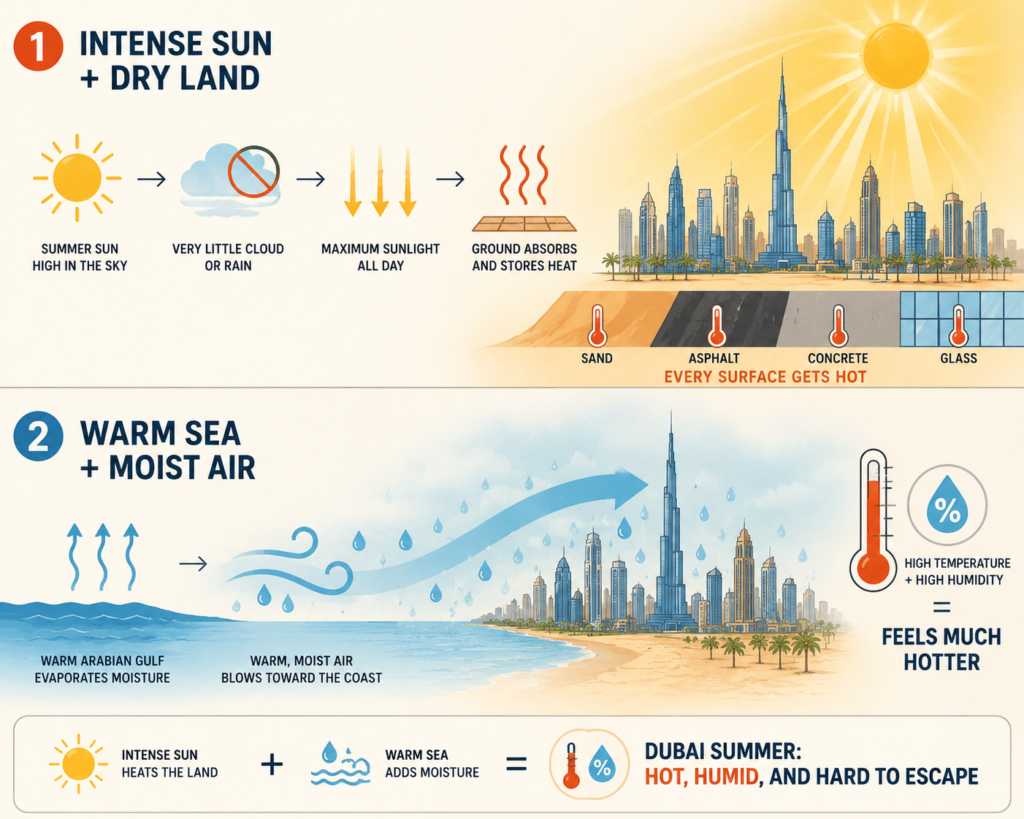
Why is Dubai so hot in summer? The short answer is that Dubai sits in a subtropical desert under almost constant sunshine, receives intense solar radiation, and is surrounded by land that heats up rapidly during the day. At the same time, the warm Arabian Gulf fills the air with moisture, so the heat feels far more oppressive than the thermometer alone suggests. That’s why many people are surprised that a desert city can also feel uncomfortably humid.
Why Is Dubai So Hot in Summer?
If you’re looking for why is Dubai so hot in summer explained simply, it helps to forget the idea that all deserts behave the same way.
Many people imagine deserts as places with dry air, cool nights and huge temperature swings between day and night. That description fits many inland deserts, but Dubai is different because it sits directly on the coast of the Arabian Gulf. Its climate is shaped by two powerful forces working together: one creates extreme heat, while the other traps moisture in the air.
The first part is easy to understand. During summer, the sun is almost directly overhead for much of the day. Cloud cover is rare, rainfall is practically nonexistent and the ground absorbs enormous amounts of solar energy. Sand, asphalt, concrete and glass all become extremely hot after hours of direct sunlight.
The second part is what surprises most visitors. Instead of remaining dry like the Sahara or the interior of Saudi Arabia, Dubai constantly receives warm, moisture-rich air from the sea. The result is a combination of high temperatures and high humidity that makes the city feel much hotter than many other desert locations.
That is why people asking why is Dubai so hot even though it is near the sea are actually looking at the wrong assumption. The sea doesn’t cool Dubai during summer. In many ways, it makes the heat harder to tolerate.
Why Is Dubai Humid When It Is Surrounded by Desert?
This is probably the biggest misconception about Dubai’s climate.
People see endless sand dunes outside the city and naturally expect dry desert air.
The reality is that Dubai isn’t located in the middle of a continent. It sits directly beside the Arabian Gulf, and during summer the sea itself becomes extremely warm. Surface water temperatures often exceed 33°C (91°F), which means the Gulf behaves less like a cooling influence and more like a giant source of water vapor. Warm seawater dramatically increases evaporation, adding moisture to the air that eventually reaches Dubai’s coastline.
Warm water evaporates continuously.
That moisture is carried inland by sea breezes, increasing humidity across the city. Instead of evaporating quickly, sweat begins to remain on your skin because the surrounding air already contains so much water vapor.
This explains why is Dubai humid when it is surrounded by desert.
The desert creates intense heat.
The Gulf creates humidity.
Together they produce one of the world’s most uncomfortable summer climates.
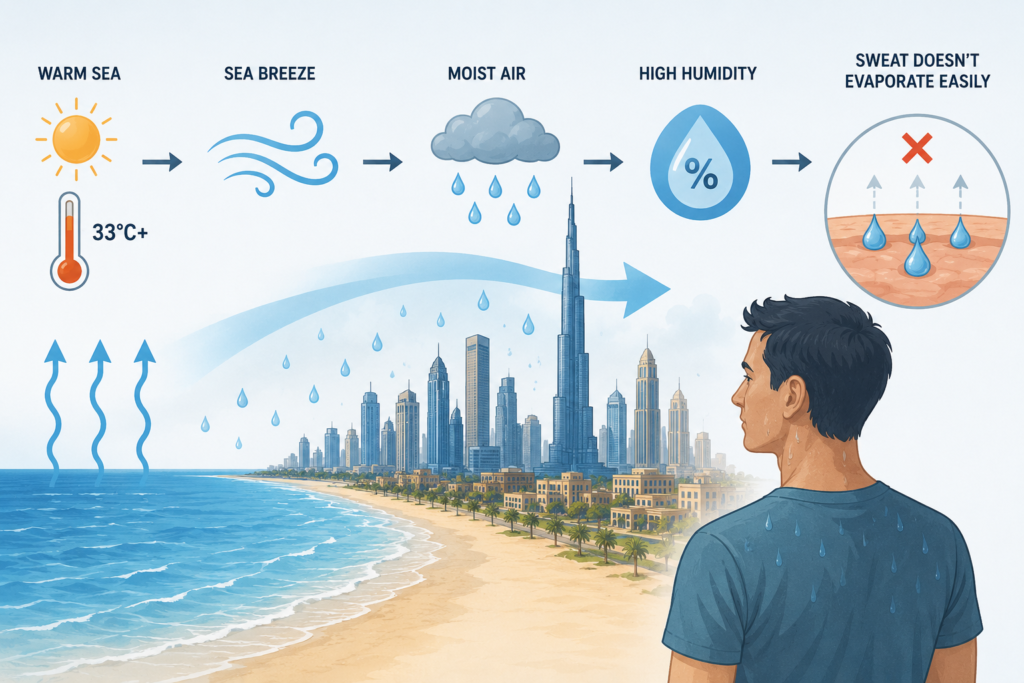
If Dubai were hundreds of kilometers farther inland, the air would likely be much drier. Daytime temperatures might still reach similar levels, but many people would actually find the heat easier to tolerate because sweat could evaporate more efficiently.
Why Does Dubai Feel Hotter Than the Temperature Says?
One reason visitors are often shocked is that they look at a weather app showing 40°C (104°F) and assume they’ve experienced similar temperatures elsewhere.
Then they step outside and immediately realize something feels different.
That’s because the number shown on your phone is the air temperature, not how hot your body actually feels.
Meteorologists use another measurement called the Heat Index, which combines temperature with humidity to estimate how difficult it is for the human body to cool itself.
When humidity rises, sweat evaporates much more slowly.
Sweating is your body’s natural air-conditioning system. As sweat evaporates, it removes heat from your skin. When evaporation slows down, your body keeps producing sweat but loses much less heat.
That’s one of the main reasons behind questions like why does Dubai feel hotter than the temperature says and why does the heat in Dubai feel different.
Humidity isn’t the only factor.
Dubai also receives:
- Intense solar radiation because there are very few clouds;
- Strong reflected heat from glass buildings;
- Hot surfaces such as asphalt and pavements;
- Very limited natural shade in many neighborhoods;
- Hot winds that often feel like air from a hair dryer rather than a cooling breeze.
Each of these factors adds a little more heat stress.
Together they make walking outside feel much harder than the forecast alone suggests.
Why Dubai Feels Hotter Than the Thermometer Suggests
| Factor | What Happens | Effect on Daily Life |
|---|---|---|
| High humidity | Sweat evaporates slowly. | The body struggles to cool itself. |
| Intense sunlight | Very strong solar radiation. | Direct sun feels much hotter than shaded areas. |
| Warm Arabian Gulf | Adds moisture to the air. | Heat feels heavier and more oppressive. |
| Asphalt and concrete | Absorb heat all day. | Streets continue radiating heat after sunset. |
| Glass buildings | Reflect sunlight. | Pedestrian areas become even warmer. |
| Limited natural shade | More direct sun exposure. | Walking long distances becomes uncomfortable. |
| Urban Heat Island | Buildings trap heat overnight. | Even evenings often remain very warm. |
Why Does Dubai Not Cool Down After Sunset?
People who have never visited Dubai often expect the evenings to provide relief.
That expectation comes from experiences in many other deserts, where temperatures fall rapidly after sunset because dry air allows heat to escape quickly into the atmosphere.
Dubai behaves differently.
The city spends the entire day absorbing heat.
Roads, sidewalks, skyscrapers, parking lots and residential buildings all act like giant thermal batteries. Concrete, asphalt and glass store solar energy hour after hour. Once the sun disappears, they begin releasing that stored heat back into the surrounding air.
This process continues for much of the night.
At the same time, humid air from the Arabian Gulf slows the cooling process. Moist air retains heat more effectively than dry desert air, meaning nighttime temperatures stay surprisingly high even after midnight.
Researchers describe this phenomenon as the Urban Heat Island effect. Numerous studies have shown that densely built urban areas often remain several degrees warmer than nearby rural surroundings after sunset because buildings, roads and other hard surfaces release the heat they accumulated during the day.
Air conditioning also plays a role.
Every air conditioner removes heat from inside a building, but it doesn’t destroy that heat—it transfers it outdoors. Across a city filled with millions of apartments, offices, shopping malls and hotels, thousands of cooling systems continuously release additional warm air into already hot streets.
That combination explains both why is Dubai hotter at night than other desert cities and why does Dubai not cool down after sunset.
The sun may have disappeared.
The city itself is still giving back the heat it collected all day.
Why Is Dubai More Humid Than Riyadh If Both Are in the Desert?
At first glance, Dubai and Riyadh seem as though they should have almost identical climates. Both are located on the Arabian Peninsula, both experience extremely hot summers and both are surrounded by desert landscapes.
Yet anyone who has spent time in both cities usually notices one major difference almost immediately.
Dubai feels much heavier.
The reason is geography.
Riyadh sits deep inland, hundreds of kilometers from the sea. The surrounding desert produces extremely dry air, allowing sweat to evaporate quickly. Even when the air temperature climbs above 45°C (113°F), many people describe the heat as harsh but surprisingly bearable in the shade because the body can still cool itself efficiently.
Dubai doesn’t have that advantage.
The Arabian Gulf acts as a constant source of moisture. During summer, warm sea water evaporates throughout the day, filling the atmosphere with humidity before winds carry that moist air across the city.
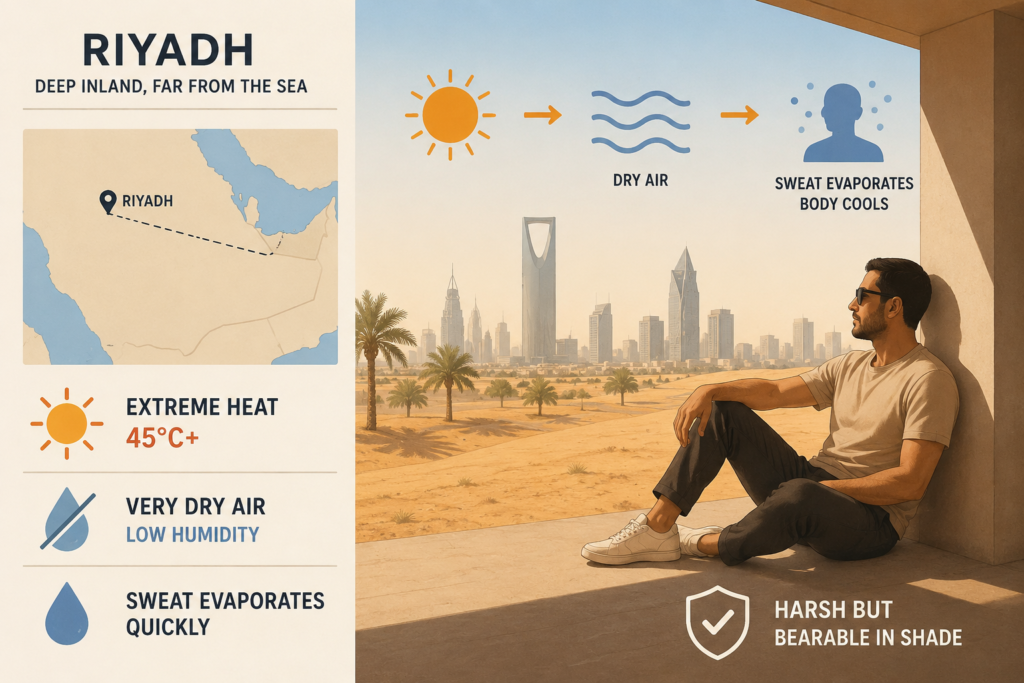
This explains why is Dubai more humid than Riyadh and also answers Why is Dubai more humid than Riyadh if both are in the desert?
Is Dubai Hotter Than Abu Dhabi?
People often ask why is Dubai hotter than Abu Dhabi, but the answer is more nuanced than a simple yes or no.
The two cities share almost the same climate classification. Their daytime summer temperatures are usually very similar because they’re located only about 140 kilometers apart along the same coastline.
On many days, Abu Dhabi may actually record a slightly higher air temperature. On other days, Dubai does.
What people often notice instead are differences in the urban environment.
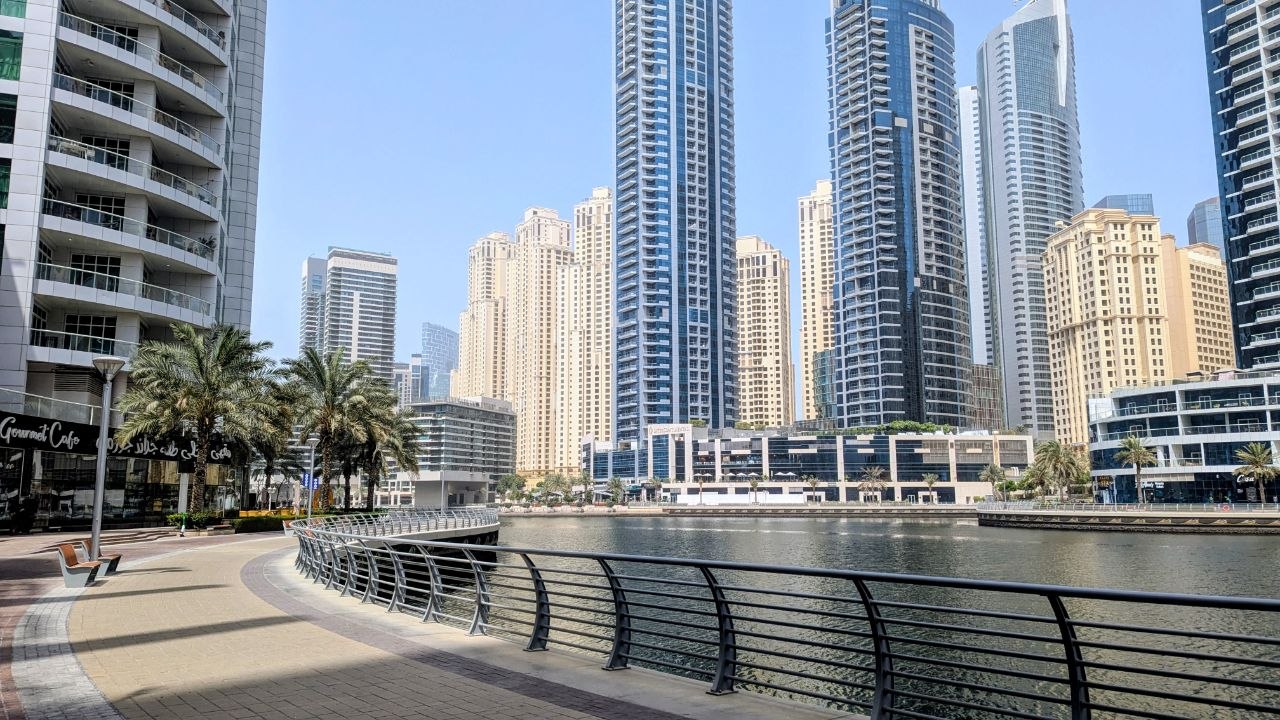
Dubai has a denser concentration of skyscrapers, highways, glass buildings and paved surfaces, particularly around Downtown Dubai, Business Bay and Dubai Marina. Those areas can intensify the Urban Heat Island effect, making evenings feel warmer than nearby suburban districts.
Humidity also changes from day to day depending on wind direction and local weather patterns. Some evenings Dubai feels noticeably more humid, while on others Abu Dhabi does.
So the better question isn’t which city records the highest temperature.
It’s which city feels hotter at a particular moment.
Often, the answer depends on humidity and the built environment rather than the thermometer.
Is Dubai Hotter Than Saudi Arabia?
This question sounds straightforward, but Saudi Arabia is enormous.
Comparing Dubai with the entire country isn’t really possible because Saudi Arabia contains coastal cities, inland deserts, mountains and high plateaus.
If you’re asking is Dubai hotter than Saudi Arabia, the answer depends entirely on which Saudi city you’re comparing.
Some inland locations regularly experience higher daytime temperatures than Dubai.
However, Dubai frequently feels more uncomfortable because of humidity.
For example:
- Riyadh often experiences hotter but much drier afternoons.
- Jeddah, located on the Red Sea, can feel humid in a way that’s more similar to Dubai.
- Mountain cities such as Abha remain dramatically cooler throughout summer.
That’s why climate scientists often distinguish between air temperature and thermal comfort.
The first tells you how hot the air is.
The second describes how difficult it is for your body to cool itself.
Dubai often ranks poorly on thermal comfort because high humidity reduces your body’s ability to lose heat through evaporation.
Is Dubai Hotter Than Las Vegas?
Questions like is Dubai hotter than Las Vegas appear frequently because both cities are famous for desert heat.
In terms of maximum daytime temperatures, they’re surprisingly comparable. Both can exceed 45°C (113°F) during extreme summer periods.
The difference lies in the atmosphere.
Las Vegas sits in a dry desert environment. Humidity is usually very low, allowing sweat to evaporate efficiently. Standing in direct sunlight is still extremely uncomfortable, but stepping into shade often provides noticeable relief.
Dubai rarely offers that same feeling.
Even shaded areas remain humid because the surrounding air already contains so much moisture.
Evenings also behave differently.
Las Vegas usually cools down much faster after sunset because dry desert air loses heat rapidly.
Dubai’s combination of humidity, warm sea air and urban heat storage keeps nighttime temperatures significantly higher.
Many visitors therefore describe Las Vegas as hotter on paper but Dubai as harder to tolerate for extended periods outdoors.
Why Does Dubai Feel Hotter Than Arizona?
A similar comparison explains why does Dubai feel hotter than Arizona.
Arizona’s deserts are famous for extreme heat, but they’re also among the driest places in North America.
People often joke that Arizona is “like standing inside an oven.”
Dubai feels different.
Instead of oven-like heat, many visitors compare it to stepping into a steam room.
The thermometer may show similar numbers, but humidity changes how your body experiences those temperatures.
That’s why weather forecasts sometimes appear misleading.
Forty-two degrees in Dubai and forty-two degrees in Arizona are not necessarily equally stressful for the human body.
The Heat Index in Dubai can be substantially higher because humidity prevents efficient cooling.
Dubai Heat vs Singapore Humidity
Some travelers compare Dubai with Singapore because both can feel overwhelmingly hot.
In reality, the two cities produce discomfort in different ways.
Singapore experiences high humidity throughout the year, but air temperatures are usually lower than Dubai’s. Daily highs often remain around 31–33°C (88–91°F), yet the humidity can make outdoor activity surprisingly tiring.
Dubai combines similarly high humidity during parts of the summer with temperatures that frequently exceed 40°C (104°F).
That means people aren’t simply dealing with moisture.
They’re dealing with moisture on top of extreme desert heat.
Many residents who have lived in both cities describe Singapore as consistently humid but Dubai as more physically intense during the hottest months because the starting temperature is already so much higher.
Dubai Summer vs Other Hot Cities
| City | Humidity | Night Temperatures | Outdoor Comfort | Type of Heat |
|---|---|---|---|---|
| Dubai | Very high in summer | Very warm | Poor during the day | Hot + humid |
| Riyadh | Low | Warmer evenings but cooler than Dubai | Better in shade | Dry desert heat |
| Doha | Very high | Very warm | Similar to Dubai | Hot + humid |
| Las Vegas | Low | Much cooler nights | Better after sunset | Dry desert heat |
| Singapore | Extremely high | Warm year-round | Humid but lower temperatures | Tropical humidity |
Is Climate Change Making Dubai Hotter?
When people ask whether Dubai is getting hotter because of climate change, they’re usually talking about something they’ve noticed themselves. Residents often say that summers seem to start earlier, last longer and remain uncomfortable well into autumn.
Research generally supports at least part of that perception.
Scientists studying the Gulf region have found that average temperatures have been rising over recent decades, and one of the clearest trends is the increase in nighttime temperatures. Instead of cooling significantly after sunset, many cities—including Dubai—are experiencing warmer nights than they did in the past.
This matters because the human body depends on cooler nights to recover from daytime heat. If temperatures remain high until morning, buildings require more air conditioning, electricity consumption increases and people spend even less time outdoors.
Climate models also suggest that heat waves in the Middle East are becoming longer and more frequent. That doesn’t necessarily mean every summer will break a temperature record, but extremely hot periods are expected to occur more often and last for more consecutive days than they did decades ago.
Local urban development adds another layer. As Dubai continues expanding, new roads, towers and paved surfaces increase the amount of heat stored during the day. Climate change raises the background temperature, while urban growth makes the city itself retain even more heat after sunset.
For residents, the practical result isn’t necessarily seeing dramatically higher numbers on the weather forecast every year. Instead, it’s noticing that uncomfortable conditions arrive earlier, persist longer and become harder to escape during the hottest months.
How Do People Survive Summer in Dubai?
Visitors sometimes imagine that people simply become accustomed to the heat.
The reality is different.
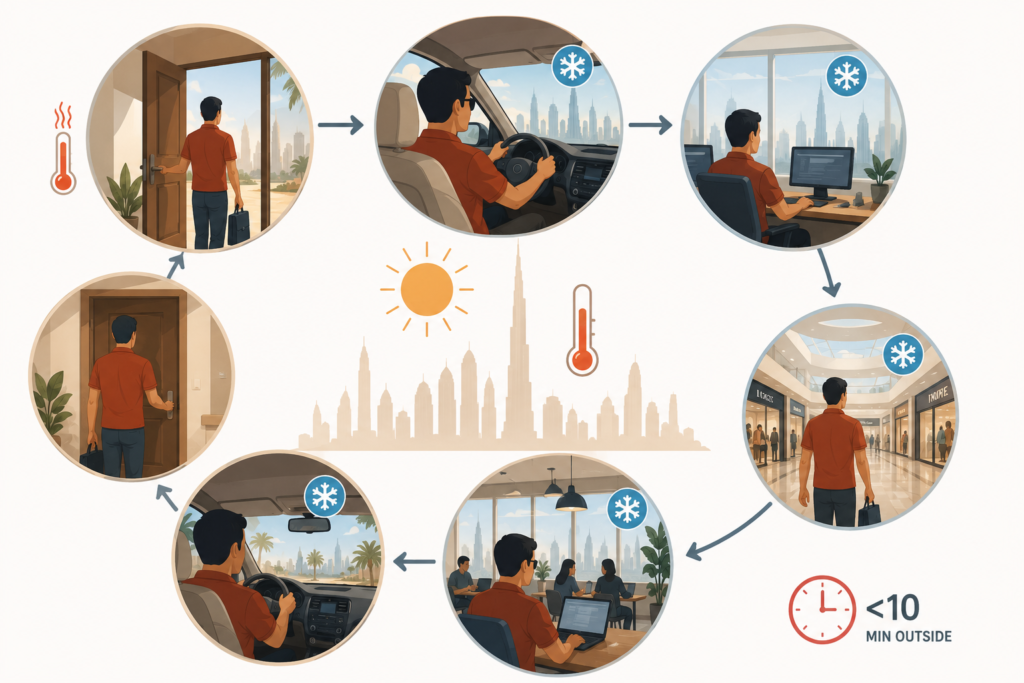
Most residents don’t adapt by spending more time outdoors—they adapt by reorganizing their entire daily routine around air-conditioned spaces.
During July and August, many people leave home in the morning, walk only a few meters to an air-conditioned car, drive to an office, shopping mall or coworking space, and repeat the process when returning home. Entire days can pass with less than ten minutes spent outside.
This explains how do people survive summer in Dubai.
The city has been designed around the assumption that people will move between climate-controlled buildings. Shopping malls function as social spaces, indoor cafés replace outdoor terraces, and restaurants remain busy even when streets appear almost empty during the afternoon.
Technology also plays a surprisingly important role. Grocery deliveries, restaurant deliveries, pharmacy deliveries and ride-hailing services allow people to avoid unnecessary exposure to the heat. Many residents simply choose not to walk if driving is an option.
Exercise follows the same pattern.
Outdoor running groups often meet before sunrise or late in the evening. Parks become noticeably busier after sunset, while gyms remain crowded throughout the day because they’re fully air-conditioned.
What Daily Life in Dubai Is Like During Summer
The weather doesn’t simply change what people wear.
It changes how the entire city functions.
One of the biggest differences newcomers notice is that public life moves indoors. Instead of meeting friends in parks or walking through neighborhoods, people arrange dinners in restaurants, spend evenings in shopping malls or choose cafés inside hotels and business districts.
If you’re looking for air-conditioned venues where residents spend summer evenings, many locals naturally gravitate toward popular indoor places to socialize after work, where the climate has little impact on conversation or nightlife.
Daily schedules also shift.
Construction workers, delivery drivers and other outdoor professions often begin earlier in the morning to reduce exposure during peak afternoon heat. Many businesses remain busy late into the evening because residents prefer going out after sunset, even though temperatures may still exceed 35°C (95°F).
Electricity bills increase substantially during summer because air conditioners operate almost continuously. Apartment buildings, offices and hotels consume enormous amounts of energy simply to maintain comfortable indoor temperatures.
Living without a car also becomes much more difficult.
This answers the question can you live in Dubai without a car in summer.
Technically, yes.
Practically, it can be exhausting.
Even short walks between metro stations and office buildings become physically demanding when humidity is high and pavements have been absorbing heat all day.
People often ask how much time can you spend outside in Dubai summer, but there isn’t one universal answer because it depends on humidity, direct sunlight, physical fitness and the time of day. Early mornings and evenings are considerably more manageable than mid-afternoon, when exposed surfaces can become extremely hot.
Why Do People Leave Dubai During Summer?
Every summer, airports become noticeably busier.
Part of this is simply school holidays.
But many residents also leave because they want a break from months of relentless heat.
This explains why people leave Dubai during summer and do expats leave Dubai in July and August.
Those with flexible jobs often work remotely from Europe, Southeast Asia or their home countries for several weeks before returning in September. Others plan annual holidays specifically around the hottest part of the year.
Some remote professionals even relocate temporarily to cooler destinations during August, where spending time outdoors is once again part of everyday life rather than something carefully planned around sunrise and sunset.
Others decide that the climate no longer matches the lifestyle they want. If outdoor living has become a priority, it’s easy to understand why many eventually explore cities with a much milder summer climate, even if that means giving up some of Dubai’s unmatched convenience and infrastructure.
Can Digital Nomads Live in Dubai During Summer?
Whether can digital nomads live in Dubai during summer depends largely on what kind of remote lifestyle they want.
If your work happens almost entirely indoors, Dubai remains highly functional. Internet is excellent, coworking spaces are modern, cafés are comfortable and almost every service can be delivered directly to your apartment. Productivity itself rarely suffers because of the weather.
The bigger question is lifestyle.
Someone hoping to combine remote work with long walks, outdoor cafés and weekend hikes may find summer frustrating. Much of the city’s social life shifts indoors, spontaneous walking becomes uncommon and even short outdoor errands require planning.
That doesn’t mean Dubai summer is unsuitable for remote workers.
It simply means expectations should be realistic.
For some people, spending three months moving between apartments, coworking spaces and cafés with reliable air conditioning isn’t a problem at all. Others eventually realize they miss spending ordinary evenings outside and prefer destinations where the climate encourages outdoor life throughout the year.
FAQ
Why is Dubai so hot in summer?
Dubai becomes extremely hot because it sits in a subtropical desert with intense sunshine, almost no cloud cover and very high solar radiation. During summer, the warm Arabian Gulf also fills the air with moisture, making the heat feel much more oppressive than the air temperature alone suggests.
Why is Dubai humid if it is surrounded by desert?
The surrounding desert produces the heat, but the nearby Arabian Gulf supplies humidity. Warm seawater evaporates continuously during summer, and sea breezes carry that moisture inland. That’s why Dubai experiences both desert temperatures and tropical-like humidity at the same time.
Why does Dubai stay hot at night?
The city absorbs enormous amounts of heat during the day. Roads, buildings, glass towers and concrete surfaces continue releasing that stored heat long after sunset. Combined with humid air and the Urban Heat Island effect, nighttime temperatures remain surprisingly high.
Is Dubai hotter than Saudi Arabia?
Not necessarily. Some parts of Saudi Arabia record higher daytime temperatures than Dubai. However, Dubai often feels more uncomfortable because humidity slows the evaporation of sweat, making it harder for the body to cool itself.
Is Dubai hotter than Las Vegas?
Air temperatures can be similar, but Dubai usually feels hotter because of humidity. Las Vegas has a much drier desert climate, allowing sweat to evaporate quickly and evenings to cool down far more than in Dubai.
Why does Dubai feel hotter than Arizona?
Arizona’s desert air is extremely dry, while Dubai combines high temperatures with high humidity. As a result, identical temperatures often feel significantly more exhausting in Dubai because your body’s natural cooling system works less efficiently.
Can you walk outside during Dubai summer?
You can, but most residents avoid spending long periods outdoors during the afternoon. Even short walks can become uncomfortable because of the combination of intense sunshine, hot pavements and high humidity. Outdoor activity is much more common early in the morning or after sunset.
Why do many expats leave Dubai in July and August?
Many residents travel during the hottest months because schools close for summer holidays and remote work makes temporary relocation easier. Others simply want to escape several weeks of extreme heat and spend time somewhere with a milder climate before returning in autumn.
Is Dubai summer suitable for digital nomads?
It depends on your priorities. Dubai remains one of the easiest cities in the world for indoor remote work thanks to excellent internet, coworking spaces and modern infrastructure. However, people who want to spend a large part of their day outdoors may find the summer climate restrictive.
Does climate change make Dubai hotter every year?
Research suggests that climate change is contributing to longer heat waves, warmer nights and more frequent periods of extreme heat across the Gulf region. At the same time, continued urban development increases heat retention within the city, making summer conditions feel even more persistent.
This article combines personal experience of living in Dubai, independent editorial research, and scientific information explaining how desert climate, humidity, urban design, and global warming influence summer conditions in the city.
Research sources included:
- Personal observations from living in Dubai year-round and experiencing how extreme summer heat affects daily life, commuting, outdoor activities, and remote work.
- Scientific assessments of climate change, heat waves, and rising temperatures published by the Intergovernmental Panel on Climate Change (IPCC).
- Educational resources explaining evaporation, humidity, ocean-atmosphere interactions, and coastal weather patterns published by NOAA Ocean Service.
- Research on the Urban Heat Island effect, heat retention in cities, and how buildings, roads, and asphalt influence nighttime temperatures published by the U.S. Environmental Protection Agency (EPA).
- Independent editorial research comparing Dubai’s climate with other hot cities, including Riyadh, Doha, Las Vegas, Arizona, and Singapore.
The goal of this article is to explain why Dubai becomes exceptionally hot in summer, why the city is both desert and humid, why nights remain so warm, and how these climate conditions shape everyday life for residents, expats, and digital nomads.

Written by
Anna
Founder of The City Theory — writing about digital nomad lifestyle, modern city culture, remote work, travel experiences, psychology, and human behavior around the world.