
Why Do Arab Men Wear White? What I Learned Living in Dubai
Arab men in Gulf countries wear white robes, called the kandura in the UAE and the thobe in Saudi Arabia, mainly because the long, loose clothing suits the hot climate, but that is only part of the reason. In the UAE, Saudi Arabia, Qatar and Kuwait, garments such as the kandura and thobe are also connected to modesty, tradition and national identity. White fabric makes sense under intense sunlight, but after living in Dubai I realised that answering why do Arab men wear white with “because it is hot” misses most of the story. In the UAE, the kandura is not simply desert clothing or something men put on for religious occasions. It is everyday national dress, and you see Emirati men wearing immaculate white kanduras while shopping, going to work, meeting friends for coffee, having dinner or simply spending a Saturday afternoon in Dubai Mall. Official UAE sources describe the kandura — also called a dishdasha or thobe — as the traditional clothing of Emirati men. The official UAE guide to traditional Emirati clothing explains how it reflects the country’s heritage, climate, and cultural identity.
When I first moved to Dubai, traditional Arab clothing was honestly one of the things that shocked me most. I had travelled in Muslim countries before, but Dubai was different because the contrast was everywhere. You could be standing in Dubai Mall surrounded by tourists in shorts, Indian families, European expats, people dressed for luxury restaurants and groups of Emirati men walking past in perfectly pressed white kanduras. I remember noticing how incredibly white the clothes looked, almost unnaturally clean considering that people were wearing them throughout an ordinary working day. At first I assumed I was mostly seeing people dressed for some special occasion. After living here, I realised that there was nothing special happening at all. That was simply what many local men wore to go about their lives. The same contrast becomes even more obvious during the hottest months, when daily routines shift indoors and the city takes on a completely different rhythm. If you’re visiting between June and September, here’s how to enjoy Dubai without spending much in the heat.
This is also why the common search why arabs wear white dresses is slightly misleading. The garment is not usually called a “white dress,” and not all Arab men dress this way. What tourists associate with “Arab men in white” is particularly connected with the Gulf and Arabian Peninsula. Go to Lebanon, Morocco or Egypt and everyday male clothing can look completely different. Even within the Gulf, terminology, cuts and details vary, so treating Arab clothing as one universal uniform is a bit like assuming everyone in Europe has the same traditional dress.
First: Not All Arab Men Wear White Thobes
One of the biggest problems with articles answering why do Arabs wear white clothes is that they often treat “Arab” as if it describes one country and one culture. It does not. The Arab world stretches across North Africa and the Middle East, and what looks completely normal in Dubai may not be normal everyday clothing in Casablanca or Beirut.
In the UAE, white kanduras are extremely visible because UAE nationals commonly wear traditional clothing in public. The official Abu Dhabi tourism guide to Emirati national dress describes the national attire for men as a white, full-length kandura worn with a ghutra, often secured by the black agal. Likewise, Dubai Culture’s guide to Emirati traditional dress and heritage explains how the kandura and ghutra remain central symbols of Emirati identity and cultural heritage.
That distinction matters because when someone searches why do men in Dubai wear white, what they are normally asking is really: Why do Emirati and other Gulf Arab men still wear traditional white clothing so regularly?
Dubai makes that question especially visible because locals are a minority within a very international population. The city can feel like dozens of cultures occupying the same physical space, something I notice constantly living here. That same mixture is also why the question of how Dubai became home to such a large Indian community is so interesting: traditional Emirati identity remains extremely recognizable even inside one of the most internationally mixed cities in the region.
So when you see a man in a white kandura in Dubai Mall, the clothing is doing more than protecting him from sunlight. It also immediately communicates a connection to local Gulf culture.
What Is the White Arab Robe Actually Called?
If you are wondering what is the white dress Arab men wear, there isn’t one universally correct name. In Dubai and the UAE, the term you will hear most often is kandura. The official UAE guide to traditional Emirati clothing notes that the garment can also be referred to as a dishdasha or thobe, describing it as a long white robe traditionally worn by Emirati men.
That explains several of the confusing searches people make after arriving here: what is the white Arab dress called, what is the white robe called in Dubai, or what is the white robe men wear in Dubai called. In Dubai, calling it a kandura is usually the most locally appropriate answer.
In Saudi Arabia, you are much more likely to hear thobe/thawb, which is why people search why do Saudi men wear white thobes or why do Saudi men wear white robes. In other Gulf countries, dishdasha is also common. The basic silhouette may look similar to an outsider — a long, loose garment extending toward the ankles — but tailoring, collars, cuffs, headwear and regional styling can make the differences fairly obvious once you have spent some time around them.
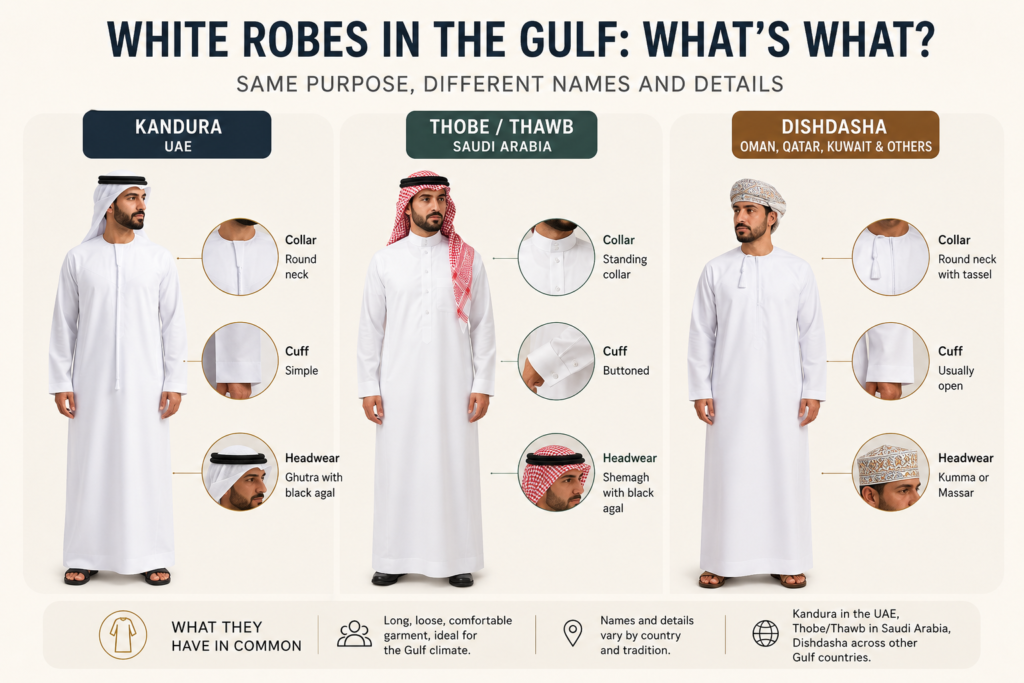
I didn’t notice those differences when I first arrived. At the beginning, I simply saw “men wearing long white clothes.” After living in Dubai, you gradually start noticing that traditional clothing is much more specific than that. The fit matters. The headwear matters. The way the ghutra is arranged matters. Even very subtle details can signal regional or personal style.
That is why why do Arabs wear long white clothes is a better starting question than a complete explanation. The length and looseness have practical roots, but the modern kandura is also a carefully maintained piece of national clothing.
White Makes Sense in the Gulf Climate — But Heat Is Not the Whole Answer
The obvious explanation for why do Arab men wear white in the desert is sunlight. Dubai summers are brutally hot, and lightweight clothing that covers the skin while remaining loose is intuitively sensible. If you have ever spent more than a few minutes outside here in July or August, you quickly understand why clothing evolved very differently from what people historically wore in Northern Europe.
Living here also changed the way I think about the climate. Before moving to Dubai, “45°C” was just a weather number. Once you experience the combination of intense sun, hot pavement, warm wind and the strange transition from freezing air conditioning to outdoor heat, clothing choices make much more practical sense. I have written separately about what makes Dubai’s summer temperatures so extreme, because the climate affects everyday routines here in ways tourists don’t always anticipate.
But there is an important nuance when people ask does white clothing keep you cooler in desert conditions. It is tempting to turn the whole explanation into “white reflects sunlight and black absorbs it, therefore white robes keep men cool.” Clothing physiology is more complicated than that.
A famous 1980 study published in Nature compared black and white Bedouin robes in hot desert conditions and found that although black robes absorbed substantially more solar heat, the extra heat did not necessarily reach the wearer’s skin. The researchers reported that the overall heat gained by the wearer was effectively the same in black and white robes because of how the loose garment interacted with airflow and heat transfer.
That study is useful because it stops us from reducing Gulf clothing to one colour rule. The loose shape matters enormously.
The Loose Shape Matters as Much as the Colour
When people ask why are thobes usually white, they often focus so heavily on the colour that they miss the architecture of the garment itself. A kandura doesn’t cling to the body like a T-shirt and jeans. It creates space between fabric and skin, covers a large amount of the body from direct sunlight and allows air to move differently around the wearer.
This was one of those details I only really understood after watching people wear kanduras normally in Dubai rather than seeing them in photographs. They are long, but they don’t look heavy. On a hot day, the garment hangs away from much of the body instead of wrapping tightly around it. That combination of coverage and looseness makes far more sense in strong sun than wearing something tight simply because it contains less fabric.
It also helps explain why do Gulf men wear white without pretending climate is the only reason. The climate influenced the clothing tradition, but once a style of dress becomes connected to family, community and national identity, it doesn’t disappear simply because air conditioning has been invented. If you want to go deeper into this side of the city, I found that some books exploring Dubai’s culture and identity provide much more context than you normally get from travel guides.
If heat were the sole explanation, Emirati men would presumably change into Western clothes the moment they entered an air-conditioned mall. They don’t.
And that was probably the clearest thing Dubai Mall taught me.
Why Do Men in Dubai Wear White Robes?
The white robe men commonly wear in Dubai is the Emirati kandura, and for many UAE nationals it is normal everyday clothing rather than something reserved for ceremonies or religious occasions. The question why do Emirati men wear kandura became much more interesting to me once I realised how completely ordinary the clothing is here. You don’t only see it at mosques, weddings or official ceremonies. I see men in kanduras in shopping malls, restaurants, cafés, offices and hotel lobbies. You see them in Business Bay during the working week and sitting with friends over coffee at night. On Friday, traditional clothing can have an obvious religious and family context, but on Tuesday afternoon it may simply be what somebody wore to work.
The Abu Dhabi tourism authority describes traditional dress as what UAE nationals usually wear in public, while Emirati heritage institutions explicitly treat the kandura as part of national attire and cultural heritage
That gives a much better answer to why do Emirati men wear white than “because Dubai is hot.”
It’s an everyday visual expression of Emirati identity.
Dubai is perhaps the perfect city to notice this because so much of the rest of the population is international. You can walk through one floor of a mall and hear five languages, see completely different styles of clothing and encounter people who have moved here from every part of the world. Against that background, the kandura actually becomes more visually distinctive, not less.
Traditional clothing and modernity also coexist here without the contradiction outsiders sometimes expect. A man can be wearing a kandura while driving an electric car, working in finance, ordering a flat white and checking the latest iPhone. The assumption that traditional dress automatically belongs to an older or more conservative lifestyle makes much less sense once you actually live in the Gulf.

That same tension between modern global culture and local Arab identity appears in completely different forms across the region. Even contemporary Arab music shows how younger generations can be globally connected while keeping a strong cultural identity, something I noticed when looking at how Mashrou’ Leila reflected modern Arab youth culture. Clothing in the Gulf is another example of why “modern” and “traditional” don’t necessarily cancel each other out.
Why Are Emirati Kanduras So Incredibly White?
This is one of the questions I rarely see addressed properly, yet it was honestly one of my biggest observations after moving here. Why is kandura white is one thing; how people keep those kanduras looking that white is another.
In Dubai Mall, I have seen groups of men wearing white from neck to ankle in clothes that look freshly pressed despite the fact that it may already be late evening. There are no obvious creases, marks or the slightly grey look white clothing develops after repeated wear. Coming from a culture where wearing an entirely white outfit feels like inviting coffee, makeup or food to attack you within ten minutes, I found it almost impressive.
Part of the answer is simply that the kandura is treated as proper everyday clothing rather than a casual robe. Tailoring is a longstanding part of Emirati clothing culture; Abu Dhabi’s tourism authority even highlights traditional tailoring businesses that have specialized in men’s kanduras for decades.
The neatness therefore isn’t incidental. How the garment fits and presents is part of wearing it properly.
I would be careful, though, with claims you sometimes see online about exactly how many kanduras every Emirati man owns or how often every garment is professionally cleaned. Those things obviously vary from person to person. What I can say from living here is that immaculate presentation is strikingly common, especially compared with how tourists often imagine loose traditional clothing.
And once you notice it, you can’t really unsee it.
Is the White Thobe Religious or Cultural?
This is where another common misunderstanding appears. People ask why do Muslims wear white clothes, then assume that the kandura must simply be an Islamic uniform.
It isn’t that simple.
Islam does have positive references to white clothing. A well-known hadith recorded in collections including Riyad as-Salihin on Sunnah.com recommends wearing white clothes, describing them favourably and also mentioning white cloth for burial shrouds. So religion is genuinely part of the cultural background and shouldn’t be dismissed.
But is the white thobe religious or cultural? In everyday Gulf life, the best answer is that the garment is strongly cultural, while Islamic ideas of modesty and the positive association with white can reinforce that tradition.
A Muslim man does not have to be Emirati, Saudi or Qatari and wear a white Gulf thobe to be practicing his religion. Muslims around the world wear completely different clothing. Indonesian Muslim men do not generally dress like Emiratis every day, Moroccan men have their own clothing traditions, and Muslim communities in Europe may simply wear ordinary Western clothes.
So if you ask is kandura Islamic or Emirati, I would describe the kandura first as traditional Emirati/Gulf clothing that exists within an Islamic cultural environment, rather than calling it a religious uniform.
That difference matters because it explains why the clothing survives so strongly in modern Dubai: it isn’t only about following a religious rule. It also says something about where a person comes from and the culture with which he identifies.
Do Arab Men Always Wear White?
No, and this is another thing that becomes obvious once you actually live in the Gulf rather than looking at tourist photographs. If you’re wondering do Arab men always wear white, the answer is definitely not. White is the most recognizable and common colour for kanduras and thobes in the UAE and Saudi Arabia, particularly in hot weather, but it isn’t the only colour men wear.
During the cooler months in Dubai, I started noticing beige, light grey, brown, navy and occasionally much darker kanduras. They don’t suddenly replace white everywhere, but they become noticeably more common. At first this surprised me because I had mentally associated the garment itself with white, as though changing the colour somehow made it a different type of clothing. Once you live here long enough, you stop seeing “white Arab robe” as one fixed uniform and start noticing the same seasonal and personal choices that exist in any wardrobe.
So do Arab men wear black thobes? Yes, some do, although black and other dark colours are much less visually dominant than white in everyday Gulf life. Darker thobes are more practical and comfortable-looking during cooler weather, and they can also simply be a style choice. White remains strongly associated with the classic Gulf look, but there is no rule saying every kandura or thobe must be white.
This also helps answer why do Saudi men wear white robes. White is deeply established as the conventional everyday colour, particularly in a hot climate, but Saudi men also wear darker thobes, especially seasonally. The same general principle applies in the UAE: the garment has a recognizable cultural form without being restricted to one colour forever.
Why Do Men Wear White in Dubai and Women Black?
This is probably one of the first visual contrasts tourists notice, and searches such as why do men wear white in Dubai and women black or why do men wear white and women black in Dubai make complete sense once you’ve walked through Dubai Mall for the first time.
You might see a couple where the man is dressed entirely in white and the woman beside him is wearing a flowing black abaya. To somebody unfamiliar with Gulf clothing, the contrast looks so deliberate that it is tempting to assume there must be one simple rule behind it.
There isn’t.
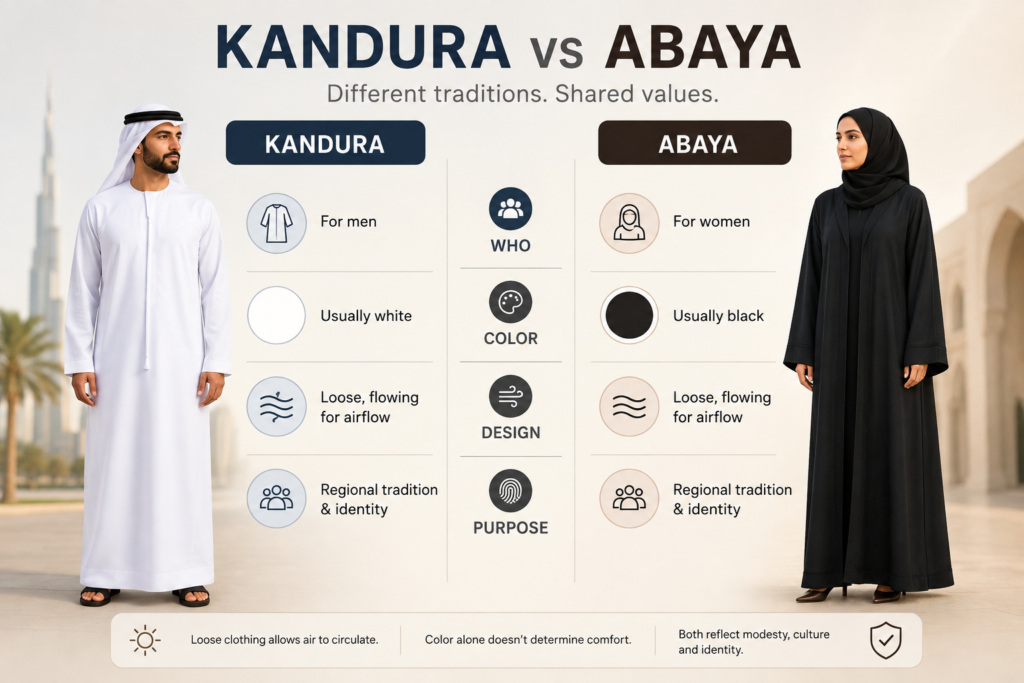
Men’s white kanduras and women’s black abayas developed as separate clothing traditions, and both are connected to modesty, regional convention and cultural identity. It would be too simplistic to say men wear white because it is cooler while women wear black for religious reasons. If colour alone determined comfort, traditional clothing across the region would look much more uniform than it actually does.
The construction of the clothing matters too. An abaya is loose rather than tight against the skin, just as a kandura is loose. The fact that black absorbs more sunlight doesn’t automatically tell you how much heat reaches the body underneath a flowing garment, which is exactly why the Bedouin clothing research I mentioned earlier is so interesting.
What I find more useful after living in Dubai is to think of the two garments as different established traditions rather than opposite sides of one temperature rule.
The other thing tourists sometimes misunderstand is that an abaya isn’t necessarily the woman’s entire outfit. It is an outer garment, and what somebody wears underneath can be completely different. Similarly, the kandura is the visible outer layer of a man’s clothing, but it doesn’t mean there is literally nothing underneath it.
What Do Emirati Men Wear Under a Kandura?
I didn’t even think about this when I first moved here, but what do Emirati men wear under kandura is a surprisingly common question online.
The exact clothing obviously depends on the person, but men normally wear undergarments underneath the kandura rather than treating it as a single layer against bare skin. Traditional undergarments can include a white undershirt and a lower garment or trousers, depending on personal and regional preference.
From the outside, though, you don’t really notice any of that because the entire point of the kandura’s shape is that it hangs cleanly and loosely from the body.
This is also why tailoring matters more than outsiders might expect. A kandura looks extremely simple when you first see one — essentially a long white garment — but when hundreds of men around you are wearing them, you start noticing that some fits look sharper than others. Length, shoulders, sleeves, collar details and how the fabric falls all affect the final appearance.
That was probably one of the biggest changes in my perception after living here. At first, all kanduras looked almost identical to me. Now I notice differences I would never have seen as a tourist.
UAE Kandura vs Saudi Thobe: They Aren’t Exactly the Same
When people ask why do Emirati men wear white clothes and why do Saudi men wear thobes, the clothing can look interchangeable from a distance, but Gulf countries have their own styles.
In the UAE, the kandura tends to have a very clean, flowing appearance and distinctive details around the neckline. Saudi thobes commonly have a more recognizable shirt-style collar and different tailoring details. Headwear also varies, as do the ways men style and arrange it.
‘m deliberately not turning this into a fashion taxonomy because that isn’t what somebody searching why do men in Dubai wear white robes wants. The practical point is simply that “the white Arab robe” isn’t one standardized garment issued throughout the Middle East.
Once you start travelling around the Gulf, these distinctions become easier to recognize. In Dubai, I can now often tell that somebody’s clothing doesn’t look particularly Emirati even if I couldn’t necessarily identify the exact country immediately.
That’s another reason the phrase why do Arabs wear white robes can hide more cultural variety than it reveals.
Can Tourists Wear a Kandura in Dubai?
Yes, generally, although there is a difference between wearing traditional clothing respectfully and treating it like a comedy costume.
The question can tourists wear kandura in Dubai comes up surprisingly often because visitors see locals looking incredibly polished in them and become curious about trying one themselves. You’ll also find kanduras sold in the UAE, and there is nothing inherently offensive about a foreigner wearing one respectfully. Of course, you don’t need traditional Emirati clothing to visit Dubai. For most tourists, the bigger question is what clothes to pack for Dubai, especially when planning outfits for shopping malls, beaches, restaurants and the occasional visit to a mosque.
What I wouldn’t do is combine it with stereotypes, fake accents or behaviour that turns Emirati clothing into a joke. The kandura isn’t fancy dress to the people wearing it around you; it is normal national clothing.
If you genuinely want one, getting the right size and understanding how it is properly worn makes a huge difference. A badly fitting souvenir version can look very different from the carefully tailored kanduras you see Emirati men wearing.
Personally, I think curiosity about local clothing is completely understandable. When you live somewhere rather than just passing through, you naturally become interested in the details of how people dress, eat, socialize and present themselves. The respectful approach is simply to remember that you are interacting with somebody else’s everyday culture, not a tourist attraction.
So Why Do Arab Men Wear White?
After living in Dubai, I think the best answer is much less dramatic than many internet explanations make it sound.
White Gulf clothing survived because several things reinforce one another. The climate helped shape long, loose garments that cover the skin without clinging to the body. White became a practical and culturally established colour. Islamic ideas of modesty and positive associations with white fit naturally around that tradition. Over generations, the kandura and thobe also became highly visible markers of Gulf identity.
Modern air conditioning didn’t remove any of that.
That’s the part I didn’t understand when I first arrived.
If the kandura were only an ancient solution to desert heat, it would probably have disappeared from modern Dubai long ago. Emirati men could easily wear Western business suits, shorts or casual clothes everywhere. Some obviously do at times, but traditional clothing remains extraordinarily visible precisely because it now means much more than temperature management. The same combination of tradition and modern consumer culture can be seen in other parts of everyday life, including Dubai’s preference for richer yellow gold, which is closely connected to the higher-purity jewellery commonly sold across the city.
When I walk through Dubai Mall today, I no longer think, Why is everyone dressed for some traditional event? I see men going shopping, meeting friends, taking their children out or stopping for coffee in clothes that happen to represent a very recognizable local identity.
And in a city where most of the people around you come from somewhere else, that identity probably matters even more.
FAQ
Why do Arab men wear white?
In Gulf countries, white thobes and kanduras combine climate practicality with modesty, tradition and national identity. The clothing is especially associated with the Arabian Peninsula rather than all Arab countries.
What is the white dress Arab men wear called?
In the UAE it is usually called a kandura. In Saudi Arabia, thobe or thawb is more common, while dishdasha is also used in parts of the Gulf.
Why do men in Dubai wear white?
Many of the men tourists notice wearing white in Dubai are Emiratis wearing the traditional kandura. White suits the Gulf climate, but the kandura is also an important part of Emirati national identity.
Why do Emirati men wear kanduras?
The kandura is traditional Emirati men’s clothing and remains normal everyday dress. Men wear it to work, malls, restaurants, family gatherings and ordinary social occasions, not only ceremonies.
Why do Saudi men wear thobes?
The thobe is established traditional men’s clothing in Saudi Arabia. White is particularly common, although darker colours are also worn.
Do Arabs wear white because of the heat?
Heat is one factor, but the loose construction of the garment matters as much as colour. Culture, modesty and tradition are also major reasons the clothing remains common today.
Is wearing a thobe religious?
Not specifically. Islam encourages modest clothing and has positive references to white, but the Gulf-style thobe itself is primarily a regional cultural garment rather than a universal Islamic requirement.
Do Arab men wear anything under the thobe?
Yes. Men normally wear undergarments beneath a thobe or kandura, although the exact combination varies by person and region.
Do Arab men wear black thobes?
Yes. White is the most recognizable colour, but black, brown, grey, beige and navy thobes or kanduras can also be worn, particularly in cooler weather.
Why do women wear black and men wear white in Dubai?
The black abaya and white kandura developed as different Gulf clothing traditions. Their colours reflect convention and cultural identity as well as practical considerations; there isn’t one simple religious or temperature rule explaining the contrast.
Can tourists wear a kandura in Dubai?
Yes, tourists can generally wear a kandura respectfully. It is better to treat it as traditional national clothing rather than as a costume or joke.
Explore the Culture & Society Hub
Discover more stories about language, identity, traditions, social habits and the cultural details that shape everyday life around the world.
Explore the Culture & Society Hub →This article is based on my own experience of living in Dubai, where I see Emirati men wearing traditional white kanduras every day. It also combines independent editorial research, official UAE government resources, scientific studies on desert clothing, and Islamic sources discussing traditional dress.
Research sources included:
- My personal observations from living in Dubai and seeing how Emirati men wear traditional clothing in everyday life, shopping malls, offices, restaurants, and public spaces.
- Official information published by the UAE Government (u.ae) explaining the traditional Emirati kandura and national dress.
- Cultural resources published by Dubai Culture about Emirati heritage, traditional clothing, and local customs.
- The classic scientific study on Bedouin desert clothing published in Nature, examining heat transfer in black and white robes under desert conditions.
- Islamic references from the Sunnah website, including authentic hadiths discussing the recommendation of wearing white clothing.
The goal is to explain why Arab men wear white by combining everyday experience in the UAE with scientific evidence, cultural context, and religious sources instead of repeating common myths or oversimplified explanations.

Founder & Editor
Founder of The City Theory, writing about digital nomad lifestyle, modern city culture, remote work, travel experiences, psychology and human behaviour around the world.