Where to Stay in LA Without a Car: 7 Areas That Actually Work
If you’re wondering where to stay in LA without a car, I would start with Santa Monica, Hollywood, Koreatown or Downtown LA, but the right choice depends much more on what you plan to do than on which neighborhood appears first on a “best areas” list. Santa Monica makes the most sense for the beach, Hollywood works well for major attractions and Metro access, Koreatown is useful for food and a fairly central location, while Downtown gives you the widest choice of rail connections. I would choose the neighborhood before choosing the hotel because in Los Angeles, saving $30 a night on a room can easily cost you more than that in Ubers.
I learned this the hard way because I lived in Los Angeles for six months without a car. I didn’t even have a driver’s license, so renting one wasn’t an option. I walked a lot, used public transport and occasionally paid for Uber when getting somewhere without one became ridiculous. That experience also taught me that saying an LA neighborhood is “walkable” can be misleading. West Hollywood, for example, is perfectly pleasant to walk around once you’re there, but that doesn’t necessarily make it convenient for reaching Santa Monica, Downtown or other parts of the city.
If you are visiting Los Angeles without a car, the goal isn’t to find one magical neighborhood from which you can walk everywhere. That neighborhood doesn’t exist. The goal is to stay somewhere where you can do plenty without transportation and still have realistic connections when you want to leave the area.
Quick Comparison: Best Areas to Stay in Los Angeles Without a Car
The Uber dependency ratings below are my practical assessment rather than an official transport score. “Low” means I would be comfortable staying there and relying primarily on walking and public transport; “high” means I would expect to spend noticeably more on rideshares.
LA Metro currently operates six rail lines, and the network is far more useful than many first-time visitors assume. The E Line connects Downtown with Santa Monica, the B Line runs through Hollywood to North Hollywood, and the D Line connects Downtown with the Wilshire corridor.
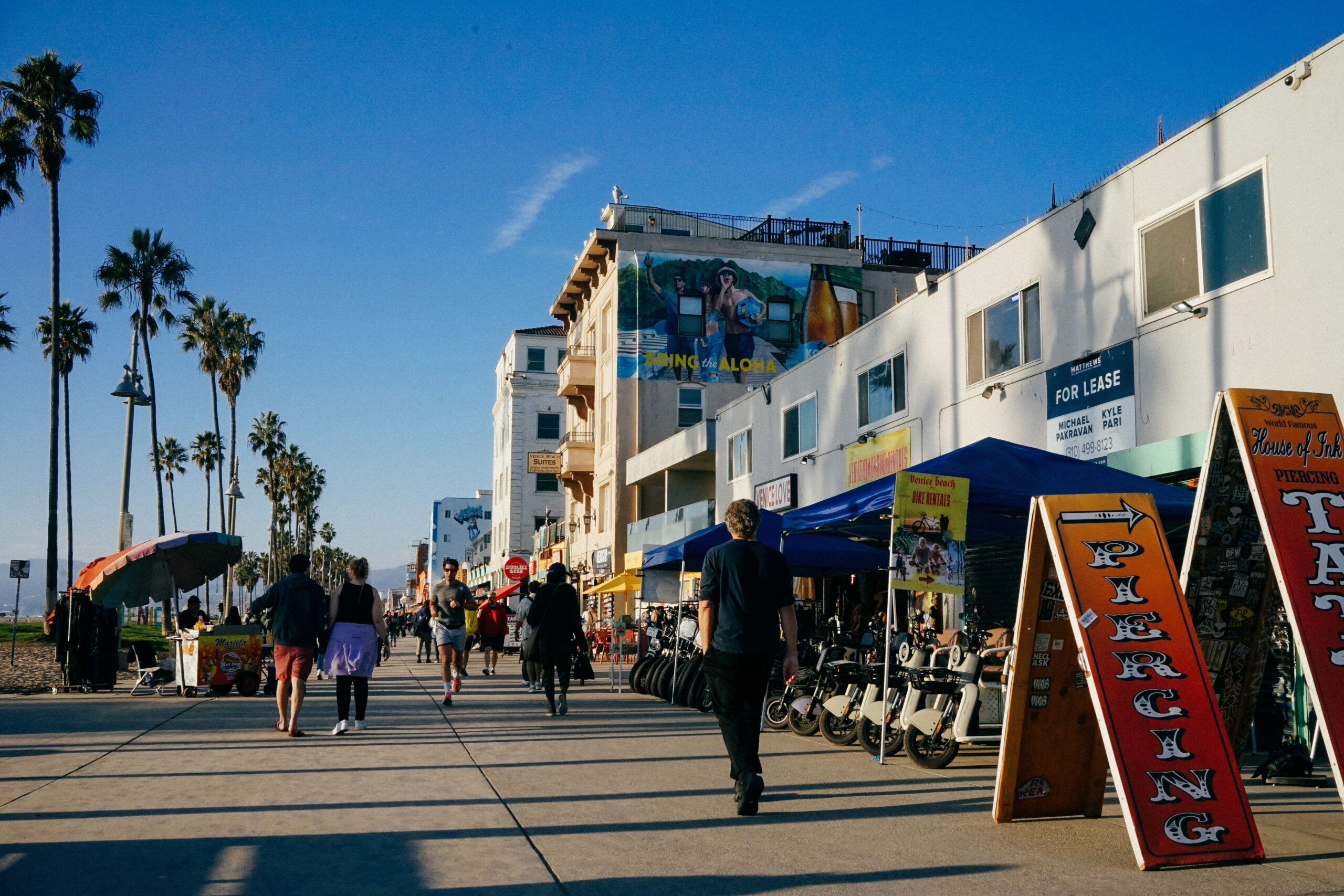
1. Santa Monica — My First Choice for the Beach and Everyday Life
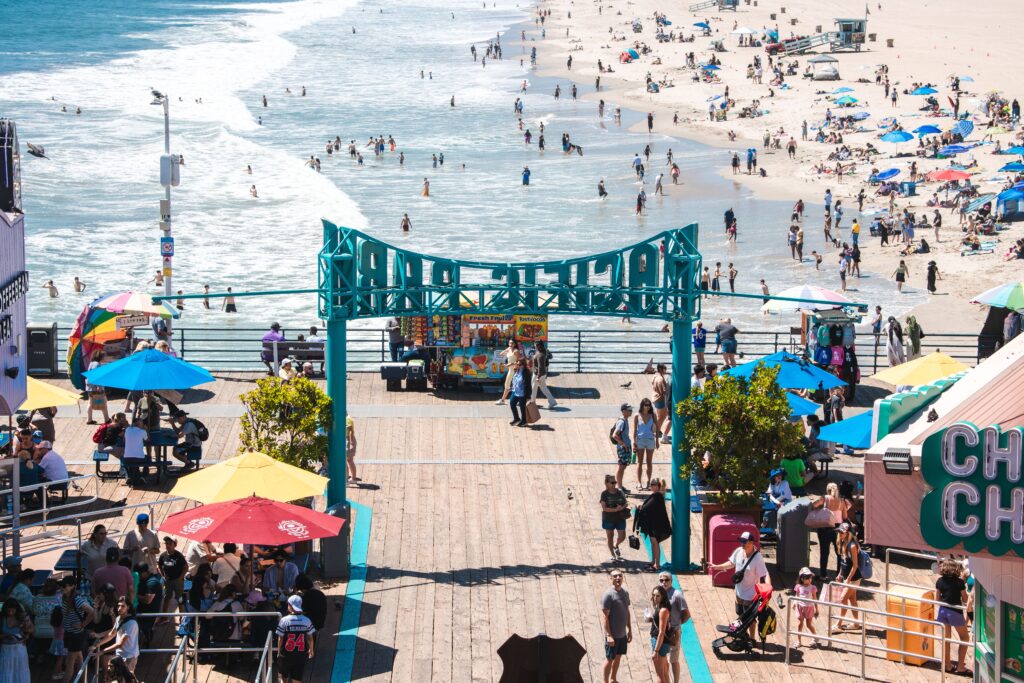
When I lived in Los Angeles, Santa Monica was one of the places where I could leave home without immediately thinking about transportation. You can get coffee, eat, shop, walk to the beach, spend time around Third Street Promenade and continue toward Venice without arranging an Uber every time you want to do something.
That is why I think Santa Monica is one of the best places to stay in LA without a car, particularly for a first visit. Downtown Santa Monica is the western end of Metro’s E Line, which runs all the way to Downtown LA. You therefore get something fairly unusual by LA standards: a neighborhood that works on foot but isn’t completely isolated from the rest of the city.
There is a catch. If most of your plans involve Hollywood, Universal Studios or East LA, staying beside the ocean means repeatedly crossing a very large city. Santa Monica is therefore my choice for someone whose trip is focused on the Westside and the coast, not someone planning to bounce between ten distant attractions every day.
If walking is important to you, I’ve written separately about the parts of Los Angeles I genuinely enjoyed exploring on foot after spending months getting around the city without driving.
Best for: beach, walking, first-time visitors and people who want plenty around their hotel.
Uber dependency: Low/Medium.
2. Hollywood — Best If Your LA List Is Full of Famous Attractions
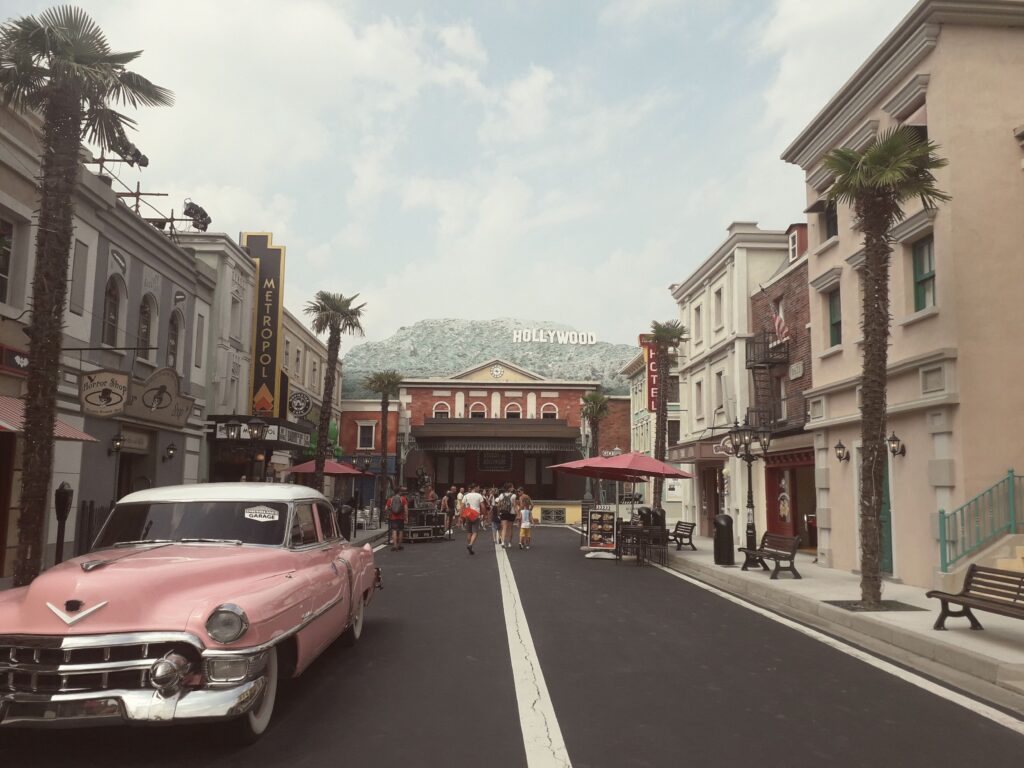
Hollywood wouldn’t necessarily be my favorite part of Los Angeles for everyday life, but that isn’t the question here. If you’re deciding where to stay in LA without a car first time, it can be extremely practical.
The B Line has stations at Hollywood/Western, Hollywood/Vine and Hollywood/Highland. From Hollywood, the same line also reaches Universal City, and a shuttle takes visitors from there toward Universal Studios.
This is the difference between choosing an area because it looks nice in photos and choosing one because it makes your actual itinerary easier. If you want the Walk of Fame, TCL Chinese Theatre, Hollywood Boulevard, Universal and perhaps Griffith Observatory, Hollywood puts several of those plans within walking distance or a relatively simple public-transport journey.
I would specifically look at hotels in LA near Metro stations, rather than simply searching for a Hollywood hotel and assuming the whole neighborhood is equally convenient. A ten-minute walk to a station feels very different from a hotel that requires a bus before you’ve even reached the train.
Best for: Hollywood attractions, Universal and first-time sightseeing.
Uber dependency: Low/Medium.
3. Koreatown — Best Balance of Location, Food and Budget
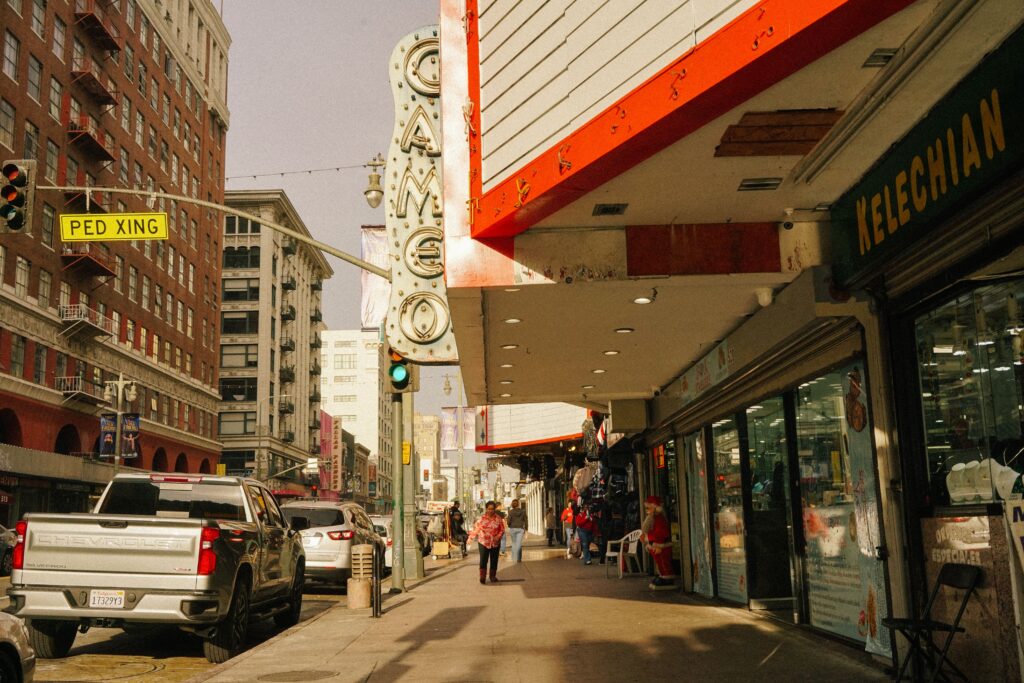
If someone asked me for the best area to stay in LA without a car on a budget, Koreatown would be one of the first places I would check.
Koreatown sits west of Downtown and south of Hollywood, so geographically you’re not pushing yourself all the way out to the coast. It’s also an unusually dense part of LA, packed with restaurants, cafés, bars and late-night businesses. The official Los Angeles tourism guide to Koreatown in Los Angeles gives a good overview of the neighborhood and what you’ll find there. That matters more than people realize: if dinner, coffee, groceries and nightlife are already around you, that’s four fewer reasons to call an Uber.
The D Line serves the Wilshire corridor and now runs between Union Station and Wilshire/La Cienega. According to the Los Angeles Metro rail schedules, travelers can check current routes and station information before choosing where to stay. If I were comparing the best hotels in LA near public transportation, I would pay close attention to the exact distance from a station rather than the hotel simply describing itself as being “in Koreatown.”
Koreatown also makes more sense to me for a week or a month than it does for someone dreaming of waking up beside the Pacific. You’re choosing practicality over the postcard version of LA.
Best for: food, budget-conscious travelers, longer stays and a more central base.
Uber dependency: Low.
4. Downtown LA — Best for Metro Connections
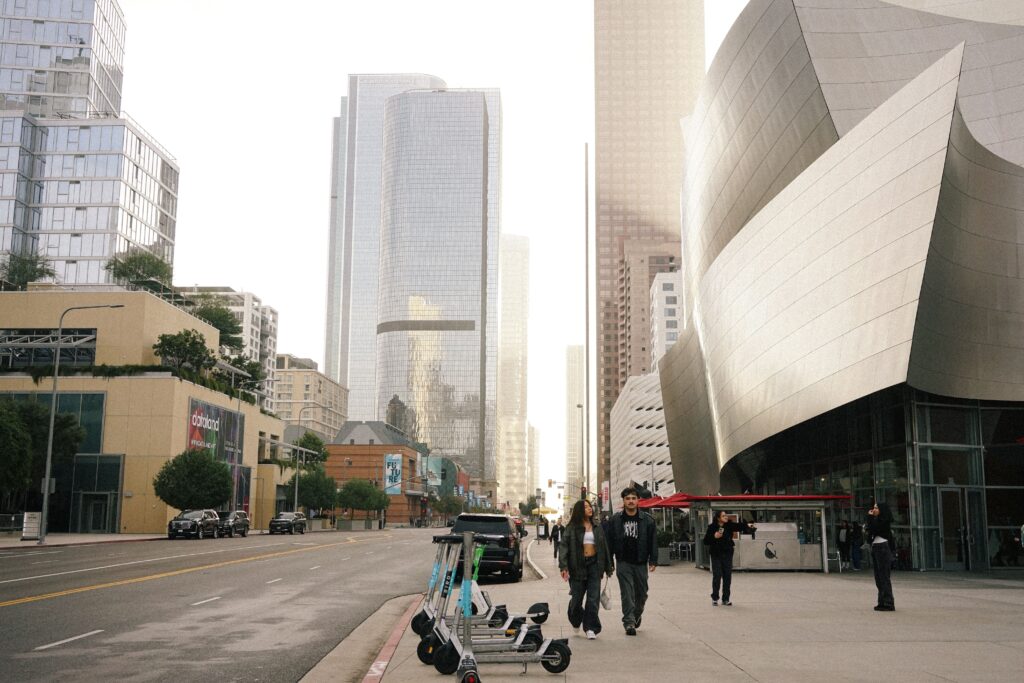
Downtown is probably the easiest answer to where to stay in Los Angeles near Metro. Multiple rail lines pass through the area, and Downtown itself contains enough museums, restaurants, markets and neighborhoods to fill several days. The Los Angeles Tourism & Convention Board also describes DTLA as the hub of the city’s urban rail network and notes that much of the area can be explored on foot.
You can walk around Little Tokyo, Grand Central Market, the Arts District, The Broad and Walt Disney Concert Hall, then use Metro when you want to go farther. The E Line also gives you a direct rail connection toward Santa Monica.
But I would be selective about the exact blocks around my hotel. Downtown changes noticeably from one street to another, and being technically within DTLA doesn’t automatically mean I would want to walk back there alone late at night.
That brings me to something I wouldn’t leave out of a guide for women. During the day I walked extensively around Los Angeles because I had no alternative, but I wouldn’t use “walkable” as a synonym for “I would happily walk here alone at 1 a.m.” If you’re a woman traveling alone, check the immediate surroundings of your accommodation and use a rideshare late at night when a route feels uncomfortable rather than forcing yourself to walk because Google Maps says it’s only 15 minutes.
Best for: public transport, museums, Downtown attractions and travelers planning to explore several parts of LA.
Uber dependency: Low.
5. West Hollywood — Great Once You’re There, Less Convenient When You Leave
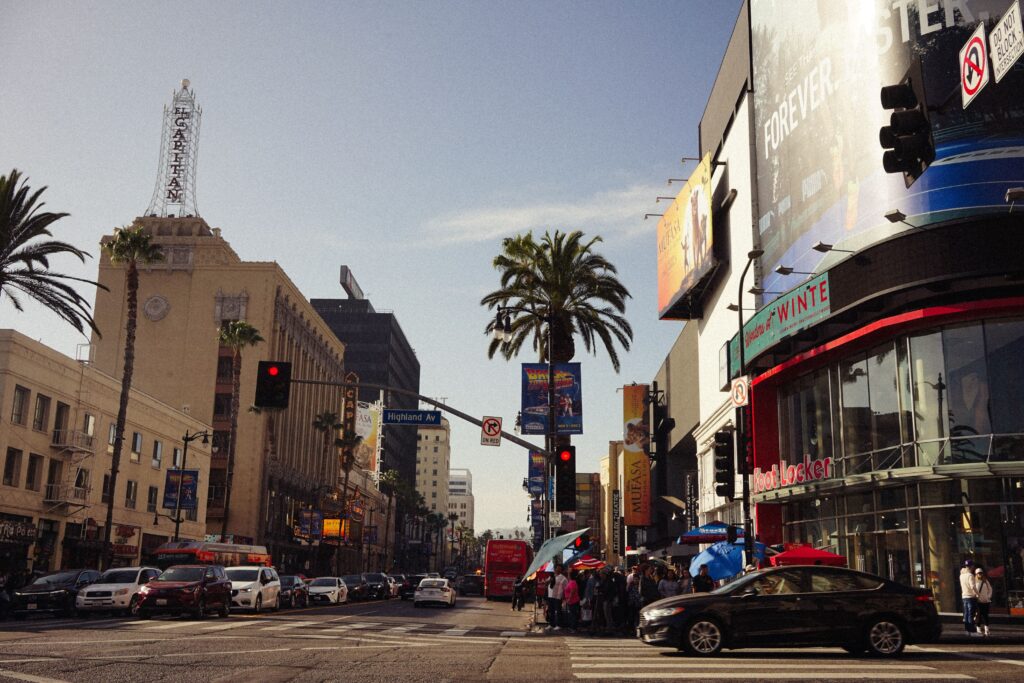
West Hollywood illustrates exactly why I don’t trust generic lists of the best walkable neighborhoods in Los Angeles for tourists.
I liked walking around this part of the city. Restaurants, cafés, bars, shops and nightlife are close enough together that you can spend an entire afternoon or evening without a car. Melrose and nearby areas are also much more enjoyable on foot than LA’s reputation would suggest.
The problem is getting elsewhere. West Hollywood doesn’t have its own rail station, although Metro buses connect it with Downtown and other parts of the city. If you spend most of your trip around West Hollywood, Beverly Grove, Melrose and nearby areas, that’s manageable. If every day involves Santa Monica, Downtown and Universal, your transportation starts becoming more annoying.
This is why my Uber-dependency rating is Medium rather than Low.
Best for: restaurants, nightlife, Melrose and travelers who care more about the neighborhood itself than rail access.
Uber dependency: Medium.
6. Culver City — Underrated for a Week or Longer
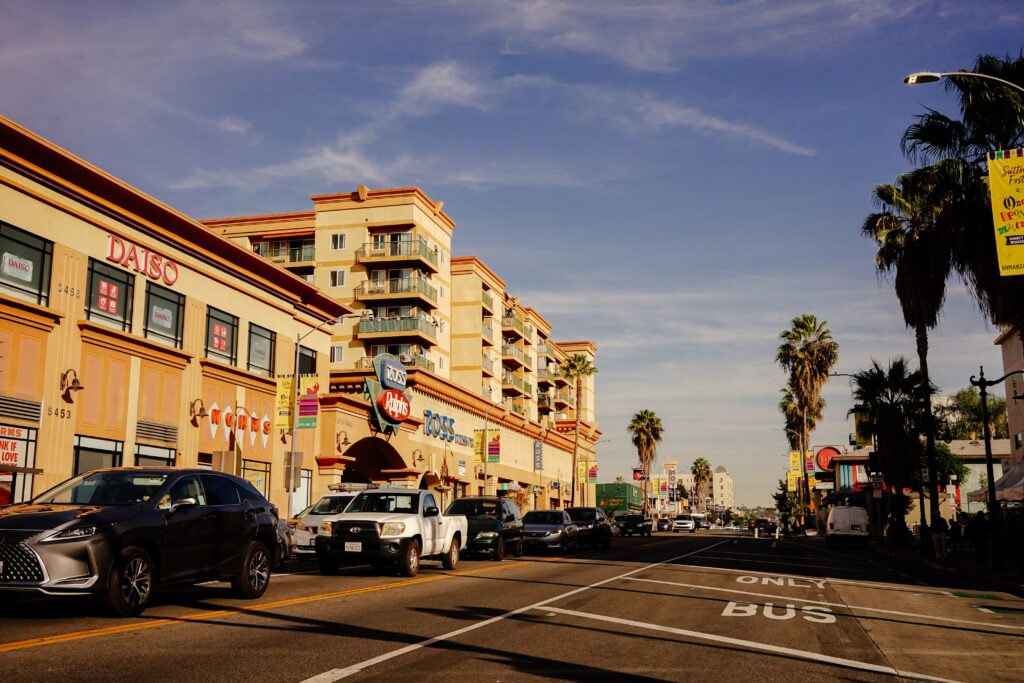
Culver City isn’t usually the first neighborhood tourists imagine when asking for the best place to stay in Los Angeles without a car, but I think it becomes much more interesting if you’re staying for a week or longer.
Downtown Culver City gives you restaurants, coffee shops and normal everyday amenities without having to travel somewhere every time you leave your accommodation. More importantly, the Metro E Line gives the area rail access toward both Downtown LA and Santa Monica.
I would particularly consider it if I were working remotely or spending a month in Los Angeles rather than trying to fit every famous attraction into four days. For a longer stay, having groceries, somewhere to work, restaurants and transport nearby starts mattering much more than being beside Hollywood Boulevard. If working from your hotel every day doesn’t appeal to you, I also compared laptop-friendly coffee shops around Los Angeles where you can actually get some work done, including options in different parts of the city.
I’ve experienced the same shift in priorities with longer trips generally: using a hotel as a longer-term base is very different from choosing somewhere for a weekend because location, laundry, food and everyday transport suddenly become part of the decision.
Best for: one-week or month-long stays, remote workers and people splitting time between the Westside and central LA.
Uber dependency: Low/Medium.
7. Venice — Best If You Want the Beach More Than the Metro
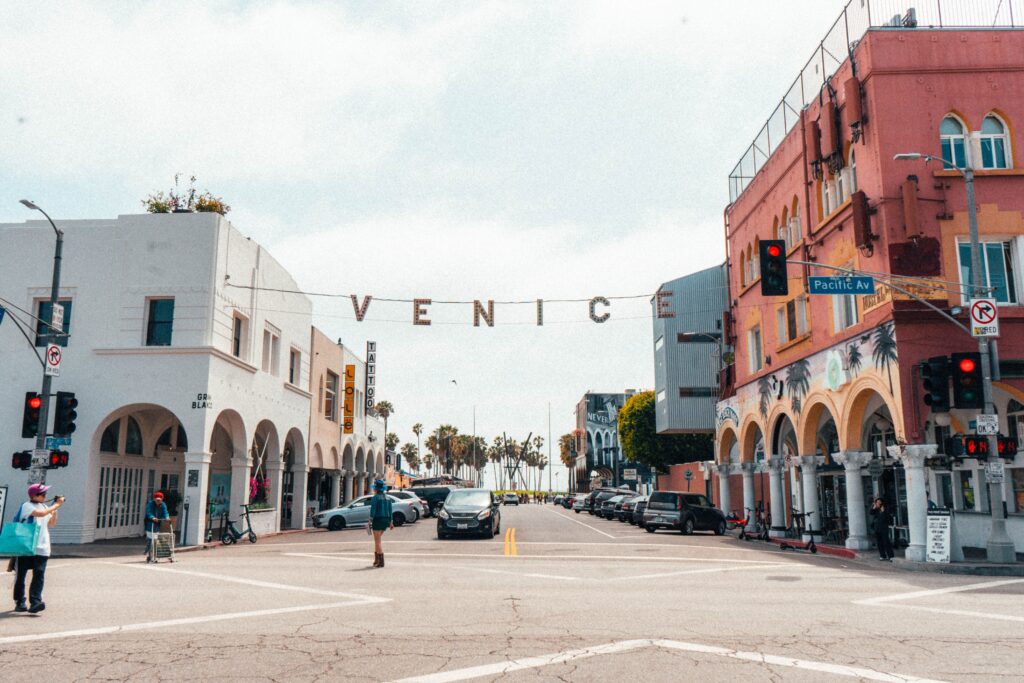
Venice is one of those places where LA without a car feels easy until you decide to leave the neighborhood.
Locally, it’s fantastic. You can walk the boardwalk, go to the beach, explore Abbot Kinney, eat and drink without needing a vehicle. Santa Monica is also close enough that the two areas can form most of your itinerary for a relaxed coastal trip.
The compromise is rail access. Unlike Downtown Santa Monica, Venice doesn’t have an E Line station, so buses, walking, cycling and occasional rideshares become more important when you need to go farther inland.
I would stay here if the beach and Venice atmosphere were the reason for my trip. I wouldn’t choose it as my base for five days of Hollywood, Downtown, Universal and museums.
Best for: beach trips, Venice, couples and solo travelers who plan to stay mostly on the Westside.
Uber dependency: Medium.
Choose Your Area Based on What You Actually Want to See
Instead of trying to identify one universal best neighborhood in LA without a car, I would match the accommodation to the itinerary.
Santa Monica + Venice + beach time → Santa Monica. You get the coast plus the E Line when you need to go inland.
Hollywood + Universal + Griffith → Hollywood. The B Line handles a surprising amount of this itinerary, with local connections for the rest.
Downtown + Little Tokyo + museums → Downtown LA. You can walk between many attractions and have several rail connections available.
Food + central location + Metro → Koreatown. This would be one of my strongest choices for someone trying to control both hotel and Uber spending.
Nightlife + restaurants + Melrose → West Hollywood. Stay there because you actually want to spend time there, rather than because it looks central on a map.
Longer stay + Downtown and Westside access → Culver City. It is less touristy but more practical for normal everyday life.
Beach + Venice atmosphere → Venice. Just accept that some cross-city days will require more planning.
Areas I Wouldn’t Choose in LA Without a Car
Malibu would be near the bottom of my list. It’s beautiful, but beautiful and practical are completely different things when you don’t drive. Metro does run bus service between Downtown Santa Monica and Malibu, but I wouldn’t choose Malibu as a base for exploring LA.
Beverly Hills is pleasant to walk around locally, but I don’t think it gives a car-free visitor enough transport advantage to justify choosing it over Santa Monica, Koreatown or Hollywood.
The LAX area can tempt you with cheaper hotel rates and airport convenience. Unless you’re there for a layover or very short stay, I wouldn’t do it. Being near your flight isn’t particularly useful when everything you want to see is elsewhere.
I would also be careful with far suburban hotels that appear much cheaper on Booking. A $30 nightly saving sounds great until you’re taking $25 rideshares in both directions. For anyone deciding where to stay in LA if you don’t have a car, transport cost belongs in the accommodation budget.
Can You Actually Visit Los Angeles Without a Car?
Yes, but only if you plan the trip around location rather than treating Los Angeles like a compact city. I managed six months without a car or even a driver’s license, so I definitely don’t agree that driving is the only way to experience LA. Even Visit California’s guide to getting around Los Angeles without a car points to the growing Metro network as a practical way to reach major neighborhoods, attractions and beaches. The city has six Metro rail lines with 115 stations, plus an enormous bus network, and the E Line alone makes it possible to travel between Downtown and Santa Monica by rail.
What doesn’t work well is staying wherever the cheapest hotel happens to be and then trying to cross LA several times every day. Group attractions geographically, walk within neighborhoods, use Metro where the route makes sense and budget for occasional Uber trips when public transport turns a simple journey into an expedition.
Los Angeles is also worth exploring beyond its obvious tourist areas. If you’re building a larger US trip rather than visiting only California, there are some surprisingly European-feeling destinations among American places that look much more like England than the US, which is one of the things I enjoy about traveling around such a geographically varied country.
FAQ
What is the best area to stay in LA without a car?
For a first visit, I would choose Santa Monica if the beach is important, Hollywood for major attractions and Metro access, or Koreatown if you want a more central location and are watching your budget. There isn’t one best area for every itinerary.
Is Santa Monica a good place to stay without a car?
Yes. Santa Monica is one of my favorite choices because you can walk to restaurants, shops and the beach, while Downtown Santa Monica is served by the E Line. The disadvantage is the distance from Hollywood and other eastern parts of LA.
Can you visit Los Angeles without renting a car?
Yes. I lived there for six months without one. The easiest approach is to group your sightseeing by area, use Metro and buses for sensible routes and take an occasional Uber rather than trying to eliminate rideshares completely.
Is Hollywood or Santa Monica better without a car?
Choose Hollywood if Universal, Hollywood Boulevard, Griffith and central LA are priorities. Choose Santa Monica if you want the beach, Venice and a neighborhood where you can spend much of the day walking.
Where should I stay in LA near the Metro?
Downtown, Hollywood, Koreatown, Santa Monica and Culver City all give you useful rail access. Check the actual walking distance between the hotel and station before booking rather than relying on the neighborhood name.
Is Downtown LA good for tourists without a car?
It can be very practical because several rail lines serve Downtown and many attractions are clustered together. I would, however, research the exact blocks surrounding a hotel, particularly if you expect to return alone late at night.
How do tourists get around Los Angeles without a car?
Use a combination of Metro rail, buses, walking and rideshares. Metro’s current network connects areas including Downtown, Hollywood, Koreatown, Santa Monica, Culver City, North Hollywood and the LAX/Metro Transit Center.
Where should I stay in LA without a car on a budget?
I would start by comparing Koreatown and Hollywood rather than automatically booking the cheapest hotel anywhere in the city. A slightly more expensive room near useful public transport can cost less overall once Uber expenses are included.
Explore the Country Guides Hub
Planning your next move or trip? Browse our complete collection of country guides covering expat life, digital nomad destinations, local culture and practical advice from around the world.
Explore the Country Guides Hub →This article is based primarily on my own experience of living in Los Angeles for six months without a car or even a driver’s license. During that time, I relied on walking, public transportation and occasional rideshares, which gave me a practical understanding of which parts of LA are easier to navigate without driving and which locations can quickly become inconvenient.
Research sources included:
- My first-hand experience of living in Los Angeles for six months and getting around the city without a car, including walking extensively through Santa Monica, Venice, Hollywood, Koreatown, Downtown LA, West Hollywood, Melrose and surrounding areas.
- Official public transportation, rail routes, station and trip-planning information published by LA Metro (metro.net).
- Official Los Angeles destination and neighborhood information published by Discover Los Angeles (discoverlosangeles.com).
- California travel and car-free Los Angeles transportation information published by Visit California (visitcalifornia.com).
The goal is to help travelers choose where to stay in Los Angeles when they don’t have a car, based on practical factors such as walkability, Metro access, nearby restaurants and attractions, the need for Uber, and how convenient each neighborhood actually feels once you’re there.

Founder & Editor
Founder of The City Theory, writing about digital nomad lifestyle, modern city culture, remote work, travel experiences, psychology and human behaviour around the world.