Friend Cancels Plans All the Time: What It Really Means and What You Should Do
If your friend keeps cancelling plans, one cancellation usually means very little, but repeated cancellations are worth paying attention to. The most important clue isn’t the excuse they give you; it’s what they do afterwards. A friend who genuinely wants to see you will usually apologise and suggest another date. If they repeatedly cancel, never reschedule and leave you doing all the work, the friendship may simply no longer be a priority for them.
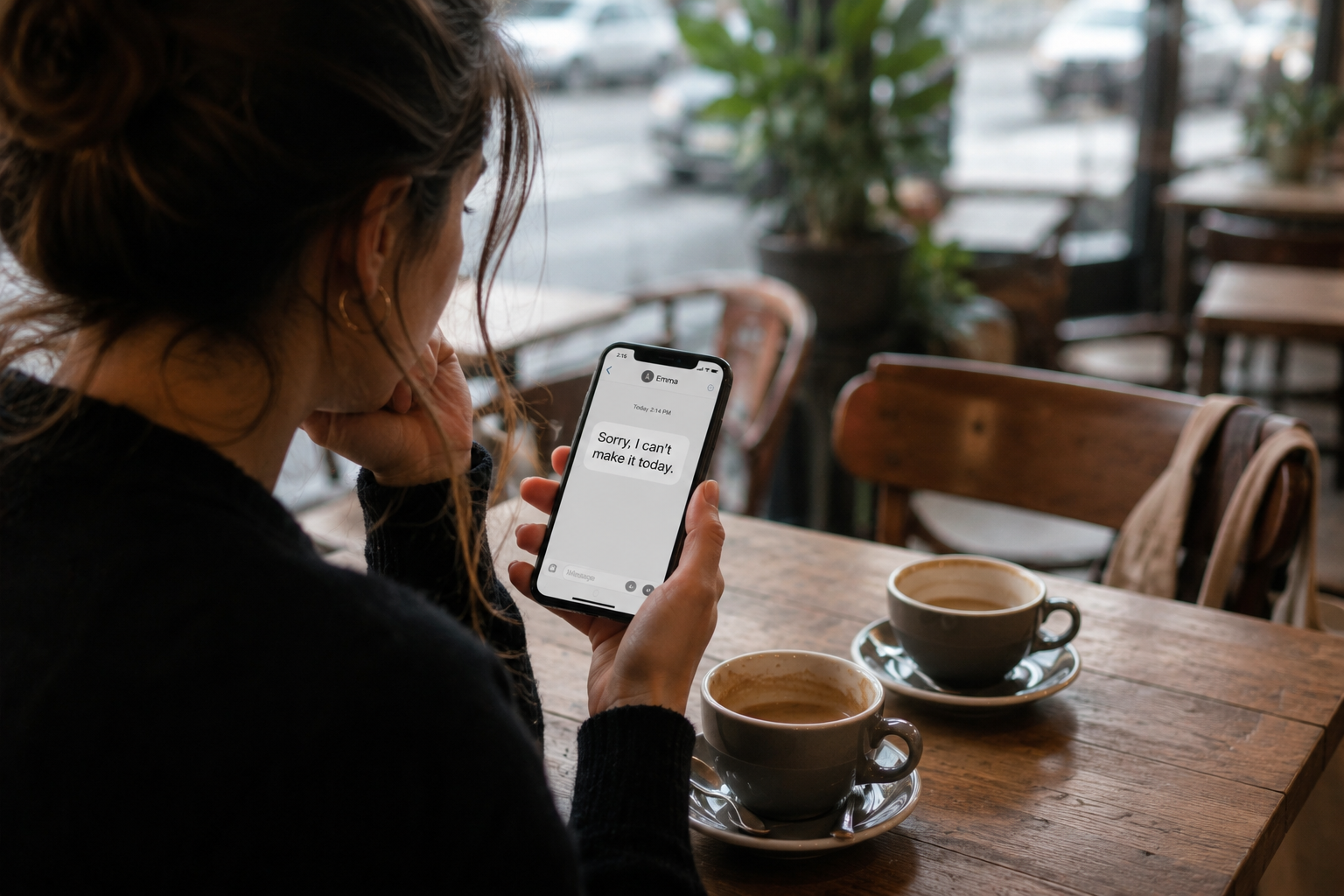
Repeated cancellations are confusing because they rarely come with a clear explanation. A friend might sound genuinely excited about meeting. They may even suggest the day themselves. Then, a few hours before you’re supposed to meet, your phone lights up with another message explaining why they can’t make it. Sometimes the reason sounds perfectly reasonable. Sometimes it doesn’t. Either way, you’re left wondering whether it’s worth making plans again. In some cases, repeated cancellations gradually turn into complete silence without any explanation, making it difficult to know whether the friendship has quietly come to an end.
What makes this situation difficult is that there isn’t one universal explanation. A friend always cancels plans for very different reasons than another person might. One friend may genuinely struggle with anxiety. Another constantly overcommits because they hate disappointing people. Someone else simply has poor organisational skills. Then there are friendships that have quietly changed, where one person keeps saying yes out of habit even though they no longer feel invested enough to follow through.
That is why this article isn’t about labelling flaky people as toxic. Real life is usually more complicated than that. Instead, the goal is to understand what repeated cancellations actually communicate, how to recognise when they have become a pattern, and what to do when a friend keeps leaving you feeling disappointed.
Why It Hurts More Than People Think
Most people describe cancelled plans as an inconvenience. In reality, they often hurt because they affect something much deeper than an evening’s schedule. Every time you agree to meet someone, you quietly rearrange your day around that commitment. You might turn down another invitation, finish work earlier, prepare dinner later, travel across town, or simply spend the day looking forward to seeing someone you care about. When those plans disappear repeatedly, the disappointment is about much more than losing a few hours. It becomes harder to trust future invitations because experience has taught you they may not actually happen. Over time, some people even begin wondering why they never seem to get invited anywhere anymore, assuming the friendship has quietly become one-sided.
That is why it can feel far more upsetting when a friend cancels plans at the last minute than when someone declines an invitation several days beforehand. Last-minute cancellations leave almost no opportunity to make alternative plans. Instead of enjoying the evening with someone else or doing something productive, you often end up sitting at home feeling frustrated that your time suddenly became empty. The emotional reaction is rarely caused by a single cancellation. It develops because the same experience keeps repeating.
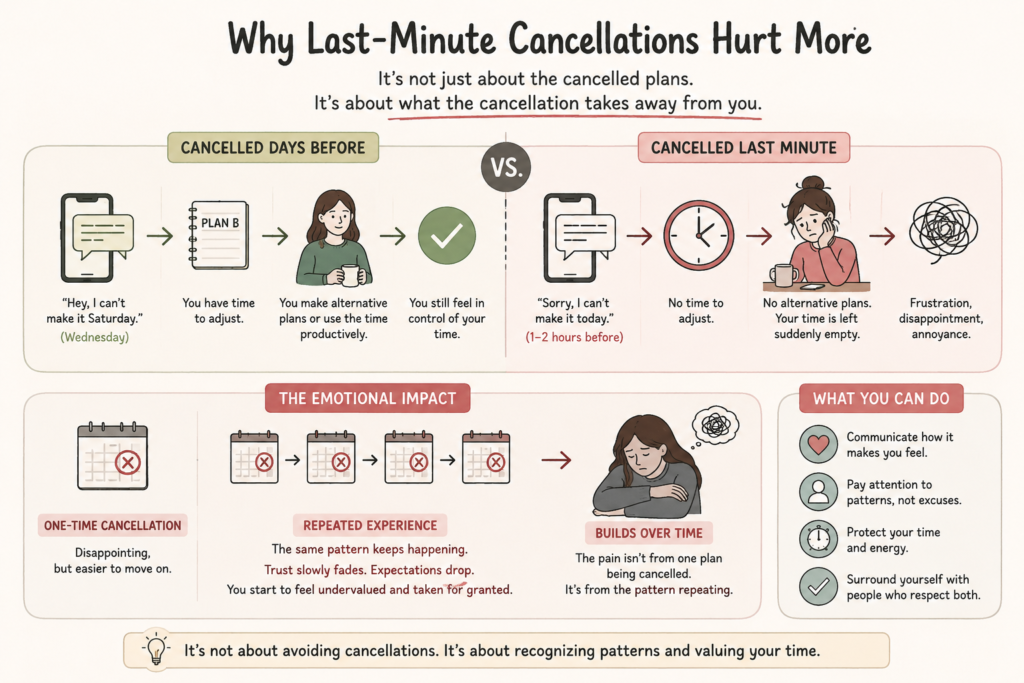
There is also an invisible psychological effect that people rarely mention. Every cancelled meeting creates uncertainty about the friendship itself. You start wondering whether you misunderstood the relationship. Was the invitation genuine? Did they actually want to meet? Are they avoiding you without wanting to say so directly? These questions usually matter more than the cancelled coffee, dinner, or weekend plans. Humans naturally look for patterns in social behaviour, and repeated cancellations begin to feel like information rather than coincidence.
This is also why people search questions like my friend cancels plans all the time what should i do instead of simply asking how to fill their evening. Deep down, they are not looking for another activity. They are trying to understand what the repeated behaviour says about the friendship itself.
Why Does My Friend Always Cancel Plans?
The frustrating part about asking why does my friend always cancel plans is that there isn’t a single answer. Assuming every flaky friend secretly dislikes you is usually just as inaccurate as assuming everything is fine. Human behaviour is messy, and different people cancel for completely different reasons.
One common explanation is simple overcommitment. Some people agree to almost every invitation because saying yes feels easier than saying no. At the time they make the plan, they genuinely expect to go. Later, reality catches up. They realise they have promised too much, become overwhelmed by competing commitments, and start cancelling whichever plans feel easiest to postpone. Unfortunately, friendships often fall into that category because friends are expected to be understanding.
Social anxiety can create a similar pattern while looking completely different from the outside. A person may spend the entire week wanting to meet, only to feel emotionally exhausted when the day finally arrives. Instead of explaining that they are struggling mentally, they invent another excuse because it feels less embarrassing. If your friend keeps cancelling plans, it doesn’t automatically mean they don’t value the friendship. Sometimes it means they are fighting a battle you never see. At the same time, repeated cancellations can feel particularly isolating when most of your friends are already coupled up and you have fewer people available for spontaneous plans.
Poor planning is another surprisingly common explanation. There are people who live almost entirely in the present. They enthusiastically agree to plans weeks in advance without thinking about work deadlines, family commitments, or how much energy they realistically have. When the day arrives, they suddenly discover that everything is happening at once. From their perspective, cancelling feels unavoidable. From your perspective, it looks like they never intended to meet in the first place.
Changing priorities are harder to accept because they involve no dramatic event. Friendships naturally evolve throughout adulthood. New relationships begin. Careers become more demanding. Children arrive. People move. Sometimes the friendship still matters, but it no longer occupies the same place in someone’s life. They continue saying yes because they don’t want to lose the relationship, yet they repeatedly cancel because other commitments keep coming first. This can lead to situations where a friend makes plans then cancels so often that you stop believing the invitations entirely.
There is another possibility that people often avoid discussing because it feels uncomfortable. Occasionally, repeated cancellations really do mean the friendship has become less important to one person than it is to the other. That doesn’t necessarily make anyone a bad person. Relationships change. Interests drift apart. Emotional investment shifts gradually rather than dramatically. The difficult part is that people rarely announce those changes. Instead, they become visible through behaviour.
Recognising the difference between a temporary difficult period and a lasting shift in the friendship requires paying attention to patterns rather than isolated events. A single cancellation tells you almost nothing. Ten cancellations spread across several months begin telling a much clearer story.
When Does It Become a Pattern?
Almost everyone cancels plans occasionally. Illness happens. Family emergencies happen. Unexpected work deadlines appear. Flights get delayed. Cars break down. Judging an entire friendship because someone cancelled once or twice would be unfair. Healthy friendships usually include enough trust to assume good intentions unless evidence suggests otherwise.
The situation changes when the same behaviour keeps repeating. Perhaps your friend keeps cancelling plans last minute every few weeks. Perhaps your friend always cancels last minute, regardless of whether the plan was coffee, dinner, a birthday celebration, or a weekend trip. Eventually, individual excuses become less important than the overall pattern. Instead of remembering each specific reason, you simply begin expecting another cancellation.
A useful question to ask yourself is whether you would confidently organise something important around this person. Would you buy concert tickets months in advance? Would you reserve accommodation together? Would you invite them to an event where their absence would significantly affect your own plans? If the honest answer is no, the issue is probably no longer about isolated cancellations. Trust has quietly started disappearing.
Patterns also reveal themselves through emotional reactions. If every new invitation fills you with excitement, the friendship is probably still healthy. If every invitation is accompanied by thoughts like “They’ll probably cancel anyway,” something has already changed. At that point, the repeated cancellations are influencing not only your schedule but also your expectations. That shift matters because trust is one of the foundations of any close friendship, and rebuilding it takes much longer than breaking it.
What If Your Friend Cancels Plans but Never Reschedules?
One detail that people often overlook is what happens immediately after the cancellation. Life genuinely gets in the way sometimes, and cancelling a plan does not automatically mean somebody doesn’t care about you. The much more revealing question is what happens next. Does your friend say, “I’m really sorry. Are you free next Thursday instead?” Or does the conversation simply end there until the next time you are the one suggesting another meet-up?
A friend cancels plans and does not reschedule sends a very different message from someone who immediately looks for another date. Rescheduling shows that the original plan still mattered. The timing changed, but the intention remained. When there is no effort to find another time, you gradually become responsible for carrying the entire friendship. You organise every meeting, send every reminder, and restart every conversation after plans fall apart. After a while, that imbalance becomes exhausting.
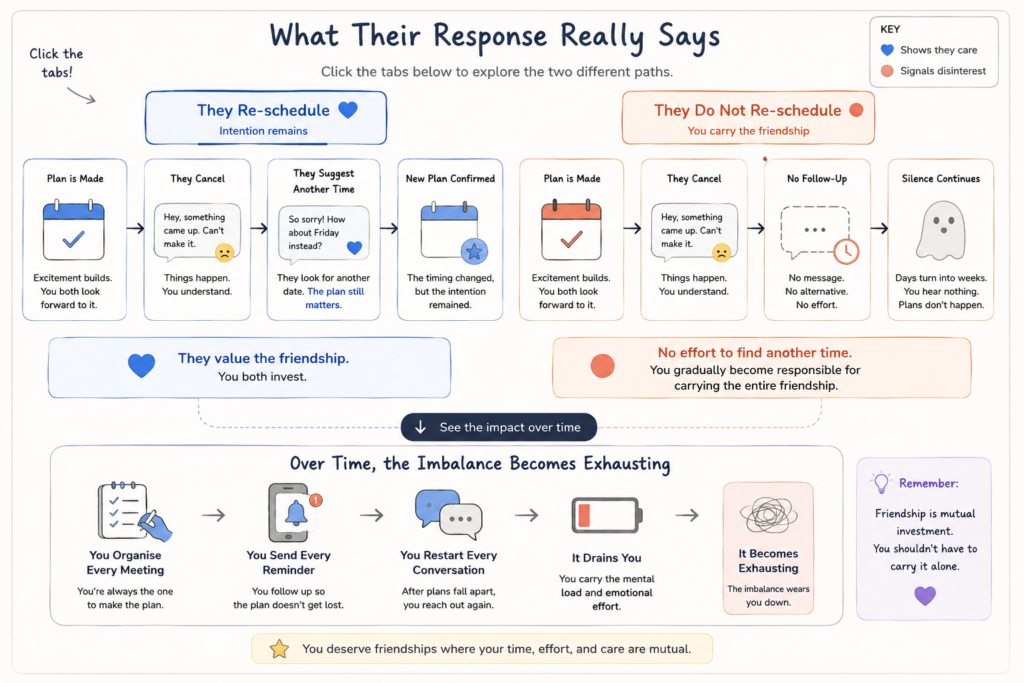
This is why a friend cancels plans and never reschedules is often more painful than someone who occasionally cancels because of genuine emergencies. The issue is not the cancellation itself. It is the lack of initiative afterwards. Friendships survive busy periods because both people continue making an effort, even if that effort looks different than before. When only one person keeps trying to keep the relationship alive, the friendship slowly begins to feel one-sided.
That does not necessarily mean your friend has stopped caring. Some people genuinely struggle with organisation and assume, “We’ll meet eventually.” Others feel guilty after cancelling and avoid bringing it up because they are embarrassed. Still, if months pass and the only invitations come from you, it is reasonable to acknowledge that the relationship may no longer be equally important to both people.
Instead of asking yourself whether the last excuse was believable, pay attention to who keeps rebuilding the bridge every time plans collapse. That usually tells you far more than the cancellation itself.
What If a Friend Cancels Plans and Does Something Else Without You?
One of the hardest versions of this situation is when a friend cancels plans with you and then does something else without you. Maybe they said they were too tired for dinner but later went out with another group, or cancelled your plans only for you to see them somewhere else on social media. At that point, the disappointment is no longer just about a cancelled meeting. It can feel as though they specifically chose another person or group over you.
Few situations feel as frustrating as this one. Your friend tells you they are too tired to meet, too busy to leave the house, or overwhelmed with work. Then, a few hours later, you open Instagram and discover they are at a restaurant, a party, or another social event. It is no surprise that so many people search for friend cancels plans but posts on social media because it creates an immediate feeling of rejection.
The first emotional reaction is usually straightforward: they lied. Sometimes that is true. Other times the situation is more complicated than it first appears. A person may have cancelled dinner because they felt emotionally drained, only to accept a spontaneous invitation from someone already nearby. They may have lacked the energy for a long evening but still gone for a short walk with a family member. They may even have posted an old photograph that had nothing to do with that day. Social media rarely tells the whole story.
At the same time, repeatedly discovering that your friend had enough energy for other activities but not enough to see you naturally affects trust. You do not need to accuse anyone of lying to acknowledge how it makes you feel. If the same situation happens several times, the explanation becomes less important than the outcome. You consistently end up feeling like the backup option rather than the priority.
Before reacting emotionally, give yourself a little time. Ask whether this was a one-off situation or part of a much bigger pattern. Everyone makes inconsistent decisions occasionally. What matters is whether those decisions consistently leave you feeling unimportant. If they do, then the issue is no longer about social media. It is about how the friendship functions.
How Many Cancellations Are Too Many?
If a friend has cancelled three times in a row, it is understandable to start wondering whether you should keep making plans with them.
One of the most common questions people ask is how many times should you let a friend cancel plans. It would be convenient if there were a simple answer. Three times? Five times? Unfortunately, friendships do not work like loyalty cards where a certain number of cancellations automatically ends the relationship.
The better approach is to stop counting individual cancellations and start looking at the overall pattern. Imagine two different friends. One cancels twice because a parent becomes ill and then spends the next six months consistently showing up. Another cancels six times for vague reasons, never suggests another date, and leaves you organising every meeting. The numbers are less important than the behaviour surrounding them.
Ask yourself a few practical questions instead. Does your friend usually apologise sincerely? Do they try to rearrange the plans? Do they seem disappointed about missing the meeting? Does their behaviour match their words? If the answers are generally yes, patience is usually worthwhile. Everyone experiences difficult periods. If the answers are consistently no, continuing to invest the same amount of energy may only create more disappointment.
There is another question that rarely gets asked but may actually be more useful: how often are you willing to feel let down before the friendship starts affecting your own wellbeing? The answer will be different for everyone. Protecting your own time does not make you selfish. It simply recognises that your evenings, weekends, and emotional energy have value too.
How to Respond to a Friend Who Keeps Cancelling Plans
The way you respond can influence the future of the friendship. Replying in anger may create unnecessary conflict, while pretending that repeated cancellations never bother you often leads to quiet resentment. The goal is to communicate honestly without turning every cancelled coffee into a major confrontation.
If the cancellation genuinely seems unavoidable, keeping your response warm is usually the healthiest option.
“No worries. I hope everything’s okay. Let me know when you’re free again.”
That message is friendly while quietly placing responsibility on the other person to suggest the next meeting. If they never follow up, you have learned something important without needing an argument.
When cancellations have become frequent, a slightly more direct response may be appropriate.
“I completely understand that things come up. I’ve noticed this has happened quite a few times recently, though. Let me know when you’re certain you’ll be available because I’d still like to catch up.”
This response acknowledges the pattern without accusing your friend of being careless or dishonest. It also protects your own time by making it clear that you no longer want to keep rearranging your schedule for uncertain plans.
People often search how to respond when a friend cancels plans because they worry about sounding rude. In reality, respectful honesty is rarely rude. You are allowed to communicate that repeated cancellations affect you, just as your friend is allowed to explain what has been happening from their perspective.
What to Say to a Friend Who Always Cancels Plans
Eventually there comes a point where a conversation may be more productive than another polite text message. This is especially true if the friendship has been important for years and you believe the relationship is worth protecting. Knowing how to tell a friend to stop cancelling plans is really about explaining the impact of the behaviour rather than attacking the person’s character.
Try focusing on your own experience instead of making accusations.
“Can I be honest about something? I’ve noticed we’ve made plans quite a few times recently, and they’ve often been cancelled at the last minute. I know life gets busy, but it’s started making me hesitant to organise things because I’m never sure they’ll actually happen.”
This type of conversation gives the other person space to explain what has been going on. They may admit they have been overwhelmed. They may apologise. They may even reveal that they had no idea how their behaviour was affecting you. Sometimes friendships improve because nobody had previously addressed the issue openly.
Of course, conversations do not always change behaviour. If your friend listens sympathetically but continues acting exactly the same way for months afterwards, you have additional information. Communication only works when both people are willing to adjust, and healthy relationships depend on mutual effort. If nothing changes despite honest conversations, you may eventually reach the point where you begin asking yourself a different question altogether: should I stop making plans with a flaky friend?
Should You Stop Making Plans With a Flaky Friend?
This is usually the point where people stop looking for explanations and start looking for permission. After weeks or months of disappointment, they wonder whether they should simply stop trying. The question should i stop making plans with a flaky friend sounds harsh at first, but it is actually a very reasonable one. Friendships require effort from both sides. If one person is constantly organising, reminding, rearranging, and forgiving while the other simply accepts or cancels depending on their mood, the relationship gradually becomes exhausting instead of enjoyable.
That doesn’t mean you need to dramatically announce the end of the friendship. Real life is rarely that black and white. Sometimes the healthiest approach is simply to stop being the only person keeping the friendship alive. Instead of sending another invitation next week, wait and see what happens. Does your friend reach out? Do they suggest meeting? Do they check in after a few weeks? If nothing happens, you have your answer without needing a confrontation. Friendships rarely disappear because somebody stopped sending invitations once. They disappear because one person was carrying the relationship for much longer than they realised.
Stepping back also protects your own emotional energy. Every cancelled plan creates a small disappointment, and those disappointments accumulate over time. By reducing your expectations instead of constantly hoping that “this time will be different,” you give yourself the opportunity to invest in people who consistently enjoy spending time with you. That is not punishment. It is simply recognising where your effort is appreciated.
The Difference Between a Busy Friend and a Friend Who Doesn’t Prioritise You
This is probably the hardest distinction to make because, on the surface, both people behave similarly. They are busy. They cancel occasionally. They take longer to reply than they used to. The difference is rarely found in what they say. It is found in what they do over time.
A genuinely busy friend still finds ways to keep the friendship alive. They may not be available this weekend, but they suggest another one. They remember your birthday even if they cannot attend your party. They send a message after cancelling to ask how you are doing. They apologise without making excuses because they understand your time matters too. Their schedule may be full, but their actions consistently show that the friendship still has a place within it.
A friend who no longer prioritises the relationship usually behaves differently. Plans remain vague. Responses become increasingly delayed. Invitations receive enthusiastic replies followed by cancellations. Rescheduling rarely happens unless you organise everything yourself. If you stop making the effort, the friendship almost disappears. That pattern says much more than any individual excuse ever could.
Adult friendships naturally become more complicated than they were at school or university. Careers become demanding, families grow, people move cities, and responsibilities multiply. In some cases, friends disappear when they are in relationships because a new partner temporarily becomes the centre of their attention. Sometimes the friendship eventually returns to its previous balance. Sometimes it does not. The important thing is to judge the relationship over months rather than days. Temporary changes happen in every friendship. Permanent patterns tell a different story.
It is also worth remembering that building long-term friendships requires flexibility from both people. Life changes. Availability changes. Expectations change. The strongest friendships survive because both people adapt together rather than expecting everything to remain exactly as it was ten years earlier. That flexibility, however, should never become one-sided. Understanding someone’s circumstances is generous. Constantly accepting being treated as an afterthought eventually becomes unfair to yourself.
What I Learned From My Own Experience
I had a friend who often suggested meeting first. She would send a message asking whether I wanted to get coffee or have dinner after work, and everything sounded completely genuine. We would agree on a day, decide where to meet, and I’d assume the plan was settled. Then, usually a few hours before we were supposed to meet, another message would arrive saying she couldn’t make it after all.
Sometimes another plan had suddenly appeared. Other times something “unexpected” had come up. Occasionally she simply said she was too tired and asked whether we could do it another time. If it had happened once or twice, I honestly would not have thought much about it. Everyone has weeks when life becomes chaotic. The problem was that it kept happening. Looking back, I realised that almost every second plan we made ended the same way.
For a long time I kept giving her the benefit of the doubt because none of her excuses sounded impossible. I also genuinely liked her and wanted the friendship to continue. Eventually, though, I noticed something I had ignored for months. I was always the person trying again. I was always the one suggesting another day, checking my calendar, and restarting the conversation after another cancellation. Without really meaning to, I had become responsible for keeping the friendship moving forward.
The uncomfortable realisation wasn’t that she disliked me. I don’t actually believe she did. It was something much simpler. I simply wasn’t a priority anymore. That doesn’t automatically make somebody a bad friend or a bad person. People’s lives change. Relationships evolve. Priorities shift without anyone making a conscious decision for it to happen. Once I accepted that possibility, the situation stopped feeling so confusing.
I decided to stop asking her to meet. Not to test her and not to prove a point. I was simply tired of arranging plans that rarely happened. Weeks passed, then months. She never suggested another meeting. We exchanged the occasional message, wished each other happy birthday, and slowly our friendship faded on its own. There was no dramatic argument, no betrayal, and no clear ending. It simply became one of those relationships that quietly disappeared because only one person had been keeping it alive.
Looking back, I do not regret stepping back. I also do not regret giving her so many chances. What I learned was that repeated behaviour matters more than individual excuses. When someone consistently makes time for you, you rarely have to wonder where you stand. When someone consistently leaves you questioning the friendship, that uncertainty becomes part of the relationship itself.
One final thought is worth mentioning. Repeated cancellations alone do not necessarily mean you are dealing with a toxic friendship. Some people genuinely struggle with anxiety, burnout, or overwhelming life circumstances. Others simply communicate poorly. The important thing is to pay attention to the whole picture rather than one behaviour in isolation. At the same time, your own feelings deserve attention too. If a friendship repeatedly leaves you feeling disappointed, unimportant, or emotionally drained, stepping back does not make you unkind. Sometimes it is simply the healthiest response.
FAQ
Why does my friend always cancel plans?
There is no single explanation. Common reasons include overcommitting, social anxiety, emotional exhaustion, poor organisation, changing priorities, people-pleasing, or a gradual shift in the friendship itself. Instead of focusing on one excuse, look at the overall pattern of behaviour.
What should I do when a friend keeps cancelling plans?
Start by giving them the benefit of the doubt, especially if the cancellations are unusual. If the pattern continues, communicate honestly, stop rearranging your schedule repeatedly, and see whether they make an effort to organise the next meeting.
Is it rude to cancel plans last minute?
Sometimes it is unavoidable because of illness, emergencies, or unexpected situations. When it happens repeatedly without much consideration for the other person’s time, it can feel disrespectful even if that was never the intention.
How do I respond to a friend who keeps cancelling plans?
Keep your response calm and respectful. If it has only happened once, wish them well and let them suggest another date. If it keeps happening, acknowledge the pattern without accusing them. Honest communication is usually more effective than passive frustration.
What should I say to someone who always cancels plans?
Tell them calmly that you’ve noticed the pattern and that repeated cancellations make it difficult to organise your time. Instead of immediately suggesting another date, ask them to contact you when they know they are genuinely available. This keeps the conversation respectful while putting responsibility for the next plan back on them.
What if my friend always cancels plans but wants to stay friends?
Words matter, but actions matter more. Someone may genuinely value the friendship while struggling with organisation or anxiety. If they continue making an effort in other ways and eventually reschedule, the relationship may simply need patience. If they repeatedly cancel without following through, the friendship may no longer have the same importance for them.
How can I deal with flaky friends?
The healthiest approach is to adjust your expectations rather than trying to change another person’s behaviour. Avoid relying on them for important plans, stop being the only one arranging meet-ups, and invest more energy in friendships where the effort is mutual.
Explore the Human Connection Hub
Discover more articles about friendship, loneliness, dating, ghosting and modern relationships in our Human Connection Hub.
Explore the Human Connection Hub →This article combines personal experience, observations from real-life friendships, independent editorial research, and discussions from people who have experienced repeated cancellations, changing friendships, and the challenges of maintaining relationships in adulthood.
Research sources included:
- Personal experiences and observations from friendships that gradually changed over time, as well as conversations with friends who have faced similar situations.
- Community discussions and first-hand experiences shared on Reddit, including conversations about flaky friends, cancelled plans, adult friendships, and changing social priorities.
- Research, articles, and expert commentary on relationships, trust, empathy, and social connection published by the Greater Good Science Center at the University of California, Berkeley.
- Psychological research and educational resources on interpersonal relationships, communication, and human behaviour published by the American Psychological Association (APA).
- Independent editorial research exploring how modern work, stress, anxiety, and changing life circumstances influence adult friendships and long-term social connections.
The goal is to provide balanced, practical guidance for people whose friends repeatedly cancel plans, helping readers understand possible reasons behind the behaviour, recognise unhealthy patterns, communicate more effectively, and make thoughtful decisions about their friendships without jumping to conclusions.

Founder & Editor
Founder of The City Theory, writing about digital nomad lifestyle, modern city culture, remote work, travel experiences, psychology and human behaviour around the world.