Why Do Lebanese Speak French? The History Is More Complicated Than Colonialism
Yes, many Lebanese people speak French, although not everyone does. French became deeply rooted in Lebanon through schools, religious institutions and later the French Mandate, and it remained important after independence because generations continued using it in education, universities, media and professional life. Arabic is Lebanon’s official language, but French is still widely spoken alongside Lebanese Arabic and, increasingly, English. According to the Organisation internationale de la Francophonie, Lebanon remains one of the world’s major French-speaking countries outside Europe, reflecting the language’s lasting role in education, business, government and everyday communication.
That is the direct answer to why do Lebanese speak French, but it does not fully explain what the language sounds like in everyday life. Lebanon is not a country where everyone simply walks around speaking standard French instead of Arabic. Most people use Lebanese Arabic as their everyday language, while French or English may appear depending on their school, family, profession, generation and social circle.
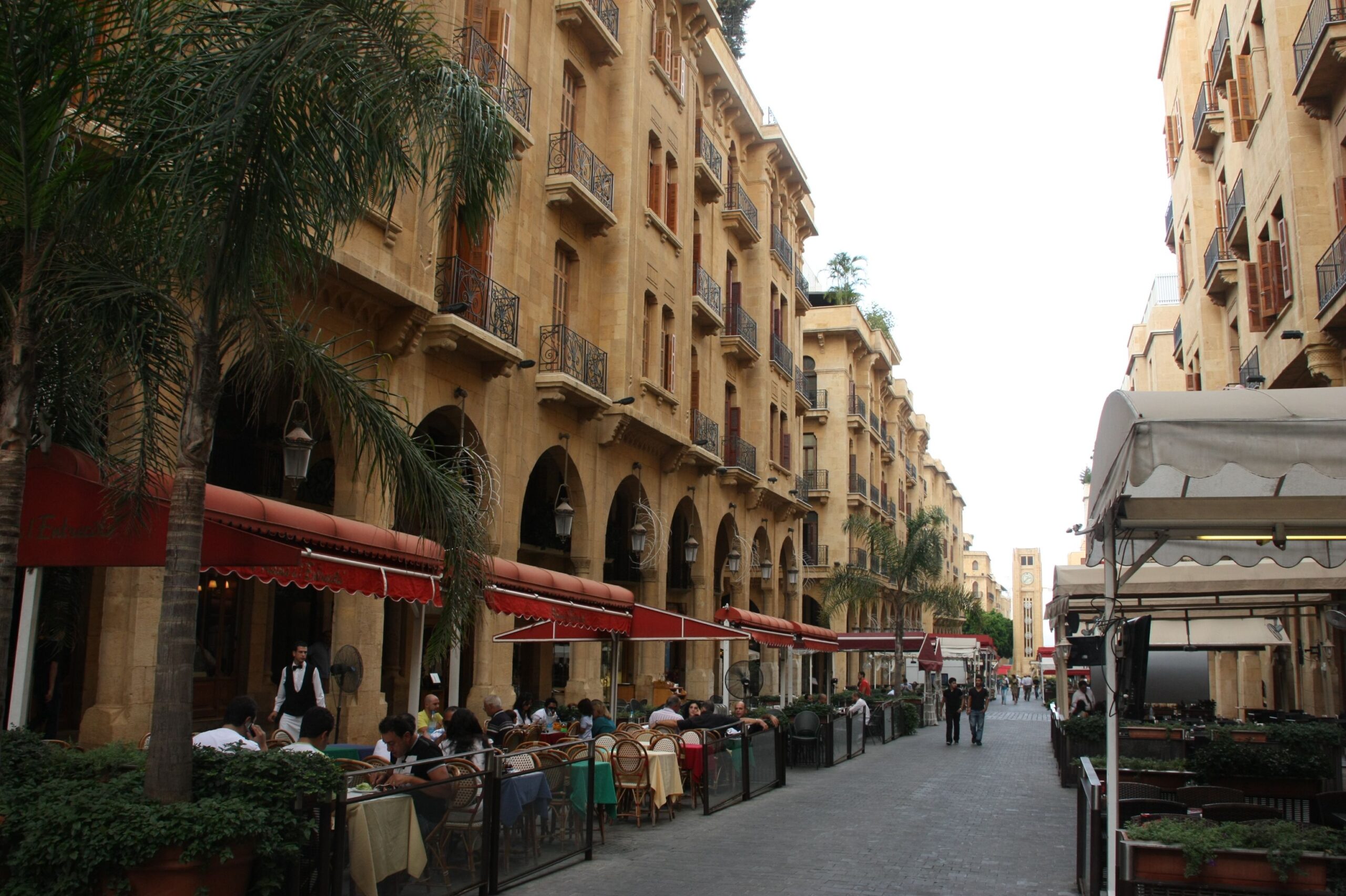
A conversation in Beirut can begin with “Hi,” continue in Lebanese Arabic, include “ça va?” or “merci,” and end with a complete sentence in English. The speakers may not even notice that they have changed languages several times. This is not necessarily an attempt to appear sophisticated. For many Lebanese people, switching languages is simply how they learned to communicate.
Understanding why Lebanese speak French therefore requires more than remembering that France once controlled Lebanon. The real story involves missionary schools, religion, education, social mobility, family habits, media and a multilingual culture that continued long after the French Mandate ended.
Do Lebanese People Speak French?
Many Lebanese people speak or understand French, but the level varies enormously. Some use it as comfortably as Arabic. Others studied it at school but rarely speak it as adults. Some can read French and understand conversations without feeling confident enough to answer. Younger people educated in English-medium institutions may know very little French.
The Organisation internationale de la Francophonie has estimated that approximately 2.54 million people in Lebanon, or around 38% of the population in its 2022 data, are francophone. That figure does not mean that 38% of Lebanese people use only French or speak it as their mother tongue. It includes different levels and types of French-language ability.
So, is French widely spoken in Lebanon? Yes, especially compared with most countries in the Middle East, but it is neither universal nor evenly distributed. French tends to be more visible in particular schools, universities, media outlets, professional circles and families.
The answer to does Lebanon speak French is therefore similar to the answer you might give about English in many multilingual countries: the language is highly important, but not everyone speaks it in the same way or for the same reasons.
Arabic remains the official national language under Article 11 of the Lebanese Constitution. The same article states that legislation determines the circumstances in which French may be used. According to the Lebanese Constitution (Parliament of Lebanon), French consequently has a recognised legal and institutional presence, but it is inaccurate to describe it as an equal official language used by every citizen.
Is Lebanon a French-Speaking Country?
Lebanon is often described as a francophone country, but that does not mean French is its official or dominant everyday language. Arabic is the official language, while French has a strong presence in education, universities, media and some professional and family environments. Lebanon is also a member of the Organisation internationale de la Francophonie, which reflects the country’s continuing cultural and institutional relationship with French.
In practice, describing Lebanon as multilingual is more accurate than simply calling it French-speaking. Lebanese Arabic dominates everyday communication, French remains important in many parts of education and professional life, and English has become increasingly influential among younger generations.
What Lebanese Multilingual Speech Can Sound Like
The easiest way to understand why do Lebanese people speak three languages is to stop imagining Arabic, French and English as three separate boxes.
For many Lebanese people, the languages overlap:
| Context | Common Language Mix |
|---|---|
| Home | Lebanese Arabic with French or English words |
| French-medium school | French and Arabic |
| English-medium school | English and Arabic |
| University | English or French, depending on the institution |
| Business and technology | Increasingly English |
| Traditional francophone media | French |
| Informal conversation | Arabic, French and English mixed together |
A person may speak Arabic with grandparents, French with former classmates, English at work and a mixture of all three with friends. Another family may use almost no French at all. There is no single Lebanese language pattern that applies to everyone.
This also explains why do Lebanese switch between Arabic and French so naturally. The languages may be connected to different parts of the same person’s life. A technical term learned at school may come to mind in French, while the emotion around it is expressed in Arabic. A workplace phrase may arrive in English. Code-switching is not always a conscious decision.
Lebanese Arabic itself has developed through centuries of contact between different communities and languages. Modern multilingual speech reflects education, migration, media, commerce and family history rather than one simple colonial influence. Research published by UNESCO on multilingual education and linguistic diversity supports the idea that Arabic, French and English continue to coexist in Lebanon, with each language serving different social, educational and professional roles rather than one completely replacing the others.
Why Do Lebanese Use French Words When Speaking Arabic?
People often ask why do Lebanese use French words when speaking Arabic, especially after hearing expressions such as:
- bonjour – hello
- merci – thank you
- ça va? – how are you?
- pardon – excuse me / sorry
- déjà – already
- rendez-vous – appointment or meeting
The simple explanation is habit. If a person heard these words at home, used them throughout school and continued hearing them in media and public life, they may feel as ordinary as their Arabic equivalents.
This is also why do Lebanese say merci instead of shukran. It does not necessarily mean that they prefer France, reject Arabic or want to display social status. Sometimes merci is simply the word that comes out first.
In other situations, language choice can carry social meaning. French has historically been associated with certain schools, professional circles and sections of the urban middle and upper classes. English now performs a similar role in technology, international business and youth culture. The meaning of using one language rather than another depends heavily on context.
That multilingual identity is also connected to Lebanon’s wider history and to the country’s complicated Mediterranean cultural background. Language, appearance, religion and identity are often discussed as though Lebanon must fit neatly into one category, while its history has repeatedly placed it between several cultural worlds.
Did Lebanese Speak French Before the French Mandate?
Yes, some Lebanese people learned and used French before the Mandate, but it would be misleading to suggest that French was already a mass language across the entire population.
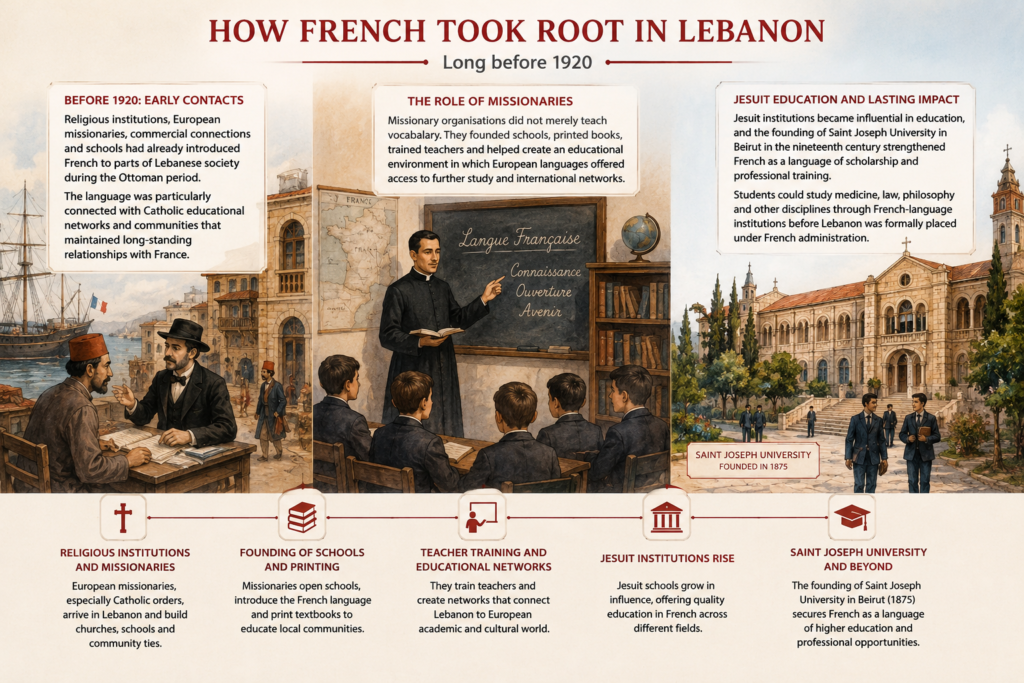
French influence did not suddenly begin in 1920. Religious institutions, European missionaries, commercial connections and schools had already introduced French to parts of Lebanese society during the Ottoman period. The language was particularly connected with Catholic educational networks and communities that maintained long-standing relationships with France.
This is where the role of missionaries in spreading French in Lebanon becomes important. Missionary organisations did not merely teach vocabulary. They founded schools, printed books, trained teachers and helped create an educational environment in which European languages offered access to further study and international networks.
The history of French Jesuit schools in Lebanon is especially relevant. Jesuit institutions became influential in education, and the founding of Saint Joseph University in Beirut in the nineteenth century strengthened French as a language of scholarship and professional training. Students could study medicine, law, philosophy and other disciplines through French-language institutions before Lebanon was formally placed under French administration.
This answers the question did Lebanese speak French before the French Mandate with an important qualification:
French was not spoken everywhere, nor did it replace Arabic. Access was shaped by geography, community, wealth and education. Nevertheless, the infrastructure already existed. When France received control over Lebanon after the First World War, it did not introduce the language into an empty space. It took an existing influence and gave it much greater political and institutional power.
What the French Mandate Actually Changed
The French Mandate over Lebanon began after the collapse of the Ottoman Empire following the First World War. Greater Lebanon was proclaimed in 1920, and the mandate system continued until Lebanese independence was recognised during the 1940s.
People searching how long was Lebanon under French rule often receive slightly different answers because the political transition took place in stages. France exercised mandate authority from the early 1920s, Lebanon declared independence in 1943, and the last French troops left in 1946.
The Mandate changed the position of French by making it central to administration, education and elite professional life. Schools that taught in French gained institutional support, and the language became increasingly valuable for anyone seeking access to government, universities and international employment.
So, did the French Mandate make Lebanon francophone? It helped make French far more widespread and prestigious, but it was not acting alone. It strengthened institutions that had already been developing through schools and religious networks.
That distinction matters because the weak version of this story usually reads:
The more accurate version is:
This is also part of why France has strong cultural influence in Lebanon today. The connection is visible not just in language but in universities, publishing, architecture, diplomacy and migration. French-language media also remained part of Lebanese public life long after colonial administration ended. L’Orient-Le Jour, for example, grew into one of the region’s best-known francophone newspapers and continues publishing today.
French Survived Because It Never Left the Classroom
The French Mandate ended, but French-language education did not.
This is probably the most important answer to why is French spoken in Lebanon today. Languages usually decline when younger generations stop needing them. In Lebanon, generations of children continued using French at school, not only as a foreign-language subject but as the language through which they learned mathematics, biology, chemistry and physics.
UNESCO reports that 74% of Lebanon’s public schools use French as the medium of instruction for core subjects such as mathematics and science from Grade 4 onward. That means students cannot treat French as an optional cultural extra. Their ability to understand important academic subjects may depend on it.
This explains why are science and maths taught in French in Lebanon. The practice comes from a bilingual education system that developed historically and was maintained through national curricula, teacher training and francophone institutions.
It also answers several related questions at once:
- Do Lebanese students study in French? Many do, although others attend English-medium schools.
- Is French required in Lebanese schools? Foreign-language education is deeply embedded in the system, but the language of instruction differs between schools.
- Why is French important for education in Lebanon? It is used to teach entire academic subjects rather than only basic vocabulary.
- How many schools in Lebanon teach in French? The exact number changes, but French remains the main foreign instructional language in a large majority of public schools according to UNESCO’s cited data.
- Why did French schools become popular in Lebanon? They offered established educational networks, access to universities and professional opportunities both inside Lebanon and abroad.
The result is that French remained practical. A student could graduate from school knowing the French terms for equations, organs, laboratory equipment and scientific processes even if the family spoke Lebanese Arabic at home.
That distinction is critical. French survived in Lebanon not simply because people felt nostalgic about France, but because the language remained tied to qualifications, education and employment.
French Language Universities in Lebanon Kept the System Alive
Schools explain how children first acquire French, but universities explain why many continue using it as adults. Lebanon has several institutions where French remains part of academic and professional life, most notably Saint Joseph University of Beirut, which grew out of the nineteenth-century Jesuit educational network.
The French schools in Beirut history and the later development of French language universities in Lebanon created a continuous path. A child could enter a francophone school, study science in French, continue to a French-medium university and eventually work in medicine, law, education, publishing or business without ever treating French as an unused school subject.
That continuity is one reason why is French common in Lebanon even after independence. The language did not survive only in old books or ceremonial speeches. It remained connected to degrees, professions and social networks.
The same educational environment also shaped Beirut’s wider cultural life. Lebanon’s multilingual identity appears in music, journalism and debates about religion, class and personal freedom, including the way Beirut’s alternative scene influenced modern Arab youth culture. French is only one part of that story, but it became one of the languages through which Lebanese writers, artists and students communicated with audiences outside the Arab world.
Do Lebanese People Speak French at Home?
Some do, but many do not.
Whether Lebanese people speak French at home depends largely on family history and education. In some households, parents deliberately speak French with their children because they attended francophone schools themselves. In others, family conversations happen almost entirely in Lebanese Arabic, while French appears only when discussing schoolwork. Some families mix Arabic with French and English so frequently that choosing a single “home language” becomes difficult.
A child might hear:
That sentence moves between Lebanese Arabic, English and French without requiring any translation for someone raised in that environment.
This does not mean every multilingual household divides languages in the same way. One parent may prefer French, another Arabic, while siblings answer in English because that is the language they use online. Lebanese multilingualism is often inconsistent, personal and shaped by whatever language feels easiest in that particular moment.
This kind of family bilingualism is not unique to Lebanon. In Ukraine, for example, historical language patterns created families where Russian remained the language spoken at home even when people identified completely as Ukrainian. It is one reason a Ukrainian can grow up speaking Russian as a native language while also understanding and speaking Ukrainian fluently.
Which Lebanese Communities Speak French?
Questions such as do Lebanese Christians speak more French, do Lebanese Muslims speak French, and which Lebanese communities speak French often appear online, but simple religious divisions produce misleading answers.
French has historically been more deeply embedded in some Christian communities, particularly families connected to Catholic and francophone schools. France maintained especially close relations with Maronite institutions, and many missionary schools were built within Christian educational networks.
However, it would be wrong to conclude that French belongs only to Christians. Many Muslim students attend francophone schools and universities, work in French-speaking professions or grow up in families where French is familiar. In modern Lebanon, school, location, family background and generation are often better predictors of language use than religion alone.
A more accurate explanation is:
The same person may also adjust language according to the social situation. Someone who speaks French with former classmates may use only Arabic with neighbours and English at work.
Is French Spoken More in Beirut Than Other Parts of Lebanon?
French is highly visible in Beirut because the capital concentrates universities, private schools, media companies, international organisations and professional services. It is therefore reasonable to ask is French spoken more in Beirut than other parts of Lebanon.
You are more likely to encounter French in certain Beirut cafés, schools, bookshops and professional environments than in many smaller towns. Nevertheless, even within Beirut the experience changes from one neighbourhood and social circle to another. One group may communicate mainly in French, while people at the next table mix Arabic and English.
Outside Beirut, French remains strong in places with established francophone schools and particular educational traditions. It should not be treated as an exclusively Beirut phenomenon, although the capital makes multilingualism more visible.
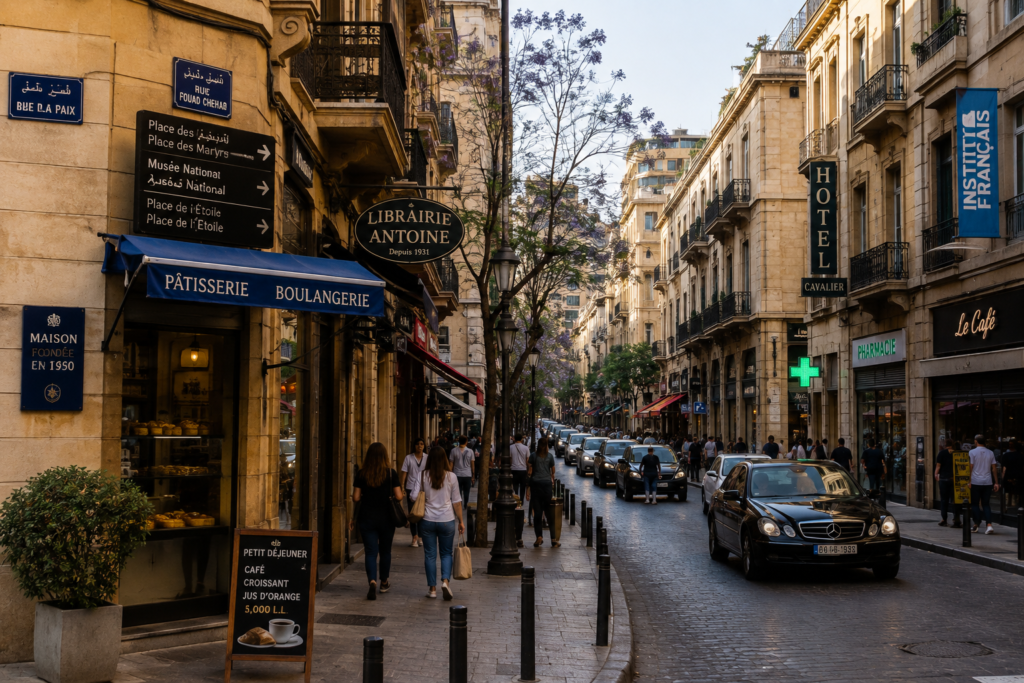
This is also why visitors sometimes ask why is Lebanon so French after spending only a few days in central Beirut. They notice French signs, menus, schools, bakeries, university names and conversations, then assume the entire country operates in French. Beirut magnifies the most visible parts of Lebanon’s francophone identity, but it does not represent every household or region.
Why Does Lebanon Speak French but Syria Does Not to the Same Extent?
Lebanon and Syria were both placed under French mandate authority after the First World War, yet French remained much more culturally visible in Lebanon.
The difference cannot be explained by the Mandate alone. Lebanon already had stronger francophone missionary and educational networks before French administration began. Its political structure, religious diversity, private-school system and long relationship with France helped the language remain institutionally useful after independence.
In Syria, Arabic became more dominant in state institutions and education after independence. Lebanon maintained a more decentralised educational system in which private French- and English-medium schools continued playing a major role.
This comparison helps answer why does Lebanon speak French more clearly. Colonial rule introduced or expanded European languages across many countries, but those languages survived only where local institutions continued reproducing them.
Why Lebanon’s French Is Different From Morocco’s
Lebanon and Morocco are often grouped together because both use Arabic and French, but the histories are not identical.
In Morocco, French became deeply connected to the colonial administration, business and higher education during the French Protectorate. In Lebanon, francophone religious and educational networks had already developed before the Mandate and became closely tied to particular schools, universities and communities.
The result can look similar from the outside—Arabic conversation mixed with French vocabulary—but the historical routes were different. Anyone interested in the comparison can see how French became embedded in Moroccan public and professional life.
French also occupies a different position in each country today. In Morocco, it remains extremely important in business, administration and higher education. In Lebanon, it competes more visibly with English within an already highly multilingual system.
Is English Replacing French in Lebanon?
Partially, but not completely.
English has become increasingly influential in:
- technology;
- international business;
- private universities;
- social media;
- entertainment;
- communication with the Lebanese diaspora.
Some younger Lebanese people now speak English more confidently than French, particularly if they attended an English-medium school or consume mainly English-language media. For them, French may belong more to their parents’ generation or to a specific educational circle.
This does not mean French is disappearing. Francophone schools continue operating, universities still teach in French, established newspapers publish in French and many families maintain the language at home. The change is better described as a move from an Arabic–French model toward an Arabic–French–English model.
That is the clearest answer to why is code-switching common in Lebanon. People are not simply replacing one language with another. Different languages are accumulating and being assigned different functions.
A younger professional might:
- speak Lebanese Arabic with family;
- write work emails in English;
- remember scientific vocabulary in French;
- follow Arabic news;
- mix all three languages with friends.
Why Do People in Lebanon Speak French Today?
At this point, the answer to why do people in Lebanon speak French can be reduced to five practical reasons:
- French entered Lebanese education before the Mandate through religious and missionary institutions.
- The French Mandate expanded its role in administration and public life.
- Schools continued using French after independence.
- Universities and professional networks made it economically useful.
- Families, media and cultural institutions passed it from one generation to the next.
This is also the real answer to why is French spoken in Lebanon more than seventy years after the last French troops left. Political control ended, but the institutions teaching and rewarding the language remained.
FAQ
Do all Lebanese people speak French?
No. Many Lebanese people speak or understand some French, but proficiency varies by school, family, location and generation. Lebanese Arabic remains the main everyday language for most people.
Is French an official language in Lebanon?
Arabic is Lebanon’s official national language. French has a recognised institutional position and may be used in circumstances determined by law, but it is not an equal official language spoken by everyone.
What percentage of Lebanese people speak French?
The Organisation internationale de la Francophonie reported approximately 2.54 million francophones in Lebanon, representing around 38% of the population in its 2022 figures. This includes different levels of fluency.
Was Lebanon a French colony?
It is more precise to say that Lebanon was governed under the French Mandate after the First World War. It was not a classic settler colony in the same form as Algeria.
When did French become popular in Lebanon?
French educational influence developed during the Ottoman period through missionary and Catholic institutions. Its institutional role expanded significantly during the French Mandate beginning in the early twentieth century.
Why did French schools become popular in Lebanon?
They offered established teaching systems, access to universities and opportunities in medicine, law, business and international employment. French therefore became a practical educational asset rather than merely a cultural preference.
Is French required in Lebanese schools?
Lebanese students study a foreign language, but the main instructional language differs by school. Many schools use French for mathematics and science, while others use English.
Do Lebanese people speak French at home?
Some families do. Others speak Lebanese Arabic or mix Arabic with French and English. Home language depends on family tradition and education.
Is Beirut a French-speaking city?
French is frequently heard in Beirut, but the city is not exclusively francophone. Lebanese Arabic remains dominant, while English is also increasingly common.
Why do Lebanese say “merci” instead of “shukran”?
Usually because merci has become an ordinary part of their daily vocabulary. It may be learned at home or school and does not necessarily carry a political or social message.
Why do Lebanese switch between Arabic and French?
They often learned different topics, emotions and professional terms in different languages. Switching allows them to use whichever expression comes most naturally.
Is English replacing French in Lebanon?
English is gaining ground in technology, business, universities and youth culture, but French remains deeply established in schools, families, media and traditional professional circles.
Explore the Culture & Society Hub
Discover more stories about language, identity, traditions, social habits and the cultural details that shape everyday life around the world.
Explore the Culture & Society Hub →This article combines independent historical research, linguistic sources, and discussions from people living in and travelling through Lebanon to explain why French continues to play an important role in Lebanese society.
Research sources included:
- Official publications from the Organisation internationale de la Francophonie (OIF) on the global French-speaking community.
- The Constitution of Lebanon and official information published by the Lebanese Parliament.
- UNESCO research and publications on multilingual education, linguistic diversity, and cultural heritage.
- Community discussions and first-hand perspectives shared on Reddit by Lebanese residents, expats, and travellers.
The goal is to explain the historical, educational, and cultural reasons behind Lebanon’s multilingual identity while separating common misconceptions from the country’s more complex linguistic reality.

Founder & Editor
Founder of The City Theory, writing about digital nomad lifestyle, modern city culture, remote work, travel experiences, psychology and human behaviour around the world.