Why Do Ukrainians Speak Russian? I’m Ukrainian — Here Is the Explanation
Many Ukrainians speak Russian because several generations grew up in an environment where Russian had a strong position in cities, education, government, media and professional life during the Russian Empire and the Soviet period. For many families, Russian eventually became the language spoken at home even though they remained Ukrainian by nationality and identity. That is the first thing I would explain to anyone asking why do Ukrainians speak Russian: hearing a Ukrainian speak Russian does not automatically tell you where that person’s loyalties are, what nationality their parents are or how they feel about Russia.
I know this from my own life because I am one of those Russian-speaking Ukrainians. I grew up in southern Ukraine in a predominantly Russian-speaking city, in a mixed family that includes both Ukrainians and Russians. Russian was the language we naturally used at home, and it is still the language I use with my family and old friends today. At the same time, I have understood and spoken Ukrainian for as long as I can remember. I honestly cannot tell you when I “learned” it, because there was never a moment when Ukrainian felt like a foreign language I had to sit down and study. I heard it at school, on television and radio, in music and films, at university and in government institutions from childhood. To me, it is a second native language rather than a foreign one.
The Short Answer: History, Not Nationality
One of the biggest misunderstandings I hear from foreigners is the assumption that a Russian-speaking Ukrainian must somehow be Russian. That simply does not reflect how language works in Ukraine.
A person can be Ukrainian, identify completely with Ukraine, speak Ukrainian perfectly well and still use Russian with their parents because that is the language the family has spoken around the kitchen table for several generations. Language habits are incredibly persistent. If your mother spoke Russian to you when you were five, your childhood friends spoke Russian when you were fifteen and your university friends spoke Russian when you were twenty, it does not feel natural to suddenly change that relationship into another language just because you are capable of doing so.
This is also why does speaking Russian make someone Russian has a very simple answer: no. In the same way, speaking French does not automatically make someone French. Historical circumstances can leave languages deeply embedded in countries long after the political circumstances that introduced or strengthened them have changed. I have written about something comparable in North Africa, where French remains part of everyday life for many Moroccans because of history, even though Moroccans obviously do not become French simply by using it.
The same principle helps explain are Russian speaking Ukrainians Russian, but Ukraine’s linguistic history is its own complicated story.
Why Did Ukrainians Start Speaking Russian?
When people ask why did Ukrainians start speaking Russian or how did Ukraine become Russian speaking, the wording can make it sound as if an entire country simply decided to change languages. That is not what happened. Ukraine was never uniformly Russian-speaking, and it still is not. Russian became more dominant in some places and social environments than in others over a long historical period.
Under the Russian Empire, Russian was the language of administration and carried enormous social and professional advantages. Ukrainian continued to be spoken extensively, especially outside the largest urban centres, but its public development faced restrictions. So was Ukrainian banned in the Russian Empire? There were periods of serious restrictions rather than one simple uninterrupted ban. Measures such as the Valuev Circular of 1863 and the Ems Ukaz of 1876 restricted Ukrainian-language publishing and public use. That history is one part of the answer to why was Ukrainian language suppressed, but it should not be reduced to a single decree or a single date.
The practical result over generations mattered enormously. If Russian was useful for education, government jobs, administration and social mobility, families moving into cities had a strong incentive to use it. Kyiv Post’s historical overview of Ukraine’s language landscape describes this old prestige hierarchy: Russian became associated with educated urban and professional life, while Ukrainian was often pushed toward a lower-status, more rural image.
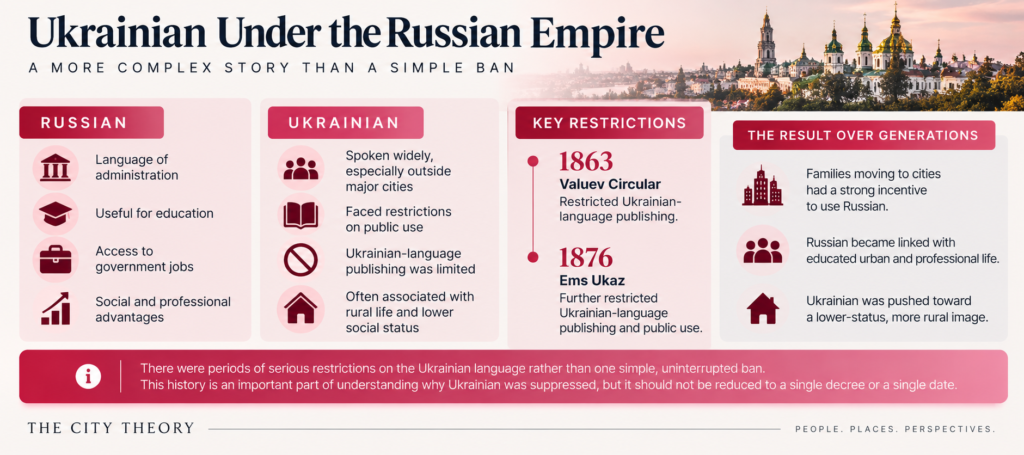
That is why the question why was Russian more common in Ukrainian cities is particularly important. Language change did not happen evenly across a map. Cities concentrated universities, government offices, industry and career opportunities. Those were exactly the environments where Russian was especially useful. Ukrainian survived much more strongly in many villages and smaller communities, where people had less reason to abandon the language they already used at home.
Why Was Russian Spoken in Soviet Ukraine?
The Soviet period made this linguistic pattern even more complicated. Russian functioned as the common language across a huge multinational state. If a Ukrainian, Georgian, Armenian and Latvian ended up studying or working together, Russian was usually the language through which they could communicate.
So why did the Soviet Union promote Russian in Ukraine? Part of the reason was practical administration across the USSR, but Russian also occupied a privileged political and social position. Higher education, professional advancement, the military, large industrial enterprises and much of mass media strongly exposed people to Russian. Research into Ukrainian-Russian language contact notes that Russian politically and socially dominated Ukrainian and other languages through much of both the Russian imperial and Soviet periods.
That helps answer why was Russian spoken in Soviet Ukraine, but there is an important nuance: Ukrainian did not simply disappear. Families continued speaking Ukrainian, schools and Ukrainian cultural life existed in varying forms, and Soviet language policy changed over time. The result was not a country where everyone suddenly spoke one language. It was a country where millions of people became comfortable operating in two.
That bilingual reality is something outsiders sometimes find surprisingly difficult to imagine.
What Being Bilingual in Ukraine Actually Feels Like
My own experience is probably easier to understand through an ordinary conversation than through statistics. If somebody approaches me and starts speaking Ukrainian, I can answer in Ukrainian without translating every sentence in my head. I understand what they are saying immediately. If the next person speaks Russian, I switch back to Russian. Neither situation feels unusual.
There is another completely normal scenario in Ukraine that surprises foreigners even more: one person can speak Ukrainian while the other answers in Russian.
They do not necessarily have to agree on which language to use first. They can simply continue the conversation. I have seen and experienced this countless times. One person asks something in Ukrainian, another replies in Russian, and nobody needs an interpreter because both understand both languages.
This is why can Ukrainians understand Russian is usually a much easier question than foreigners expect. For a huge number of Ukrainians, the answer is yes, although language knowledge naturally varies by age, region and personal background.
The reverse situation is different. Can Russians understand Ukrainian? Russians who were born and raised in Russia and had little exposure to Ukrainian often cannot understand it nearly as well as Ukrainians understand Russian. Duolingo’s comparison of Ukrainian and Russian makes the same broader point: the asymmetry is largely the result of historical exposure rather than proof that Ukrainian and Russian are simply the same language.
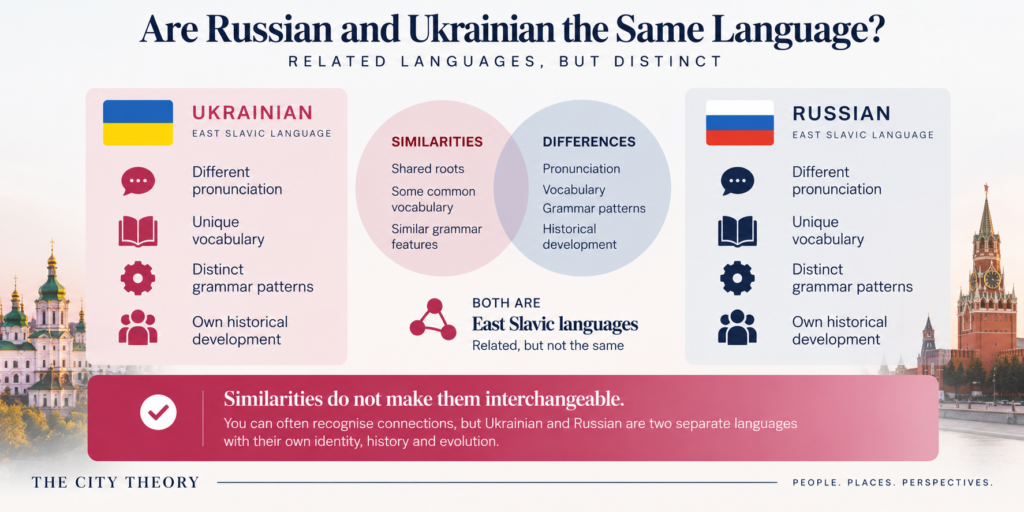
And no, are Russian and Ukrainian the same language? They are not. They are related East Slavic languages, which means there are similarities in vocabulary and grammar, but they have their own pronunciation, vocabulary, grammar patterns and historical development. Asking how similar are Ukrainian and Russian is a bit like asking how similar two related European languages are: there is enough overlap to recognise connections, but that does not make them interchangeable.
For foreigners trying to understand Ukraine through language, this distinction matters. It is also why I am building a broader collection of stories about Ukrainian culture, everyday life and identity rather than treating the country as if language alone could explain it.
Why Eastern and Southern Ukraine Became More Russian-Speaking
Because I come from southern Ukraine myself, this is the part of the subject where overly simple explanations bother me most. The question why is eastern Ukraine Russian speaking often assumes that there is a neat linguistic line across the country: Ukrainian in the west, Russian in the east.
There isn’t.
Russian historically became more prevalent in many eastern and southern urban centres, but Ukraine never divided neatly into two linguistic halves. Industrialisation, migration within the Soviet Union, large factories, ports, universities and urbanisation all contributed to Russian becoming particularly common in some cities. At the same time, Ukrainian-speaking communities continued to exist throughout the east and south, while Russian speakers could also be found in central and western Ukraine.
Academic research on the Black Sea coast makes the same important distinction: using Russian as a main language does not mean a person is ethnically Russian, and Springer’s research on the linguistic situation on Ukraine’s Black Sea coast shows that the linguistic reality includes Ukrainian, Russian and mixed forms of speech such as Suržyk.
This is also where comparisons with other multilingual societies become useful. Language can remain embedded in a country for generations because of education, prestige, migration and political history; Lebanon’s continued relationship with French is another example of why the language someone uses every day cannot be treated as a simple nationality label.
And that historical background brings us to the much more interesting question in 2026: if millions of Ukrainians grew up with Russian, what has actually happened to the language since 2022?
What Language Do Ukrainians Speak Today?
The linguistic picture in Ukraine has changed considerably since I was growing up. When people ask what language do Ukrainians speak at home, there is no single answer because Ukrainian families can be Ukrainian-speaking, Russian-speaking, bilingual or use a mixture of both. What has changed dramatically is the balance between those groups.
According to the Razumkov Centre’s September 2025 survey, 67.4% of respondents said they mainly spoke Ukrainian at home, 11.4% mainly Russian, and 19.7% used Ukrainian and Russian approximately equally. KIIS found a very similar pattern in 2025: 63% mainly Ukrainian, 13% Russian and 19% both. The particularly interesting change is that the Russian-only share in the KIIS data fell from 25% in 2020 to 13% in 2025.
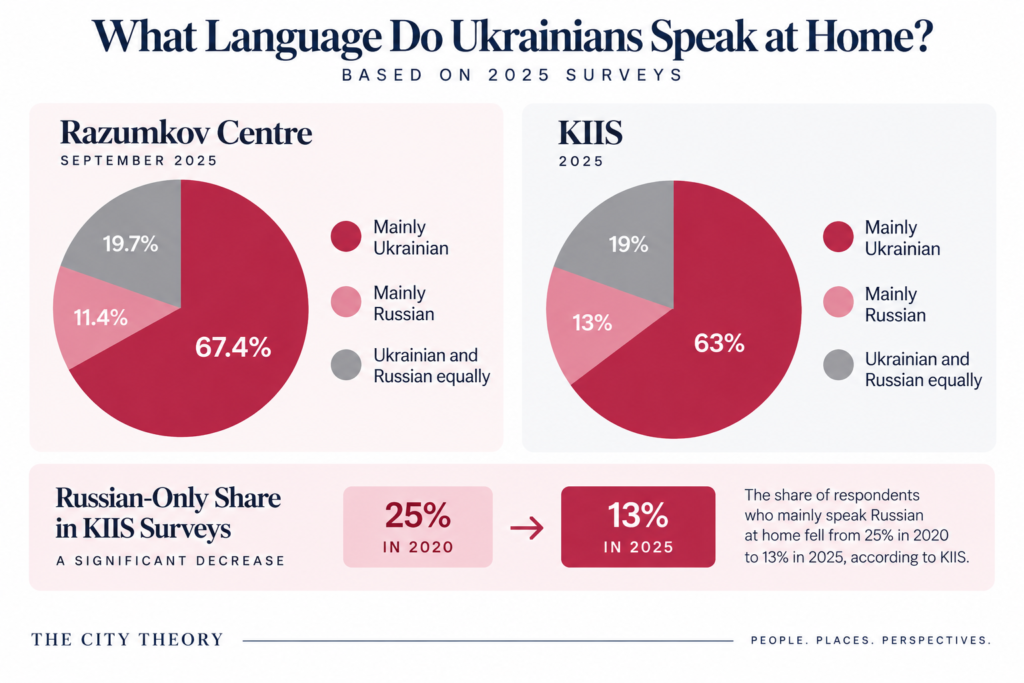
So what percentage of Ukrainians speak Russian? It depends on what exactly we mean by “speak.” Far more Ukrainians can understand and speak Russian than use it as their primary home language. Surveys measuring the language spoken at home therefore should not be interpreted as measuring everybody capable of speaking Russian. They also have methodological limitations, particularly because people living in occupied territories cannot always be represented in the same way as residents of government-controlled Ukraine.
Do Ukrainians Still Speak Russian in 2026?
Yes. If somebody asks do Ukrainians still speak Russian in 2026, the answer is absolutely yes, but Russian is less dominant than it was before the full-scale invasion. Many people who previously used Russian every day have consciously switched to Ukrainian, while others have become more bilingual, using Ukrainian publicly but continuing to speak Russian with particular relatives or old friends.
That is also the answer to are Ukrainians switching from Russian to Ukrainian: many are, but it is not happening in exactly the same way for everyone. Language is connected to memories and relationships. I can decide which language I use in a shop or with someone I have just met much more easily than I can suddenly change the language I have used with my family my entire life.
In my own case, I can switch to Ukrainian immediately when somebody speaks Ukrainian to me, yet Russian remains the language that feels most automatic with my family and long-term friends. There is no contradiction in that for me. Ukrainian is my country’s national language and one of my native languages; Russian is the language in which many of my oldest personal relationships were formed.
Why Do Some Ukrainians Still Speak Russian After 2022?
This is where explanations from outside Ukraine sometimes become too simplistic. Why do some Ukrainians still speak Russian after 2022 if Russia invaded Ukraine? Because a language learned from your mother is not the same thing as a government, an army or a political ideology.
For a native Russian-speaking Ukrainian, Russian can be the language of childhood jokes, grandparents, school friends and the first conversations they remember having. You cannot erase those associations overnight. That is also why can Ukrainians be native Russian speakers has an obvious answer: yes. Plenty of Ukrainians grew up with Russian as their first household language while simultaneously growing up Ukrainian.
People sometimes phrase the question more aggressively as why do Ukrainians speak Russian if they hate Russia. I think the question itself mixes two completely different things. A Ukrainian may strongly oppose the Russian state, condemn the invasion and support Ukraine while still speaking Russian because it is the language they have used since childhood. A language does not belong exclusively to a government.
This becomes especially obvious when people ask why do Ukrainian soldiers speak Russian. Some Ukrainian soldiers grew up in Russian-speaking families and regions. In stressful situations people naturally fall back on the language that comes most automatically. Al Jazeera has documented Russian-speaking Ukrainians, including people connected with the military, explaining why changing the language in which they instinctively think is not always immediate.
The same applies to why do Ukrainian refugees speak Russian. Hearing a Ukrainian refugee speaking Russian abroad tells you almost nothing about that person’s politics. They may come from Odesa, Kharkiv, Zaporizhzhia or another historically bilingual environment, or simply from a Russian-speaking family.
Does Speaking Russian Mean Someone Supports Russia?
No, and current data makes that especially clear. The question are Russian speaking Ukrainians pro Russian assumes that language and political identity move together, but modern Ukraine is a strong example of why that assumption fails.
Razumkov Centre data published in 2025 found that among respondents who mainly spoke Russian at home, 82% expressed a negative attitude toward Russia and 81.5% said they trusted the Armed Forces of Ukraine. In other words, Russian can be somebody’s everyday language while their national and political identity remains firmly Ukrainian.
For me this distinction has always seemed obvious because I grew up around people whose families, surnames and languages did not fit into one neat ethnic box. Ukraine itself is like that. Language can tell you something about a person’s family background or the city where they grew up, but it cannot reliably tell you whom they support politically.
Is Russian Still Common in Kyiv?
Is Russian still common in Kyiv? Yes, you will still hear it, although Ukrainian has become much more visible and dominant in public life than it was years ago. Kyiv has always attracted people from every part of the country, so its language environment is more complicated than the stereotype of one city speaking one language.
Young people are changing particularly quickly, which is why do young Ukrainians speak Russian does not have the same answer it might have had twenty years ago. Some still do, especially in families where Russian remains the home language, but Ukrainian has become much more prominent among younger Ukrainians in education, social media, cultural life and everyday public communication.
This is one reason the Ukrainian vs Russian language in Ukraine debate cannot be understood from old maps showing one colour in the east and another in the west. Ukraine’s linguistic reality is changing in real time.
Is Russian Banned in Ukraine?
No. Is Russian banned in Ukraine is one of the misconceptions I encounter most often. Ukrainian is the state language, which means it has a legally protected role in government, education and public services, but people are not prohibited from having private conversations in Russian.
I can speak Russian with my family, my friends or another Russian-speaking Ukrainian. Nobody is standing next to us telling us which language we must use.
There are regulations governing the use of Ukrainian in public institutions, media, education and customer service, and these have expanded significantly in recent years. That is different from banning people from speaking Russian. The distinction matters because claims that “Russian is forbidden in Ukraine” create a completely misleading picture of everyday life.
What Is Surzhyk?
Another part of Ukrainian language life that foreigners often miss is what is Surzhyk. Surzhyk is a mixed form of speech containing elements of Ukrainian and Russian. It developed through prolonged contact between the two languages and exists in different forms depending on the region and speaker.
So do Ukrainians speak Surzhyk? Yes, some do, and sometimes people move between more standard Ukrainian, Russian and Surzhyk without thinking much about it. Linguists study it as a real outcome of long-term language contact rather than simply “bad Ukrainian” or “bad Russian.”
This is another reason trying to place every Ukrainian into a Ukrainian-speaking or Russian-speaking box does not work particularly well. Real conversations are often much more fluid than that.
The Part Foreigners Often Miss
For me, the easiest way to understand Ukraine’s language situation is to stop treating Ukrainian and Russian as two teams. I am Ukrainian, I grew up speaking Russian at home, and Ukrainian has been part of my life for as long as I can remember. If someone addresses me in Ukrainian, I can continue in Ukrainian. If I am speaking with my family, I naturally return to Russian. Sometimes in Ukraine one person speaks Ukrainian and the other Russian, and the conversation simply continues because both understand each other perfectly.
That everyday reality is probably the most useful answer to why do Ukrainians speak Russian. History explains why Russian became widespread, but family habits explain why it survived from one generation to another. The dramatic move toward Ukrainian since 2022 shows how language use can change, yet it does not erase the lives of millions of bilingual Ukrainians whose identities were never determined by the language they happened to speak at home.
FAQ
Why do Ukrainians speak Russian instead of Ukrainian?
Many Russian-speaking Ukrainians inherited Russian as their household language because Russian held a dominant position in many cities, institutions and professional environments during the Russian Empire and Soviet period. It became a family language across generations, even among people who remained Ukrainian in identity.
Do Ukrainians still speak Russian?
Yes. Russian is still spoken in Ukraine, although surveys show that Ukrainian has become much more dominant and the share of people using only Russian at home has fallen substantially since 2022.
What percentage of Ukrainians speak Russian?
Recent surveys suggest roughly 11–13% primarily use Russian at home, while around another fifth use both Ukrainian and Russian. The number of people capable of speaking or understanding Russian is considerably higher.
Do Ukrainians understand Russian?
Most Ukrainians who grew up with exposure to Russian understand it very well. Many are bilingual and can switch languages easily, although this varies by age, region and individual background.
Can Russians understand Ukrainian?
Some can, especially with previous exposure, but Russians raised only in Russia often understand Ukrainian much less easily than Ukrainians understand Russian. Ukrainians historically had far greater exposure to Russian than Russians had to Ukrainian.
Are Ukrainian and Russian the same language?
No. They are related East Slavic languages but have distinct vocabulary, pronunciation, grammar and historical development.
Why is Russian common in eastern Ukraine?
Russian became especially common in many eastern and southern industrial cities because of urbanisation, Soviet migration, education, industry and the historically privileged position of Russian in professional life. The region has never been linguistically uniform, however.
Do people in Kyiv speak Russian?
Yes, Russian is still heard in Kyiv, but Ukrainian has become considerably more dominant in public life, particularly since 2022.
Why do Ukrainian refugees speak Russian?
Many refugees come from Russian-speaking or bilingual families and cities. Speaking Russian does not indicate Russian nationality or support for Russia.
Is Russian banned in Ukraine?
No. Ukrainian is the state language and is required in many official and public contexts, but private use of Russian is not prohibited.
Does Speaking Russian Mean a Ukrainian Supports Russia?
No. Language is not a reliable indicator of political loyalty. Many Russian-speaking Ukrainians strongly identify with Ukraine and oppose Russia’s invasion.
Explore the Culture & Society Hub
Discover more stories about language, identity, traditions, social habits and the cultural details that shape everyday life around the world.
Explore the Culture & Society Hub →This article combines historical and linguistic research with my own memories of living in Ukraine to explain why so many Ukrainians understand or speak Russian, how language use developed across different regions and generations, and why speaking Russian does not make someone ethnically Russian.
Research sources included:
- My own experiences and memories of living in Ukraine, including everyday observations of how Ukrainian and Russian were used in different social settings.
- Academic linguistic and sociolinguistic research published by Springer on Ukrainian-Russian language contact, language use, and the historical position of Russian and Ukrainian.
- Language research and educational explanations published by Duolingo on the relationship between Ukrainian and Russian and differences in mutual understanding.
- Historical reporting from the Kyiv Post on Ukraine’s linguistic landscape and the historical social prestige associated with Russian in urban and professional life.
- Historical reference material from the Encyclopedia of Ukraine, including information about restrictions on Ukrainian-language publishing and public use under the Russian Empire.
The goal is to explain Ukraine’s linguistic reality in its historical and social context while separating language, ethnicity and national identity — concepts that are often incorrectly treated as if they mean the same thing.

Founder & Editor
Founder of The City Theory, writing about digital nomad lifestyle, modern city culture, remote work, travel experiences, psychology and human behaviour around the world.