How to Date as a Digital Nomad: Finding Love Without Giving Up Your Lifestyle
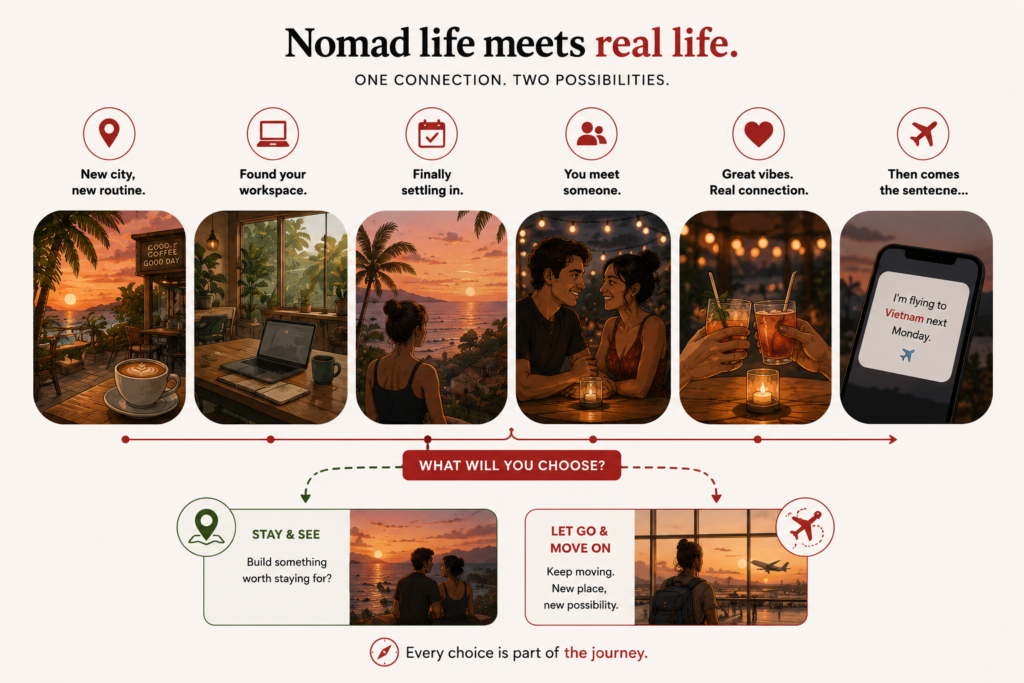
You’ve been in Bali for three weeks.
The café owner already knows your coffee order. You’ve found a coworking space you genuinely enjoy. You finally feel like you’ve settled into a routine instead of living out of your suitcase. Then you meet someone. Maybe it’s after a language exchange, maybe during trivia night, maybe through mutual friends you made surprisingly quickly. The conversation is effortless, the chemistry is obvious, and for the first time in months you’re genuinely excited to see where something might go.
Then one of you casually says, “I’m flying to Vietnam next Monday.”
Suddenly the excitement is replaced by a question that almost every long-term traveler eventually asks: is it actually possible to build a real relationship when your entire lifestyle is designed around leaving?
This is something most digital nomad blogs barely touch. They happily explain how easy it is to meet people abroad, recommend downloading Tinder, suggest joining coworking spaces, and tell you to attend local events. None of that advice is wrong. The problem is that it answers the easiest part of the question.
Finding dates has never been the difficult part.
Keeping someone in your life after you’ve found them is where almost everything becomes complicated.
If you’re wondering how to date as a digital nomad, you’re probably not struggling to get matches on dating apps. You’re trying to figure out whether it’s even realistic to build something meaningful when your next visa expires in six weeks, your apartment lease lasts one month, and everyone around you seems to be arriving and leaving at different times. It’s also worth understanding why short but intense connections formed on the road can be surprisingly difficult to leave behind, especially when distance becomes part of the relationship almost immediately.
After spending years around remote workers, freelancers, entrepreneurs, backpackers and expats, I’ve noticed something that almost nobody says out loud. Casual dating fits the digital nomad lifestyle surprisingly well. Serious relationships don’t. Not because they’re impossible, but because they demand exactly the opposite qualities that long-term travel encourages: stability, consistency, shared routines and the foundations of healthy long-term relationships.
The good news is that plenty of digital nomads do find lasting relationships. The interesting part is that almost none of them do it the way Instagram makes it look.
Why Dating Is Easier Than Most People Think
One misconception about digital nomad life is that it’s lonely from the very beginning. That isn’t usually true. During the first months, meeting people can actually feel easier than it did back home. Travelers tend to be curious, social and unusually willing to start conversations with strangers. Unlike people who have lived in the same city for twenty years and already have established friendship groups, newcomers are actively looking for connections. That openness creates opportunities that are surprisingly rare in everyday life, especially if you’ve previously experienced what it’s like when most people in your social circle are already in relationships and spontaneous social plans become much less common.
Coworking spaces contribute to this in ways that people often underestimate. They aren’t just places to work. They become small communities where you repeatedly see the same faces over coffee, lunch and networking events. Familiarity develops naturally. Someone asks whether you’d like to join a group for dinner. A few days later you’re playing board games together. Before long you’ve met dozens of people without ever deliberately trying to date. If you’ve already learned how to make friends in a new city as an adult, you’ll recognise that relationships often grow out of the same environments where friendships begin.
Dating apps work surprisingly well for travelers too. Most people using them in popular nomad destinations understand that international dating is part of the local culture. Nobody finds it unusual that someone from Germany is meeting someone from Brazil while both happen to be living temporarily in Portugal. Geographic differences become normal rather than exceptional.
This explains why digital nomad relationships often begin much faster than relationships back home. There is less hesitation. People suggest coffee after exchanging only a few messages. They spend entire afternoons exploring cities together. They ask personal questions earlier because they know time may be limited. Ironically, travelers sometimes become emotionally open more quickly than people with permanent homes because both recognise that tomorrow isn’t guaranteed. Meeting someone organically can sometimes be easier in a social venue than through another dating app. During my time in Thailand, I found several Bangkok bars that felt comfortable for foreigners going out alone.
The challenge, however, begins after those first exciting weeks. Attraction develops quickly. Compatibility takes much longer to reveal itself. Someone might seem like the perfect partner until you realise they’re planning to spend the next six months moving through South America while you’ve already booked an apartment in Thailand. Suddenly the relationship isn’t facing ordinary dating problems. It’s facing geography.
That is why people often believe they are struggling with dating when the real obstacle is logistics. Meeting people has rarely been easier. Building a shared future has rarely required so many practical compromises.
Why Dating Is Hard as a Digital Nomad
The question isn’t whether you can meet someone abroad. You almost certainly can. The real question is whether two independent lifestyles can continue moving in the same direction for long enough to become something serious.
This is the reason why dating is hard as a digital nomad even though opportunities seem endless. Every relationship quietly depends on routines that most travelers don’t have. Couples gradually develop favourite cafés, weekend habits, mutual friends and small everyday traditions that make the relationship feel stable. Constant travel interrupts those routines before they have time to become meaningful, which is why short-term dating on the road can sometimes fit a nomadic lifestyle more naturally than trying to build a conventional relationship in every new city.
Visa deadlines create another layer of pressure that people rarely discuss honestly. Imagine you’ve been dating someone in Lisbon for two months. Things are going well. Normally that would be the point where you simply keep seeing each other and let the relationship develop naturally. Instead, one of you has thirty days left before needing to leave the country. Suddenly decisions that most couples postpone for a year arrive after only eight weeks. Do you travel together? Does somebody stay longer? Does somebody abandon their original plans? Relationships begin carrying immigration questions before they’ve even had time to answer emotional ones.
Freedom also creates unexpected complications. Most digital nomads chose this lifestyle because they enjoy flexibility. They like deciding next month’s destination based on curiosity rather than obligation. That freedom is one of the biggest reasons they became location independent in the first place. It can also explain why casual dating appeals to some people who value connection but are not ready to reorganize their lifestyle around a serious partner. A serious relationship inevitably introduces another person’s priorities into those decisions. The conversation changes from “Where do I want to go next?” to “Where does it make sense for both of us to live?” For people who have spent years making decisions independently, that adjustment can feel surprisingly difficult.
This is also why dating is difficult as a digital nomad even when both people genuinely care about each other. The relationship is competing with an identity that often existed long before the partner appeared. Someone who has built their entire life around movement may unconsciously experience commitment as the loss of freedom, even if they deeply want the relationship to succeed.
Another factor rarely mentioned is decision fatigue. Long-term travelers make dozens of practical decisions every week. Which country next? Which apartment? Which insurance? Which visa? Which coworking space? Which SIM card? Which bank? Eventually another enormous decision—whether to reorganise your life around another person—can feel overwhelming simply because everything else already requires constant adaptation.
People often ask, does traveling make dating harder? After watching countless couples form and separate across different countries, I think the answer is yes—but probably not for the reasons most people expect. Travel doesn’t make attraction harder. It makes continuity harder. Relationships grow through repetition rather than excitement. They grow because two people repeatedly choose each other during ordinary Tuesdays, boring grocery shopping trips and quiet evenings at home. Constant movement reduces the number of those ordinary moments, replacing them with temporary adventures that feel exciting but don’t always build lasting foundations.
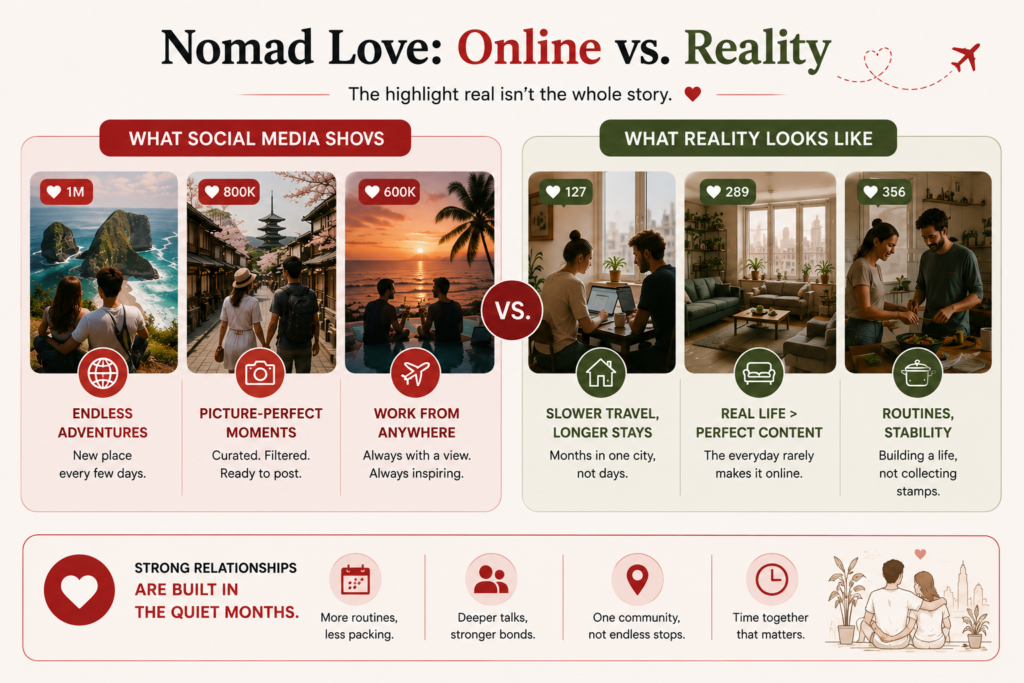
Social media has unintentionally made this even more confusing. Couples posting beautiful drone footage from Bali, Japan and Patagonia create the impression that successful nomad relationships involve endless travel together. The reality is often very different. Many couples who remain together eventually slow down. They spend several months in one city instead of several weeks. They rent apartments instead of hostels. They build local routines instead of constantly chasing the next destination. Those quieter months rarely appear in YouTube videos because they don’t generate millions of views, yet they are often the periods where the relationship actually becomes strong.
That may be the biggest misunderstanding surrounding digital nomad dating. The internet celebrates movement. Healthy relationships usually require enough stillness for two lives to genuinely overlap.
Why So Many Digital Nomads Stay Single
After a while, something interesting starts happening. The problem is no longer meeting people. The problem is finding the emotional energy to start over again.
I’ve heard versions of the same story from freelancers in Chiang Mai, software developers in Medellín, designers in Lisbon, and content creators in Mexico City. At first, every new destination feels full of possibilities. Meeting someone exciting is part of the adventure. You spend a few weeks together, promise to stay in touch, maybe even visit each other later. Sometimes you actually do. Most of the time, life quietly moves on. A few months later you’re repeating the entire process somewhere else with someone new.
That cycle is exciting in the beginning because everything feels temporary anyway. Eventually, however, it becomes emotionally expensive. Every goodbye requires a little more effort than the last one. Every promising connection ends with another airport farewell. Every conversation about the future eventually becomes a conversation about visas, flights or completely different life plans. Without noticing it, many people stop investing emotionally because they already expect the ending before the relationship has properly begun.
This is one reason why do digital nomads stay single for much longer than they originally expected. It isn’t always because they prefer casual relationships. Quite often, they’ve simply become tired of constantly building connections that geography eventually dismantles.
There is another subtle reason that rarely appears in articles about nomad dating. Constant travel encourages people to optimise almost every part of their lives. They compare apartments, flights, cafés, countries, internet speeds and living costs. Over time, that same mindset can quietly extend into dating. Instead of asking whether somebody makes them happy, they start wondering whether there might be someone even more compatible waiting in the next destination. The endless availability of new places creates the illusion of endless romantic possibilities, a phenomenon closely related to the paradox of choice>.
Ironically, that mindset makes commitment much harder than loneliness.
A designer I met in Chiang Mai explained it perfectly over dinner one evening. He had dated women in five different countries during the previous eighteen months. Every relationship ended politely. There were no dramatic arguments or betrayals. Someone simply moved first. Looking back, he admitted something that surprised even him.
“I don’t think I was protecting my freedom anymore,” he said. “I think I was protecting myself from another goodbye.”
That sentence stayed with me because it explained behaviour I had seen repeatedly but never fully understood. Sometimes people aren’t avoiding commitment because they dislike commitment. They’re avoiding another emotional investment that may disappear because of circumstances neither person can control.
This also explains why can’t i find love while traveling is such a common question. Love itself isn’t necessarily the missing ingredient. Timing often is. Two people can genuinely like each other while wanting completely different futures. One person dreams of settling in Portugal within a year. The other has already planned another two years of travelling through Asia and Latin America. Neither person is wrong. They’re simply following different maps.
Another challenge receives surprisingly little attention: expectations shaped by social media. Social media can quietly distort our expectations in another way as well. After watching hundreds of videos and relationship updates from travel creators, it’s easy to feel as though you know their lives personally. In reality, you’re often seeing carefully edited highlights rather than everyday reality. This kind of one-sided emotional connection is known as a parasocial relationship, and it can make your own dating experiences seem disappointing simply because you’re comparing them to stories that were never completely real in the first place. Spend enough time watching travel YouTubers and it becomes easy to believe every successful nomad eventually finds an equally adventurous partner, buys matching backpacks and travels the world together forever. Interestingly, the audience for this lifestyle isn’t evenly split. As explored in our article on why women travel more than men, travel motivations, social expectations and relationship priorities often differ between men and women, which can subtly influence dating experiences on the road as well.
That doesn’t fit the algorithm particularly well.
It does, however, fit reality remarkably well.
If you’re wondering is loneliness common among digital nomads, the honest answer is yes. Almost everyone experiences it eventually, even people surrounded by friends. Loneliness doesn’t always come from being physically alone. Sometimes it comes from never staying anywhere long enough for relationships to become deeply rooted. You may know hundreds of people across twenty countries while still having nobody to call on an ordinary Tuesday evening.
That is one reason dating while feeling lonely abroad can become surprisingly complicated. Loneliness often creates urgency. Urgency makes people overlook incompatibilities they would normally notice. They ignore different values, opposite life goals or obvious practical problems simply because finally having someone nearby feels better than being alone again. Those relationships rarely survive once the initial relief fades.
The opposite can happen too. After enough temporary relationships, people become emotionally cautious. They convince themselves they are happier staying independent because independence feels safer than another painful goodbye. Neither extreme usually leads to healthy relationships. One rushes commitment. The other avoids it completely.
The people I know who eventually found lasting partners rarely followed either path. They remained open to meeting someone, but they stopped treating every interesting conversation as their last chance to find love. That subtle shift changed everything.
Can Digital Nomads Have Relationships?
The short answer is yes.
The longer answer is that the relationship usually requires one or both people to change their lifestyle more than they originally expected.
When people ask can digital nomads have relationships, they’re often imagining two people travelling endlessly together, moving countries every month while somehow building a stable life at the same time. It certainly happens, especially during the early stages of a relationship. The difficulty appears later. After six months or a year, practical questions begin replacing exciting ones. Where do we actually live? Which visas make sense? What happens if one person’s clients require a different time zone? How do we build friendships if we’re constantly leaving every place just as life begins feeling comfortable?
Those questions don’t make relationships impossible. They simply mean the relationship eventually becomes about much more than romance.
A long distance relationship digital nomad situation is another common reality. One partner leaves for Mexico while the other finishes a project in Spain. Someone returns home for family reasons. Another person has visa restrictions that make staying impossible. Long-distance relationships can work, but they usually succeed for the same reason traditional long-distance relationships succeed: there is a realistic plan to eventually live in the same place again. Distance without direction gradually becomes difficult to sustain.
I met a couple in Lisbon who spent almost nine months living in different countries. One worked remotely from Portugal while the other completed a contract in Germany. What made the relationship survive wasn’t constant video calls or elaborate online date nights. It was the fact that both knew exactly when they would finally live together. Every difficult month had a visible finish line. Without that shared plan, both admitted they probably would have given up much earlier.
Questions like can digital nomads have long term relationships usually ignore one uncomfortable truth. Long-term relationships naturally create routines, responsibilities and compromises. Those things don’t eliminate freedom, but they do reshape it. Couples still travel. They simply travel differently. They choose apartments suitable for two people instead of whichever hostel has the best reviews. They stay longer because moving every two weeks becomes exhausting. They begin thinking about healthcare, taxes, furniture and neighbourhoods instead of simply finding the next exciting destination.
The same principle applies when people wonder can digital nomads get married. Marriage itself isn’t incompatible with remote work. Thousands of couples continue travelling after getting married. The larger challenge is deciding what kind of life you actually want together. Endless travel sounds romantic in theory, but many couples eventually discover that having favourite restaurants, familiar neighbours and close friends nearby brings a different kind of happiness that constant movement rarely provides.
One of the most interesting patterns I’ve noticed is that successful nomad couples rarely continue living exactly as they did when they first met. Instead, they gradually design a new lifestyle together. Sometimes that means travelling only six months each year. Sometimes it means choosing one base and taking shorter trips. Sometimes one partner travels more while the other stays home. There isn’t one correct formula.
There is, however, one consistent theme.
Every successful couple eventually compromises.
Not because they failed to become true digital nomads, but because building a shared life has always involved choosing “us” slightly more often than choosing “me.”
That may be the least glamorous lesson about nomad dating, yet it is probably the most important one.
Dating Another Digital Nomad vs Dating a Local
One of the first questions people ask after meeting someone abroad is whether life will be easier if that person is also a digital nomad. At first glance, the answer seems obvious. Another nomad understands why you work from cafés, why you carry your entire office in a backpack, and why you don’t know exactly where you’ll be living three months from now. You never have to explain your lifestyle because they’re living it too.
That shared understanding can make the early stages of a relationship feel remarkably easy. Neither person is surprised by visa runs, flexible schedules or the decision to spend a month in another country. Conversations about remote work, freelance clients and time zones happen naturally because both people already deal with them every day.
The challenge appears later.
Two people with complete freedom also have complete freedom to choose different directions. One wants to spend the winter in Thailand. The other has already booked flights to Mexico. One dreams of eventually buying a house in Portugal. The other cannot imagine settling anywhere permanently. Suddenly, the very flexibility that brought them together starts pulling them apart.
Dating a local often creates the opposite experience. The beginning may require more adjustment because your lifestyles are different. Your partner probably has family nearby, long-term friendships, and responsibilities that keep them rooted in one place. You might be the one constantly explaining why your lease only lasts one month or why your workday starts at 6 a.m. because your clients live on another continent.
Yet that stability can become one of the relationship’s greatest strengths. A local partner introduces you to a city in a completely different way. Instead of spending every weekend with new arrivals, you meet childhood friends, discover neighbourhood cafés tourists never find, celebrate local holidays, and slowly become part of a community instead of simply passing through it.
Neither situation is automatically better. They simply create different challenges.
| Dating Another Digital Nomad | Dating a Local |
|---|---|
| ✓ Instantly understands your lifestyle | ✓ Offers stability and local roots |
| ✓ Flexible with travel plans | ✓ Usually has stronger local commitments |
| ✓ Easier to travel together | ✓ Easier to build a long-term home |
| ✓ Shared experience of remote work | ✓ Introduces you to local culture and community |
| ⚠ Higher chance of conflicting travel plans | ⚠ Higher chance of different lifestyle expectations |
| ⚠ More likely to face visa issues together | ✓ Less likely to relocate frequently |
Interestingly, I’ve seen successful relationships grow from both situations. The difference was rarely whether someone was local or another nomad. The difference was whether both people were willing to adapt their plans once the relationship became important.
How to Find a Serious Relationship as a Digital Nomad
This is where most articles completely miss the point.
They tell you where to meet people.
They almost never explain how people actually end up building lasting relationships.
The biggest shift usually happens when someone stops treating every destination as temporary.
If you’re wondering how to find a serious relationship as a digital nomad, the first question isn’t which dating app to download. It’s whether you’ve stayed anywhere long enough for a relationship to realistically develop.
Think about how most relationships form outside the digital nomad world. People rarely meet on Monday and become serious partners by Friday. They run into each other repeatedly. They become acquaintances before friends. Friends before partners. Trust grows because they continue seeing each other in ordinary situations over time.
Digital nomads often remove that possibility without realising it.
Three weeks in Bali.
One month in Chiang Mai.
Two weeks in Lisbon.
Another month somewhere else.
Every time life begins feeling familiar, it’s time to leave again.
Staying one extra month often changes far more than downloading another dating app.
The reason is simple. Relationships depend on repeated contact. Seeing someone once creates attraction. Seeing someone every week for three months creates familiarity. Familiarity builds trust. Trust creates commitment.
This is why community matters much more than location.
People often obsess over finding the perfect city for dating. They compare Bali with Medellín, Lisbon with Mexico City, Bangkok with Barcelona.
In reality, almost any city becomes a good place to date once you’ve become part of its community.
The couple who met during a weekly trivia night in Lisbon didn’t meet because Lisbon has magical dating energy. They met because both kept showing up every Thursday for months.
A freelance writer I met in Portugal told me she had spent almost four years wondering how to find love as a digital nomad. Ironically, she met her partner only after deciding she was tired of constantly moving. She rented an apartment for six months instead of one. She joined a climbing gym. She volunteered at local events. She stopped introducing herself as “just passing through.”
Nothing dramatic happened.
Life simply became repetitive enough for meaningful relationships to grow naturally.
Another lesson appears repeatedly among long-term nomads.
People who actively hunt for relationships often struggle more than people who quietly build enjoyable lives.
That sounds counterintuitive, but it makes sense.
When your entire social life revolves around finding a partner, every conversation starts carrying unnecessary pressure. Every interesting person becomes a potential relationship. Every date feels like a test.
By contrast, someone who already has friends, hobbies, routines and favourite places naturally becomes more attractive because they already have a fulfilling life that another person could join.
That is probably the most overlooked answer to how to find a long term partner as a digital nomad.
Stop trying to build a relationship first.
Build a life worth sharing.
Relationships tend to appear much more naturally inside stable, satisfying lives than inside constant searching.
Another common mistake is confusing novelty with compatibility.
Travel creates intense experiences very quickly. Watching the sunset in Santorini, hiking volcanoes in Guatemala or spending weekends island hopping in the Philippines can make emotional connections feel much stronger than they actually are. Remove the travel excitement and sometimes the relationship has very little underneath it.
That doesn’t mean travel romances aren’t real.
It means they need ordinary life before you know whether they’re sustainable.
Cook dinner together.
Go grocery shopping.
Spend a rainy Tuesday working in the same apartment.
Navigate internet outages.
Meet each other’s friends.
Those experiences reveal compatibility much more accurately than another beautiful beach.
Eventually, every successful digital nomad relationship reaches the same crossroads.
One person stays longer.
One person changes countries.
One person travels less.
Or both create an entirely new lifestyle together.
Compromise isn’t evidence that the relationship failed.
It’s usually evidence that it became real.
The internet celebrates people who never stop travelling.
Real life quietly celebrates people who eventually discover that they love one person more than they love collecting another passport stamp.
Best Dating Apps for Digital Nomads
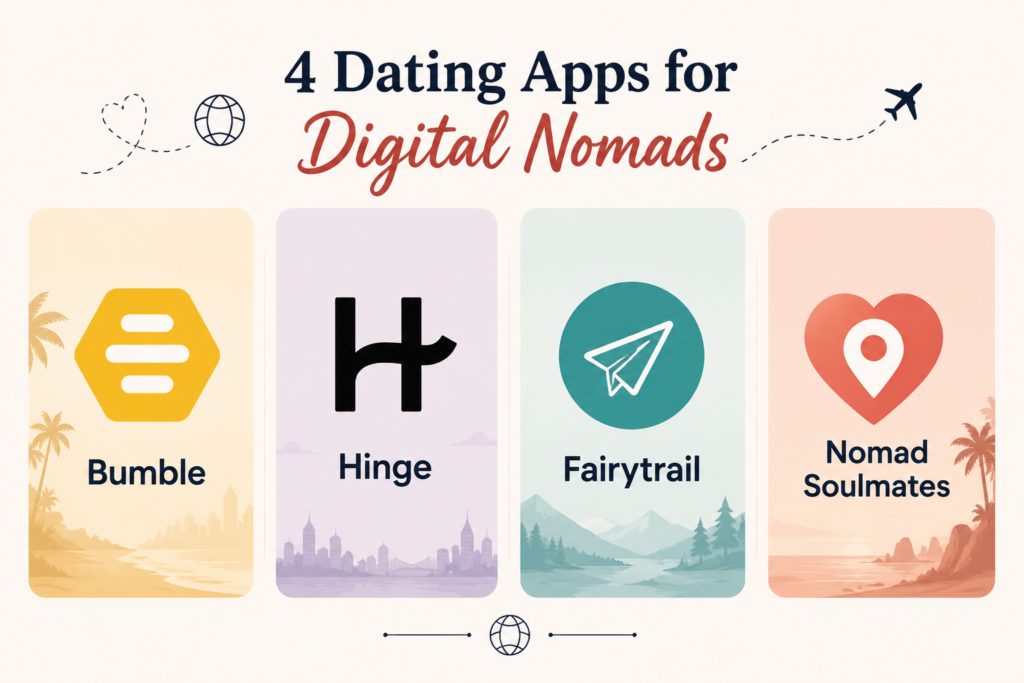
Whenever this topic comes up on Reddit, someone inevitably asks which app works best for travelers. The answers are surprisingly consistent. Despite the growing number of apps created specifically for digital nomads, most long-term travelers still report better experiences using mainstream dating platforms.
That doesn’t necessarily mean niche apps are bad. They simply have one major disadvantage: there aren’t enough people using them. Even in cities filled with remote workers, specialised nomad dating apps often produce only a handful of profiles. Meanwhile, Tinder, Bumble and Hinge continue attracting both locals and international visitors, giving you a much larger pool of people to meet.
Among the best dating apps for digital nomads, Tinder remains the easiest option if you’re looking to meet people quickly after arriving somewhere new. In destinations like Bali, Lisbon, Medellín or Chiang Mai, you’ll usually find a mixture of tourists, expats, remote workers and locals. The downside is obvious. Because so many users are only visiting for a short time, many conversations never develop beyond casual dating. If your goal is simply meeting people, Tinder works extremely well. If you’re hoping for something long term, you’ll probably need to be much more selective.
Bumble tends to attract people looking for slower, more intentional conversations. Several freelancers I met in Portugal said they eventually stopped using Tinder altogether because Bumble produced fewer matches but significantly better conversations. Since users generally invest more effort into their profiles, it’s often easier to understand whether someone is planning to stay in the city or is simply passing through for the weekend.
Hinge sits somewhere between the two. Its profile prompts encourage people to reveal more about their personalities instead of relying entirely on photos. That becomes particularly valuable when you’re trying to decide whether someone is genuinely compatible or simply exciting because you’re both travelling.
Fairytrail and Nomad Soulmates deserve mentioning because they were built specifically for location-independent people. The idea sounds perfect on paper. Everyone already understands remote work, flexible lifestyles and international travel. Unfortunately, the reality is mixed. Reddit discussions consistently point out that these platforms suffer from a relatively small user base. Unless you’re living in one of the world’s biggest digital nomad hubs, you may only find a limited number of active users nearby.
One lesson appears repeatedly across digital nomad communities. The app itself rarely determines the outcome. Two people using Tinder can build a lifelong relationship, while two people meeting through a niche nomad platform can still realise they want completely different futures. The technology simply introduces you. Everything that happens afterwards depends on timing, compatibility and the willingness to build a shared life rather than parallel adventures.
Long Distance Relationship Digital Nomad
Sooner or later, almost every digital nomad couple faces the same conversation.
“When do you leave?”
Sometimes the answer is tomorrow. Sometimes it’s next month. Either way, the relationship suddenly enters territory that most couples don’t experience so early. Instead of deciding which restaurant to visit next weekend, you’re discussing flights, visas and whether either person is willing to change carefully planned travel routes.
A long distance relationship digital nomad situation can absolutely work, but only under certain conditions. The couples I’ve seen succeed almost always had something concrete to work toward. One person planned to relocate in four months. Another had already booked flights. Someone was finishing a freelance contract before joining the other abroad. Distance felt temporary because both people knew where the relationship was heading.
The couples who struggled most usually shared one characteristic. They kept postponing difficult decisions.
“We’ll figure it out.”
“Let’s see what happens.”
“Maybe we’ll be in the same country again.”
Those conversations feel comforting in the moment, but they rarely create stability. Without a realistic plan, months gradually become years while both people continue waiting for circumstances to somehow solve themselves.
Technology helps more than it did a decade ago, but video calls are not a substitute for shared experiences. Relationships grow through everyday life. Cooking dinner together. Meeting friends. Solving ordinary problems. Watching television without constantly talking. Those quiet moments gradually build intimacy in ways that scheduled video calls simply cannot replicate.
There is another mistake that deserves mentioning because it appears surprisingly often. Some couples become so focused on preserving the relationship that they stop living their own lives. Every evening becomes another video call. Every weekend revolves around maintaining the relationship. Eventually both people begin feeling emotionally exhausted because the relationship itself has become another full-time responsibility.
Healthy long-distance relationships leave space for individual lives as well.
One freelance developer I met in Lisbon dated someone living in Prague for almost a year. They only visited each other every couple of months, but both continued building friendships, careers and routines where they lived. Looking back, he said that independence actually strengthened the relationship because neither person expected the other to solve their loneliness.
That may be one of the biggest lessons digital nomads eventually learn. Love can survive distance surprisingly well.
Uncertainty is usually much harder.
The Biggest Mistake Digital Nomads Make
The biggest mistake has almost nothing to do with dating.
It begins much earlier.
People build a lifestyle that is exciting for one person but almost impossible for two.
That sounds harsh, but it explains why so many promising relationships quietly disappear. Someone spends years optimising their life around maximum freedom. They move countries every month, change apartments constantly, work unpredictable hours and make spontaneous travel decisions without consulting anyone else. Then they meet someone wonderful and expect that person to fit neatly into a lifestyle designed entirely around individual independence.
Relationships rarely work like that.
One entrepreneur I met in Medellín used to say he wanted a serious relationship more than anything. At the same time, he refused to stay anywhere longer than four weeks because he was afraid of missing better opportunities elsewhere. He wasn’t sabotaging his relationships intentionally. His lifestyle simply never gave them enough time to grow.
Another woman spent nearly three years moving continuously across Southeast Asia while wondering why every promising relationship ended after a month. Eventually she realised something simple. Nobody was rejecting her.
Everyone was leaving exactly as planned.
She was too.
This is why community consistently outperforms nightlife.
Bars create introductions.
Communities create repetition.
A weekly football match.
A language exchange every Wednesday.
A climbing gym.
A book club.
A volunteer organisation.
Those environments allow people to know you beyond your travel stories. They see you stressed after work, laughing with friends, arriving late because your scooter broke down. They meet the ordinary version of you instead of the exciting traveller passing through.
The internet often teaches people to optimise their dating profile.
Real relationships usually begin by optimising your life instead.
Build routines.
Become part of communities.
Develop friendships.
Stay somewhere long enough for people to know your name.
Ironically, people who stop desperately searching for relationships often become much more likely to find one. Not because the universe rewards patience, but because they become grounded enough for genuine compatibility to appear naturally.
Perhaps the most surprising lesson of all is that many successful digital nomads eventually stop being full-time digital nomads.
Not because they failed.
Not because they became tired of travel.
Because one day they met someone they loved more than they loved constantly leaving.
From the outside, that might look like compromise.
From the inside, it often feels like choosing a different kind of freedom.
Practical Action Plan: How to Build a Relationship While Traveling
By now, you’ve probably realised there isn’t one perfect city, one perfect dating app or one perfect strategy. Successful digital nomad relationships usually grow because people deliberately create the conditions that allow relationships to develop instead of hoping they’ll happen by accident.
The following plan isn’t about finding someone in thirty days. It’s about increasing the chances of meeting people in a way that actually allows something meaningful to grow.
Month 1: Stop Moving Every Few Weeks
If you’ve been changing countries every two or three weeks, make your first goal staying somewhere for at least two or three months.
That single decision will probably have a bigger impact on your dating life than downloading five new apps. It allows you to become a familiar face instead of another visitor. People begin recognising you, conversations continue naturally, and friendships have time to develop.
Week 1: Build a Routine Before Looking for a Relationship
Find a coworking space you’ll actually enjoy returning to.
Choose one café instead of five.
Join a gym, climbing centre or sports club.
Visit the same places regularly.
People trust familiarity. The more often someone naturally sees you, the easier conversations become.
Week 2: Join Recurring Communities
Avoid one-off networking events where everyone disappears afterwards.
Instead, look for activities that happen every week:
- language exchanges
- trivia nights
- volunteer groups
- sports leagues
- hiking clubs
- creative workshops
The goal isn’t simply meeting new people.
The goal is meeting the same people repeatedly.
Week 3: Build Friendships First
One mistake many travelers make is treating every interesting person as a potential date.
Instead, focus on becoming part of a social circle.
Group dinners often lead to introductions.
Friends introduce friends.
You become known as a person rather than another tourist.
Ironically, this is also why learning how to make friends in a new city as an adult often improves your dating life more than spending every evening swiping through dating apps.
Week 4: Invite Someone for Coffee
By now you’ve probably spoken to several people multiple times.
Choose someone you genuinely enjoy talking to.
Keep it simple.
Coffee.
Lunch.
A walk.
Don’t try to manufacture a perfect romantic moment.
The strongest relationships often begin with ordinary conversations.
Month 2–3: Slow Down
If someone genuinely interests you, resist the temptation to immediately book flights elsewhere.
Ask yourself one question:
“If I stayed another month, would I regret it?”
Many people automatically leave because the original travel plan says so, not because leaving is actually the best decision.
One extra month often changes everything.
Month 4 and Beyond
If the relationship continues developing, start discussing practical questions honestly.
What do both of you want over the next year?
Who enjoys travelling more?
Who wants a permanent base?
Could one city realistically work for both of you?
Those conversations feel unromantic.
They’re also exactly what turns promising relationships into lasting ones.
If there’s one lesson that keeps repeating itself, it’s this:
Finding someone usually isn’t the hardest part.
Building a life together is.
Social media makes digital nomad dating look effortless because it mostly shows beginnings. It shows sunsets, scooters, beaches and airport reunions. It rarely shows visa paperwork, difficult conversations, compromise or the quiet months where two people gradually decide they would rather build a shared routine than keep chasing new destinations.
That quieter reality is where most successful relationships actually happen.
The people I’ve met who eventually found lasting partners weren’t necessarily the most attractive or the most outgoing. They were usually the ones who slowed down enough for somebody to genuinely know them. They built friendships before relationships. They became part of communities instead of constantly searching for the next destination. And when they finally met someone important, they were willing to change their plans.
Perhaps that’s the biggest surprise of all.
The digital nomad lifestyle teaches independence exceptionally well.
Love usually teaches interdependence.
Neither is better than the other.
The happiest people simply learn when each one matters most.
FAQ
Is it possible to find love as a digital nomad?
Yes. Many long-term travelers build successful relationships, but they usually do so after slowing their travel pace and becoming part of local communities rather than constantly moving between destinations.
Why is dating so hard as a digital nomad?
The biggest obstacles are unstable routines, different travel plans, visa limitations and the difficulty of spending enough ordinary time together for trust to develop naturally.
Can digital nomads have long-term relationships?
Absolutely. However, most long-term couples eventually compromise by travelling more slowly, choosing a shared base, or adjusting their lifestyle to support the relationship.
How do I find a serious relationship as a digital nomad?
Stay in one place longer, build friendships before looking for romance, join recurring community events, and prioritise consistency over constantly chasing new destinations.
What are the best dating apps for digital nomads?
Reddit users generally report the best results from mainstream apps such as Tinder, Bumble and Hinge because they have much larger user bases than niche nomad dating platforms like Fairytrail or Nomad Soulmates.
Is dating another digital nomad easier than dating a local?
Not necessarily. Another nomad understands your lifestyle immediately, but you may struggle with different travel plans. A local partner often provides more stability and a stronger connection to the community.
Can digital nomads get married?
Yes. Many digital nomads eventually marry, but most adapt their lifestyle by travelling less frequently or establishing a permanent home base together.
Why do so many digital nomads stay single?
Emotional burnout, repeated goodbyes, unrealistic expectations and constantly starting over make many long-term travelers more cautious about investing deeply in new relationships.
Does traveling make dating harder?
Meeting people is often easier while travelling. Building a lasting relationship is usually harder because distance, movement and changing plans interrupt the consistency that healthy relationships need.
How do you build a relationship while traveling?
Focus on creating a stable life before looking for a partner. Stay longer in one destination, become part of local communities, build friendships naturally, and allow relationships to develop over time instead of trying to fit them into short travel itineraries.
Explore the Human Connection Hub
Discover more articles about friendship, loneliness, dating, ghosting and modern relationships in our Human Connection Hub.
Explore the Human Connection Hub →This article combines personal experience, independent editorial research, and insights gathered from long-term digital nomads, remote workers, and expats who have navigated dating, relationships, and loneliness while living abroad.
Research sources included:
- Personal observations and experiences from dating, travelling, and living as a digital nomad, as well as conversations with friends who have built relationships while living abroad.
- First-hand experience using mainstream dating apps, including Tinder, Bumble, and Hinge, in popular digital nomad destinations.
- Community discussions and real-life experiences shared on Reddit, including digital nomad, travel, expat, and relationship communities.
- Behavioural psychology research on decision-making, commitment, and the paradox of choice published by The Decision Lab.
- Research and expert commentary on healthy relationships, trust, empathy, belonging, and social connection published by the Greater Good Science Center at the University of California, Berkeley.
- Independent editorial research examining digital nomad lifestyles, slow travel, community building, long-distance relationships, and relationship patterns among location-independent professionals.
The goal is to provide practical, realistic guidance for digital nomads who want to build meaningful relationships without giving up a location-independent lifestyle, separating common social media myths from the everyday realities of dating while travelling.

Founder & Editor
Founder of The City Theory, writing about digital nomad lifestyle, modern city culture, remote work, travel experiences, psychology and human behaviour around the world.