Why Do Turkish People Drink So Much Tea? The Real Story Behind Çay
Turks drink so much tea because çay has become the default drink of everyday social life: it appears at breakfast, at work, after meals, when guests arrive, during business conversations and whenever people sit down together for more than a few minutes. But the part that surprised me is that this isn’t some ancient Ottoman habit stretching back unchanged for centuries. Modern Turkish tea culture developed mainly during the 20th century, when Turkey began producing tea commercially around Rize and locally grown tea became an affordable alternative to imported coffee. Today the habit is so deeply established that spending even a few days in Turkey without being offered one of those tiny glasses of dark tea is almost impossible.
I understood this much better after actually living in Turkey. I spent several months in Alanya and later lived in Istanbul, and tea was one of those small things I initially noticed without thinking much about it. Then I realised just how often it appeared. I would order food in a café and sometimes receive tea afterwards without asking for it. I could sit somewhere for a while and another glass would appear. People drank it over breakfast, shopkeepers had glasses beside them while working, and groups of men could spend what seemed like hours talking over tea and playing backgammon. It happened in touristy coastal Alanya and in enormous, hectic Istanbul, which made me realise this wasn’t a regional quirk but part of the rhythm of everyday Turkish life. It was also one of the reasons I became interested in books that help explain Turkish society and its everyday habits, because many of the things you notice while living there make much more sense once you understand the cultural context behind them.
What I Noticed Living in Turkey
Before living there, I associated Turkey much more strongly with Turkish coffee. That is what gets marketed abroad: the tiny cup, the thick coffee, the fortune telling from the grounds. Once I was actually in Turkey, coffee suddenly seemed like only part of the story because tea was everywhere.
Breakfast was probably the most obvious example. A proper Turkish breakfast can continue for a surprisingly long time, and tea fits that style of eating perfectly. Instead of one large drink that you finish and move on from, the little glasses keep being refilled while everyone eats cheese, olives, eggs, bread, tomatoes, preserves and whatever else has appeared on the table. This helps explain why do Turkish people drink tea at breakfast: it isn’t really a separate breakfast ritual so much as a drink designed for a long, social meal.
Then there was restaurant tea. I lost count of the number of times I finished eating and was offered çay, sometimes without it appearing on the bill at all. This is also part of the answer to why do Turkish people drink tea after meals. A meal doesn’t always end the moment the plates disappear. Tea creates another ten or twenty minutes in which people can sit, talk and gradually finish the encounter rather than immediately getting up.
The same habit followed me outside restaurants. It is one of those everyday details that becomes particularly noticeable when you stop experiencing Turkey as a tourist and start building a routine there. I saw plenty of differences between central Alanya, Mahmutlar and Oba while figuring out what different parts of Alanya are actually like to live in, but the constant presence of tea was remarkably consistent.
That experience is why the question why do Turks drink so much tea is more interesting than it initially sounds. It isn’t simply because Turkish tea tastes good. The drink has found a role in almost every situation where people spend time together.
The Biggest Surprise: Turkish Tea Culture Isn’t Actually That Old
This was the part I didn’t know before I started looking into the history.
If you see how important tea is today, it is easy to assume that Turks must have been drinking it this way throughout the Ottoman period. But if you’re wondering when did Turkey start drinking tea on a mass scale, the answer is surprisingly recent.
Coffee has the much longer Ottoman history. Coffeehouses became an important part of Ottoman urban culture centuries before the modern Turkish tea habit developed. Tea was known, of course, and there had been earlier attempts to cultivate it, but it wasn’t yet the cheap everyday drink sitting on practically every table.
The decisive change came in the early Turkish Republic. The country needed a reliable domestic source of tea, and the humid eastern Black Sea region proved suitable for growing it. Rize eventually became the centre of the industry, with production expanding substantially during the following decades. According to the Food and Agriculture Organization of the United Nations (FAO), Turkey is now one of the world’s major tea-producing countries, with production concentrated along the eastern Black Sea coast, particularly around Rize. You can read more about tea production in Turkey through the FAO.
So did Turks always drink tea? No, certainly not in the quantities and everyday manner we associate with Turkey now. What feels like a very old tradition is largely a 20th-century success story.
This also answers another common question: is Turkish tea an Ottoman tradition? There are historical connections between tea and the late Ottoman world, but describing modern çay culture simply as an ancient Ottoman tradition misses the important part of the story. The mass habit developed later.
That actually makes Turkish tea culture more interesting to me, not less. A practice doesn’t need to be a thousand years old to become culturally important. Sometimes a few generations are enough.
Why Tea Became More Practical Than Coffee
The economics matter here.
Coffee beans had to be imported. Tea, once commercial cultivation succeeded along Turkey’s Black Sea coast, could be produced domestically. The government supported the development of tea agriculture and processing, production increased, and tea became readily available to ordinary households.
This helps explain why did tea replace coffee in Turkey as the everyday hot drink. “Replace” is slightly misleading because Turkish coffee never disappeared, but tea became much easier to consume repeatedly throughout the day.
Think about the practical difference. Coffee is normally prepared as an individual serving or a few servings. Turkish tea is brewed so that a strong concentrate can remain ready in the upper pot of a çaydanlık while hot water sits below. Someone wants another glass? You don’t need to start the entire process again.
That system makes a lot of sense in a household, restaurant, workplace or shop where different people might want tea at different times.
It also helps answer why is Turkish tea so popular today. Turkey managed to combine domestic production, affordability and a brewing system perfectly suited to repeated consumption.
Where Is Tea Grown in Turkey?
If you ask where is tea grown in Turkey, look toward the country’s northeastern Black Sea coast rather than Istanbul or the Mediterranean resorts most international visitors know.
Rize is the name most closely associated with Turkish tea, although production also extends into neighbouring areas including Trabzon, Artvin and Giresun. The Black Sea coast has the rainfall and humid conditions required for tea cultivation, making this relatively small part of the country enormously important to a national habit.
That is essentially why is Rize famous for tea. It isn’t merely a city that happens to sell a lot of tea to tourists; it sits at the centre of the domestic tea-growing industry that made mass consumption possible in the first place.
When you are drinking tea hundreds of kilometres away in Istanbul or Alanya, there is a good chance the story behind that glass begins on the Black Sea coast.
Tea Became a Social Tool, Not Just a Daily Drink
History explains how tea became available, but availability alone doesn’t explain why do Turkish people love tea this much. Plenty of countries can grow or import inexpensive tea without turning it into something offered during almost every kind of social interaction.
This is where Turkish social habits matter.
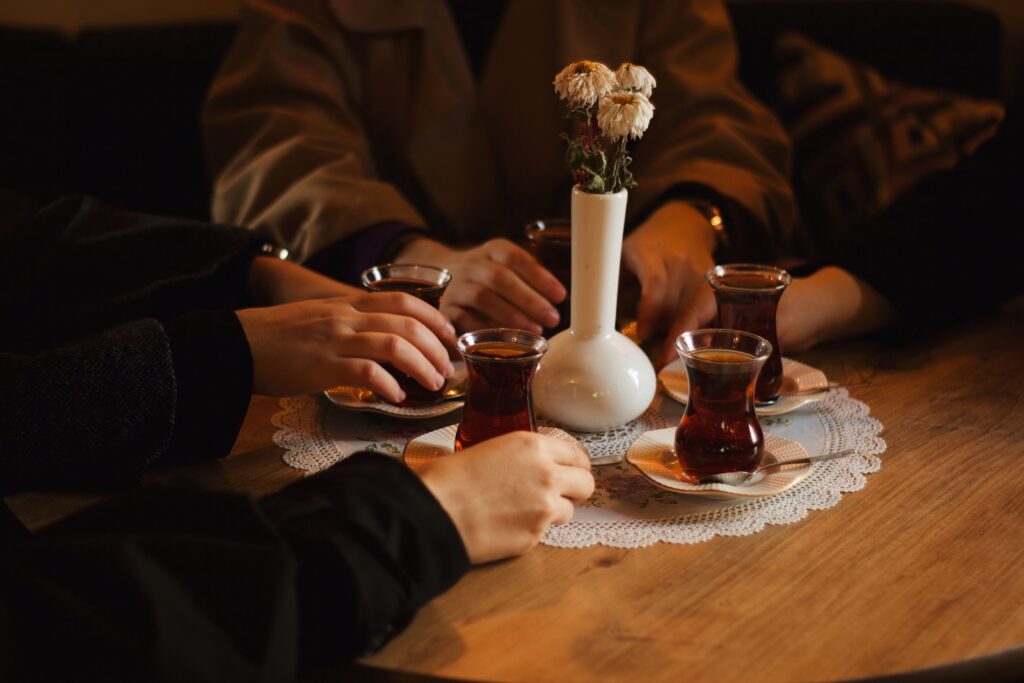
Tea fills awkward gaps extremely well. Someone visits your home: offer tea. A friend comes into your shop: tea. You are discussing something with a customer: tea. Several people are sitting around talking with no particular reason to leave: another round of tea.
It doesn’t require the commitment of ordering a meal, and because the glasses are small, accepting one doesn’t feel like accepting a huge favour. At the same time, offering something creates a tiny gesture of hospitality.
This was something I also noticed in the way neighbourhood life works in Turkey. The boundaries between businesses, streets, cafés and social spaces can feel less rigid than in places where everyone goes into a shop, completes a transaction and leaves. It’s similar to what initially surprised me about the way Turkish neighbourhoods collectively care for street cats: seemingly small everyday behaviours tell you quite a lot about how people relate to the space and people around them.
So what does tea mean in Turkish culture? Depending on the situation, it can mean welcome, let’s talk, stay a little longer, take a break, or simply I’m acknowledging that you’re here.
And is tea a symbol of hospitality in Turkey? Yes, but calling it a “symbol” almost makes it sound more ceremonial than it usually feels. Most of the time it is wonderfully ordinary.
Is Tea Free in Turkey?
Sometimes, but not always. One thing that surprised me while living in Turkey was how often a small glass of çay appeared without being added to the bill, particularly after a meal or during a longer conversation in a café or restaurant. This doesn’t mean tea is automatically free everywhere in Turkey. Many cafés sell tea normally, while some restaurants, hotels and businesses offer it as a small gesture of hospitality. If you’re unsure, don’t assume it is complimentary, but don’t be surprised if the waiter brings a final glass of tea after your meal and doesn’t charge for it.
Why Do Turkish Shops Offer Tea Even If You Buy Nothing?
This was probably the habit that confused me most at first.
In many countries, being offered a drink in a shop would feel unusual unless you were making an expensive purchase. In Turkey, the threshold can be much lower. You might be browsing, discussing a product or simply talking for a while and someone asks whether you want çay.
So why do Turkish shops offer tea? Partly because commercial interactions in Turkey can be more social than foreigners expect. The tea acknowledges that the interaction may take some time. It gives everyone something to do while talking and makes the encounter less abrupt.
Of course, context matters. A carpet seller offering a tourist tea may also be very interested in keeping that potential customer in the shop. I wouldn’t romanticise every glass as an act of unconditional friendship. But after living in Turkey, it became obvious to me that the practice extends far beyond tourist sales situations.
That is also why do Turkish people offer tea to guests at home. You don’t need an elaborate occasion. Tea is easy, inexpensive and almost universally understood. Refilling a glass is a simple way of saying that the conversation isn’t over yet.
Why Do Turkish People Drink Tea All Day?
The first reason is surprisingly practical: Turkish tea is designed to remain available.
A çaydanlık is the distinctive double teapot used to prepare it. If you’ve wondered what is a çaydanlık, imagine two pots stacked on top of each other. Water boils in the larger lower pot, while strong tea brews in the smaller upper one. When serving, you pour some concentrated tea into the glass and dilute it with hot water according to how strong the person wants it. This traditional preparation is part of Turkey’s wider tea culture and social traditions, which UNESCO recognizes as an element of Intangible Cultural Heritage shared by Türkiye and Azerbaijan.
This system means you can keep serving multiple small glasses without brewing a completely new pot every time.
That helps explain both why do Turkish people drink tea all day and why is Turkish tea so strong. What sits in the upper pot is deliberately concentrated; the final strength depends on how much concentrate and water are mixed in the glass.
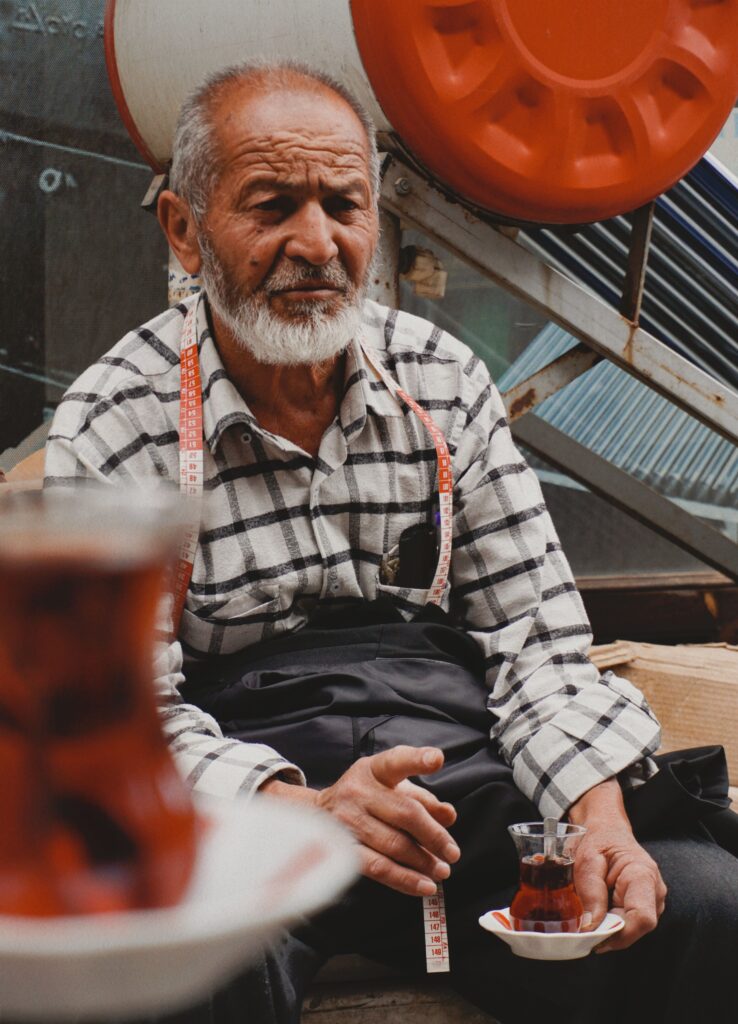
The second reason is the size of the serving. One little glass doesn’t feel substantial, so drinking several over a long conversation happens almost without noticing.
And the third is simply repetition. Breakfast leads to tea. A work break leads to tea. Someone arrives and there is tea. Lunch ends and there might be tea. Friends meet later and there is tea again.
This same culture naturally appears in modern working life too. In Istanbul I found that cafés and informal workspaces often blur together, something that became very obvious while I was looking for places where you can work around Istanbul without paying for a traditional office. A laptop, a table and repeated glasses of çay can coexist for a very long time.
Why Is Turkish Tea Served in Small Tulip-Shaped Glasses?
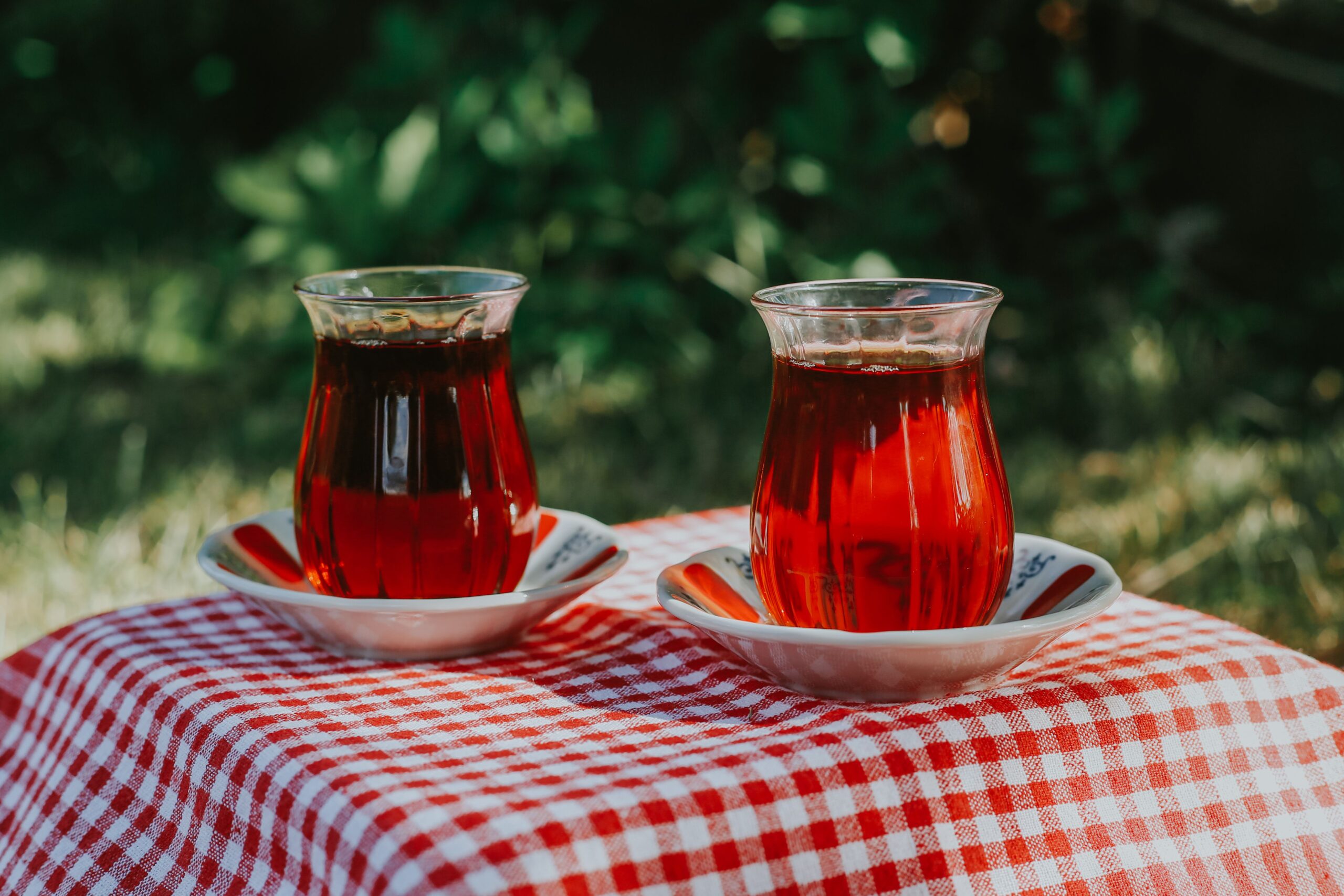
The classic glass is known as ince belli, literally referring to its “slim-waisted” shape. It narrows in the middle and widens toward the top.
So why is Turkish tea served in small glasses, and why do Turkish people use tulip shaped tea glasses rather than mugs? There are practical and aesthetic reasons. The transparent glass shows the deep reddish colour of the tea, while its shape makes the drink easy to hold around the narrower middle. The small serving also suits the Turkish habit of drinking several fresh glasses rather than one enormous mug that gradually goes cold.
For me, the glass is one reason Turkish tea feels so different from British-style tea drinking. The actual quantity in front of you is tiny, but the ritual can continue for hours.
Turkish Tea vs Turkish Coffee: Which Do Turks Actually Drink More?
If we’re comparing Turkish tea vs Turkish coffee in terms of international recognition, coffee probably wins. If we’re talking about ordinary daily consumption inside Turkey, tea is the much more constant presence.
So do Turks drink more tea than coffee? In everyday life, overwhelmingly yes. Turkish coffee remains culturally important and is still served in homes, cafés and on particular social occasions, but it isn’t normally consumed glass after glass from breakfast until evening.
This distinction confused my expectations before I lived there. Turkish coffee is the famous cultural export; çay is the drink I actually kept seeing.
As for how many cups of tea do Turkish people drink a day, there isn’t one meaningful number that describes everyone. Consumption estimates vary by source and methodology, and people obviously have very different habits. What is much more useful is the national picture: Turkey consistently ranks among the world’s heaviest tea-consuming countries per person.
The same caution applies to how much tea does Turkey consume per person. Different datasets measure dry tea, brewed tea and different time periods, so I wouldn’t treat one viral statistic as eternal fact. The important point is that Turkey’s per-capita consumption is exceptionally high, which matches what you see on the ground.
Tea Works Because Turkish Social Life Gives It Somewhere to Go
This is ultimately my answer to why is tea important in Turkish culture.
Domestic production explains why tea became affordable. The çaydanlık explains how it can be kept ready. Small glasses explain how people can drink it repeatedly. But none of those things alone explains why tea became so deeply embedded in Turkish life.
The missing piece is that Turkish social life gives tea endless opportunities to appear.
People can spend a long time over breakfast. Shopkeepers talk to regular customers. Guests are expected to be offered something. Friends sit rather than rushing through a coffee. Business conversations don’t always need to feel completely impersonal. Neighbourhood life still creates repeated encounters between the same people.
Tea fits all of those situations because it asks very little from either person. It is cheap enough to offer casually, small enough to accept without thinking about it and slow enough to extend a conversation.
That, more than any romantic story about an ancient national obsession with tea, explains why is tea so popular in Turkey today. Çay didn’t simply survive because Turkish people inherited an old tradition. It became a tradition because it turned out to be exceptionally useful for the way people already liked to spend time together.
Why Tea Feels Different When You Actually Live in Turkey
What changed my understanding of Turkish tea wasn’t learning how it was produced or memorising statistics about consumption. It was simply living there long enough for tea to stop feeling like something “Turkish” that I was supposed to notice.
During my first weeks, every little glass still registered in my mind as part of the experience. If a waiter brought free tea after a meal, I noticed it. If somebody offered me tea in a shop, I thought about how unusual that would have been in many other countries. Eventually I stopped paying attention because it became completely normal. Someone would ask “çay?” and accepting it required about as much thought as accepting a glass of water.
That is probably the best explanation I can give for why is tea served everywhere in Turkey. It isn’t reserved for special occasions. In fact, its importance comes partly from being so ordinary. You don’t need to invite somebody to a formal dinner to offer them tea, and you don’t need to have anything particularly important to discuss. Tea fills all the smaller spaces in daily life.
I saw the same thing in very different environments. Alanya is a Mediterranean resort city where daily life can feel slow, especially outside the busiest tourist months. Istanbul is the opposite: enormous, crowded and constantly moving. Yet I could sit down in either city and see those same little glasses moving between tables.
That consistency made the habit much more interesting to me than the usual explanation that “Turkish people drink tea because hospitality is important.” Hospitality is certainly part of it, but tea also works because it is practical. It gives people an inexpensive reason to stay at a table, continue a conversation or acknowledge somebody without turning the interaction into a big event.
And perhaps that is why Turkish tea is so popular after only a relatively short period in the country’s history. Turkey didn’t simply adopt a new beverage. It found a beverage that happened to fit remarkably well into everyday social life.
FAQ
Why do Turkish people drink so much tea?
Turkish people drink so much tea because çay has become the standard drink for many everyday situations, including breakfast, work breaks, visiting friends, business conversations and sitting together after meals. Domestic tea production also made it inexpensive and widely available during the 20th century, helping it develop from a relatively modern habit into an important part of daily life.
How much tea do Turkish people drink?
Turkey consistently ranks among the world’s highest tea-consuming countries per capita. Exact figures vary depending on the year and how consumption is measured, so I wouldn’t reduce Turkish tea culture to one number. What matters is the frequency: many people drink several small glasses throughout the day rather than having one large serving.
Do Turkish people drink tea all day?
Many do. Because Turkish tea is prepared in a çaydanlık and served in small glasses, it is easy to keep tea ready and pour fresh servings throughout the day. Breakfast may start with tea, followed by glasses at work, after lunch, when somebody visits or during an evening conversation.
Why is tea so important in Turkish culture?
Tea works as an easy form of everyday hospitality and social interaction. Offering someone çay can welcome a guest, extend a conversation, make a business interaction less formal or simply give people something to share while sitting together. Its cultural importance comes partly from how ordinary and accessible it is.
Did Turkish people always drink tea?
No. This is one of the biggest misconceptions about Turkish tea culture. Tea was known before the modern Republic, but today’s mass tea-drinking culture developed mainly during the 20th century as domestic cultivation expanded around Rize and tea became affordable and widely available.
Did tea replace coffee in Turkey?
Not completely. Turkish coffee remains culturally important, but tea became the more practical everyday drink. Coffee traditionally depended on imported beans, while Turkey could grow tea domestically along the Black Sea coast. Tea can also be kept ready in a çaydanlık and served repeatedly, making it particularly convenient for households, workplaces and businesses.
Why do Turkish shops offer tea?
Offering tea makes a commercial interaction more social and gives people something to drink while they talk. In tourist shops it can certainly be part of the sales process, but the custom is much broader than that. Tea is routinely offered in ordinary businesses and social situations where nobody is trying to sell an expensive souvenir.
Why is Turkish tea served in small glasses?
Traditional ince belli glasses show the colour of the tea and make small, fresh servings easy to drink repeatedly. Instead of receiving one large mug, people can have several freshly poured glasses over the course of a conversation.
Where is Turkish tea grown?
Most Turkish tea is grown along the humid northeastern Black Sea coast. Rize is the country’s best-known tea-producing area, with cultivation also extending into neighbouring provinces such as Trabzon, Artvin and Giresun.
Do Turkish people drink more tea than coffee?
Yes, in terms of everyday consumption, tea is far more ubiquitous. Turkish coffee may be better known internationally, but living in Turkey made the difference very obvious to me: coffee feels like a particular drink you decide to have, while tea can simply keep appearing throughout the day.
Explore the Culture & Society Hub
Discover more stories about language, identity, traditions, social habits and the cultural details that shape everyday life around the world.
Explore the Culture & Society Hub →This article combines my own experience of living in Turkey, first-hand observations of everyday tea culture, and independent research into the history of Turkish tea, its role in social life, and the development of tea production in the Black Sea region.
Research sources included:
- My own experience of living in Turkey and observing how tea is served in homes, cafés, restaurants, workplaces, shops, and everyday social situations.
- Cultural information from UNESCO’s Intangible Cultural Heritage programme, including background on çay culture as a symbol of hospitality, identity, and social interaction in Türkiye.
- Agricultural and historical information from the Food and Agriculture Organization of the United Nations (FAO), including background on tea cultivation and the development of production in Turkey’s eastern Black Sea region.
- Personal observations of how çay, traditional tulip-shaped glasses, and the çaydanlık remain part of ordinary daily routines rather than being limited to formal occasions or tourism.
The goal is to explain why tea became such an important part of everyday life in Turkey by combining personal experience with historical, agricultural, and cultural context, rather than treating Turkish tea culture as simply an old tradition that has always existed in its modern form.

Founder & Editor
Founder of The City Theory, writing about digital nomad lifestyle, modern city culture, remote work, travel experiences, psychology and human behaviour around the world.