

Why Do People Ghost You for No Reason? When Everything Seemed Fine
People rarely ghost for literally no reason, but the reason often has nothing to do with some dramatic mistake you made. Someone can enjoy talking to you, feel attracted to you, have a genuinely good date and still privately decide that they do not want things to go any further. They may lose interest, meet someone else, realise that you are not quite right for each other, become uncomfortable with the expectation of continued communication, or simply decide that disappearing is easier than having an awkward conversation. That is why why do people ghost you for no reason is such a frustrating question: from your side, nothing happened, while from their side a decision may already have been forming quietly without you knowing anything about it.
I have had this happen more times than I would like to admit. I would go on a first date with someone and everything seemed genuinely good. We would laugh a lot, talk easily for hours, and sometimes there was even a kiss at the end. There was no strange argument, no obvious awkward moment and no feeling that one of us was desperate to leave. I would go home thinking that, at the very least, we would probably see each other again.
Then the next day there would be complete silence, almost as if the date had never happened.
Sometimes I would send the first message myself, something completely normal like asking how his day was going. Then I would see that he had been online, sometimes several times, yet my message remained unanswered. That was always the part that confused me most. I did not immediately think, “Okay, he isn’t interested.” Instead, I started replaying everything. Did I say something strange? Was I too talkative? Did I misunderstand the chemistry? Did I suddenly become unattractive to him halfway through the evening without noticing it?
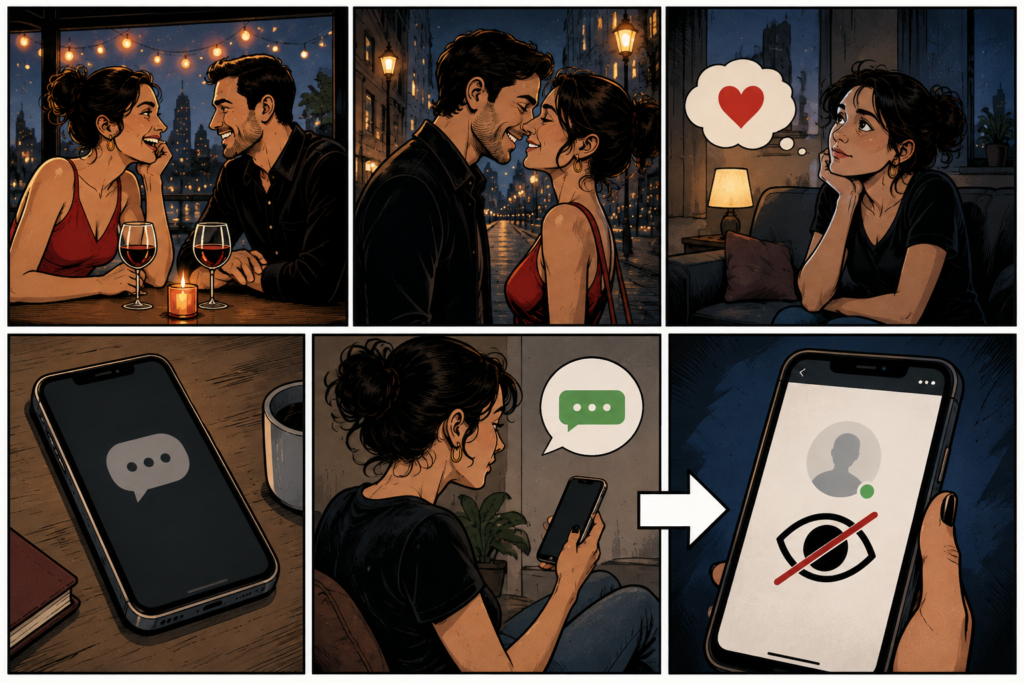
That mental replay is probably why ghosting feels much worse than a straightforward rejection. When someone says, “I had a nice time, but I don’t think we’re a match,” there is not much mystery left to solve. You may not like the answer, but your brain has somewhere to put it. When someone disappears, you are left constructing the explanation yourself, and unfortunately the explanation we invent is often much harsher than reality. This is one reason why uncertainty is so psychologically difficult to process, because our brains naturally try to fill in missing information, often with explanations that are far more negative than the truth.
Why Do People Ghost When Everything Seemed Fine?
This was the part I personally struggled with for a long time. If the date was terrible, ghosting would at least make some sense. What confused me was why do people ghost when everything seemed fine, especially when they had been laughing, flirting and clearly enjoying themselves. Sometimes the explanation is that two people were never looking for the same thing in the first place, which is why understanding why people choose casual dating can make some of these mixed signals easier to understand.
Eventually I stopped assuming that a pleasant date automatically meant both people were evaluating it in the same way.
Someone can honestly enjoy your company in the moment and still realise during the same evening that they do not see you as a romantic match. Those two things are not contradictory. I have enjoyed conversations with people I would never want to date seriously, so there is no reason to believe other people experience attraction differently.
This also helped me understand why do people ghost someone they like. Liking someone is not the same thing as wanting to build a relationship with them. You can think someone is attractive, funny and interesting while also noticing a lifestyle difference, personality mismatch or lack of deeper compatibility that makes you decide not to continue.
The problem is not necessarily that the person had this thought. The problem is what they do with it.
Some people can simply say, “I enjoyed meeting you, but I don’t think we are a match.” Others find even that small amount of discomfort unbearable. They postpone answering, tell themselves they will reply later, feel increasingly awkward because several hours have passed, and eventually decide that saying nothing is easier than explaining themselves.
That is one of the simplest explanations for why do people suddenly ghost you. The decision may not actually have been sudden at all. It only looked sudden from your side because you were not part of the internal conversation happening in their head.
Why Do People Ghost After a Great Date?
I used to interpret a good first date almost like evidence. We laughed, therefore he liked me. He kissed me, therefore he was attracted to me. He stayed for three hours instead of one, therefore he wanted another date.
Unfortunately, dating is not a mathematical equation.
Someone can kiss you because they wanted to kiss you at that particular moment. Someone can stay longer because the conversation was enjoyable. Someone can flirt heavily and still wake up the next morning deciding that they do not want to pursue anything further.
This is why searches like why do people ghost after a great date, why do people ghost after first date, why did he ghost me after a great date and why did she ghost me after a good date are so common. We naturally assume that good behaviour during the date predicts future behaviour afterward, but it often does not.
One date shows that two people can enjoy two hours together. It does not yet tell you how much emotional investment either person has.
That does not mean ghosting is a good way to handle it. I still think that if you have actually met someone face to face, especially if the date went well, a short message is basic courtesy. But understanding that a pleasant date can be genuine without leading anywhere stopped me from assuming that every person who disappeared had secretly been pretending throughout the entire evening.
In my own cases, I eventually came to a much more boring conclusion than the theories I had created in my head. The person probably had a nice time with me and also realised that we were not right for each other. Instead of saying it directly, he chose the easier option for himself and disappeared.
For me, that says much more about how someone handles uncomfortable conversations than about whether I said exactly the right thing over dinner.
Dating while travelling makes this dynamic even easier because people can treat connections as temporary without ever clearly saying so. I have noticed the same uncertainty around meeting people while constantly moving between countries: two people may behave as though something is developing while privately having completely different ideas about how serious it is.
Why Do People Ghost After Talking Every Day?
This is probably one of the most misleading situations because daily communication creates the feeling that something important is developing.
Someone sends you a good-morning message every day. You exchange memes. They tell you what happened at work. You start recognising the names of their friends. You talk late at night, flirt, complain about your boss, send photos of what you are eating and gradually become part of each other’s routines.
Then suddenly they disappear.
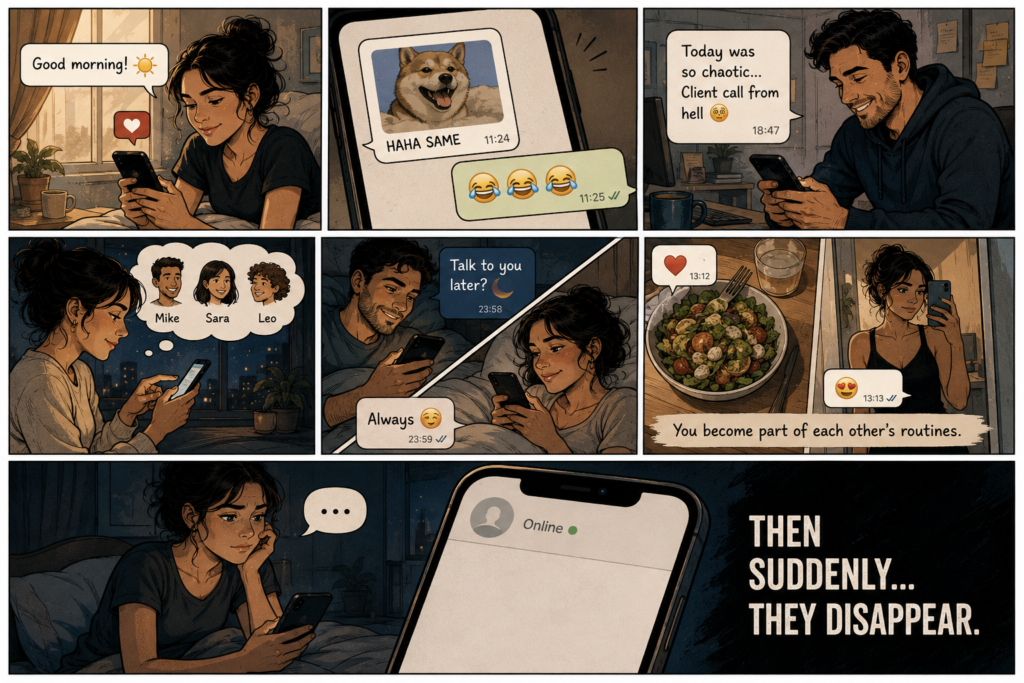
Naturally, you ask why do people ghost after talking every day or why do people ghost after texting every day because the amount of communication seemed to prove that the connection mattered.
But texting can create perceived intimacy much faster than actual commitment develops.
I think this is one of the stranger things about modern relationships. You can know what someone had for breakfast, what their colleague said in a meeting and which series they watched before bed without actually knowing what role they see you playing in their life.
Daily messages feel intimate because they create familiarity. Familiarity, however, is not automatically commitment.
Someone may genuinely enjoy having you as part of their daily routine while the interaction is new and exciting. Then the novelty fades, another person appears, work becomes stressful, or they realise the conversation is moving toward something more serious than they wanted. Instead of explaining that shift, they stop replying.
That is often the answer behind why someone suddenly stops talking to you or why people stop replying suddenly. Their emotional investment may have changed before their behaviour finally changed.
This is also where people start asking, why did he suddenly stop texting me or why did she suddenly stop texting me. The temptation is to search the last few conversations for a specific mistake, but there may not be one. Sometimes there is no sentence you could have worded differently that would have produced a different outcome.
Does Ghosting Mean They Never Liked You?
No. I think this is one of the most important distinctions to understand.
A person can like you and still ghost you.
They can find you attractive and ghost you. They can enjoy your personality and ghost you. They can have fun talking to you every night and ghost you. They can even feel some emotional connection and still decide that continuing the relationship is not what they want.
That is why why would someone ghost you if they liked you and why do people ghost someone they are attracted to have answers that are more complicated than “they were never interested.”
Interest exists in degrees.
Someone may like you enough to flirt but not enough to date seriously. They may be attracted to you but not see long-term compatibility. They may enjoy attention without wanting responsibility. They may be curious about you initially and later decide that the feeling is not developing further.
The part I had to learn personally was this:
Someone liking me in one moment did not create an obligation for them to keep liking me later.
What I could reasonably expect, however, was basic communication.
Those are two separate issues.
I cannot demand that someone continue being interested. I can still think disappearing without a word after building a connection is inconsiderate.
Why Do People Ghost Instead of Just Saying They Aren’t Interested?
This is where I think the psychology behind ghosting becomes much more ordinary than people expect.
There does not always need to be some complicated attachment style or hidden trauma. Sometimes the explanation is simply that a person does not tolerate awkwardness well. Research on conflict communication in relationships suggests that many people avoid direct conversations because they anticipate discomfort or negative emotional reactions, even when open communication would lead to a healthier outcome.
Sending a rejection message requires them to knowingly create an uncomfortable moment. They know you may be disappointed. You might ask why. You might try to change their mind. You might become angry. Even if none of those things actually happen, they have to imagine the possibility.
Ignoring the message allows them to avoid all of it.
From their perspective, silence delays discomfort. From your perspective, silence creates far more discomfort because you do not know what is happening.
That mismatch explains many of the reasons people ghost. The ghoster is often solving their immediate problem — “I don’t want to have this conversation” — without thinking very deeply about the problem they are creating for the other person.
This is also why I am careful about automatically describing every ghoster as a terrible human being. Someone can be generally kind and still behave badly when conflict appears. At the same time, repeated disappearing does tell you something about how they deal with responsibility and uncomfortable communication.
So, what does ghosting say about a person? At minimum, it tells you how that person chose to handle this particular difficult conversation. If disappearing becomes their regular way of dealing with people, I would take that much more seriously.
I use the same distinction with friendship. A single slow reply does not make someone a bad friend, just as one disagreement does not automatically mean you are in a friendship built around consistently unhealthy behaviour. Patterns matter more than isolated incidents.
Ghosting by a Friend Can Feel Even Stranger
One of my more confusing experiences with ghosting was not romantic at all.
I had a friend I could simply message to ask how she was, and my message could remain unread for more than a week. Normally I would accept the explanation that somebody was busy, because people do have work, families, problems and periods when they do not want to talk.
But I also knew this person well enough to know that her phone was almost always in her hand and that she checked the messenger constantly.
That changed how I interpreted the silence.
At some point I stopped telling myself that she simply had not seen my message. In modern life, especially with people who are constantly on their phones, there is a difference between being unable to answer and deciding that answering you is not currently important.
That does not mean somebody owes you an immediate response every time you write. I do not expect my friends to be available twenty-four hours a day. The issue is the pattern. If someone regularly communicates with everyone else, appears online constantly and leaves your ordinary message sitting there for a week, they are showing you where the interaction currently sits on their list of priorities.
This was actually more useful for me to understand than trying to diagnose the friendship.
I stopped asking, “Why hasn’t she seen it?”
The more realistic question became, “Why is replying to me something she repeatedly chooses to postpone?”
That distinction matters when asking why do people disappear from your life or why someone disappears without explanation. Sometimes there is no dramatic fight and no official ending. Your importance to them simply decreases gradually while nobody says it out loud.
The same pattern can appear when a friend keeps postponing contact before disappearing altogether. I have learned to pay more attention when cancelled plans become the normal pattern rather than an occasional inconvenience, because distancing often happens in stages long before somebody completely stops responding.
Ghosting After Several Dates or After Getting Close Feels Different
There is a big difference between somebody disappearing after three messages on a dating app and somebody disappearing after you have spent several weeks getting to know each other. The longer the connection has lasted, the more reasonable it is to expect some kind of explanation.
This is why why do people ghost after being intimate and why do people ghost after getting close are particularly painful questions. Once physical or emotional intimacy appears, most of us assume that the relationship has crossed some invisible line where basic communication becomes more important.
Unfortunately, intimacy does not guarantee that both people understand the connection in the same way.
One person may see intimacy as a sign that the relationship is progressing while the other sees it as something that happened without any promise about what comes next. Someone may genuinely enjoy becoming close and then realise afterward that they do not want the relationship to develop further. There are also people who pursue the excitement of getting close much more enthusiastically than they handle what comes afterward.
That is one reason why people ghost relationships rather than ending them properly. Starting something can be exciting; ending it requires an uncomfortable conversation.
The same issue explains why do people disappear when things are going well. Sometimes nothing actually “went wrong.” The connection simply reached a point where the other person had to decide whether to invest more, and their answer was no.
What hurts is that you were never included in that decision.
Why Would Someone Ghost You After Showing So Much Interest?
This is another situation I have learned not to interpret too literally.
Someone can show enormous interest at the beginning because they genuinely feel enormous interest at the beginning. That does not mean they were lying.
Early dating is full of novelty. You have endless questions to ask, stories to discover and anticipation about what might happen. Some people are naturally intense during this stage. They text constantly, make compliments, talk about future plans and behave as if the connection is already significant.
Then reality catches up.
This explains why would someone ghost you after showing so much interest and sometimes why do people suddenly lose interest and ghost. Initial excitement can disappear faster than the expectations it created.
The important thing is to judge consistency over time rather than intensity during the first week.
I would now be much more impressed by somebody who communicates reliably for two months than somebody who sends fifty messages a day during the first five days.
Why Do People Ghost After Making Plans?
Few situations are more irritating than agreeing on a time and place and then watching somebody disappear.
So why do people ghost after making plans or even why do people ghost before a date?
Sometimes they changed their mind and do not want to admit it. Sometimes another option appeared. Sometimes anxiety takes over. Sometimes they liked the idea of meeting more than they actually wanted to meet. And sometimes they simply have terrible manners.
The reason matters less when someone leaves you literally waiting for a date. At that point the behaviour itself is useful information.
I used to spend much more energy trying to understand why somebody behaved badly. Now I think there are moments when the explanation is less important than what the behaviour tells you about whether you want that person in your life.
Dating already becomes confusing enough when people are transient, travelling or uncertain about where they will be next month, which is one reason connections can be particularly intense and short-lived when you are trying to recover from a romance that ended without a clear future.
Do Ghosters Come Back?
Yes, sometimes they do.
That is why why do people come back after ghosting you has become almost a second chapter of the ghosting experience.
Someone may come back because they are lonely, because another relationship ended, because they miss the attention, because enough time has passed that they assume you are no longer angry, or because they genuinely regret how they handled things.
But a return does not automatically mean the person suddenly realised you were the love of their life.
If somebody vanished for three weeks and then sends “Hey stranger,” I would look at what happens next rather than treating the message itself as proof of anything.
Do they acknowledge disappearing?
Do they explain what happened?
Do they apologise?
Does their behaviour become more consistent?
Those questions matter much more than the comeback itself.
Do Ghosters Regret Ghosting?
Some probably do and some do not.
Do ghosters regret ghosting enough to contact the person again? Sometimes. People can realise later that they handled a situation badly, especially after the emotional pressure of the original conversation has disappeared.
But regret is impossible to measure from silence. You can lose weeks wondering whether someone misses you while they are simply living their life.
That is why I stopped treating imagined regret as closure.
Will Someone Who Ghosted You Come Back?
Maybe, but waiting for it usually keeps you emotionally attached to a person who is currently choosing not to communicate.
Will someone who ghosted you come back is therefore not the question I find most useful anymore. I would rather ask what I would need to see if they did come back before allowing them into my life again.
A message is easy.
Consistency is harder.
Should You Text Someone Who Ghosted You?
I think sending one normal follow-up message is perfectly reasonable.
If I had a good date and the person became quiet, I would not consider it humiliating to write first. People get busy, messages get overlooked and sometimes both people are waiting for the other one.
But should you text someone who ghosted you repeatedly after they have clearly ignored you?
I would not.
If I have sent a message, I can see the person is active and several days pass without a response, I already have information. Sending five more messages will probably not produce the kind of explanation I actually want.
It may only create another five opportunities to feel rejected.
How Long Before It’s Considered Ghosting?
There is no universal clock because communication patterns matter.
If you normally talk once every couple of weeks, two silent days mean nothing. If somebody has messaged you every morning for two months and suddenly disappears for a week while ignoring a direct question, that change is much more meaningful.
So how long before it’s considered ghosting depends on what was normal between you and what level of connection existed.
After an established relationship, disappearing without explanation is serious immediately. After one dating-app conversation, I would hesitate to call a missing reply ghosting at all.
Context matters.
How to Get Closure After Being Ghosted
The hardest lesson for me was accepting that closure does not always arrive as information.
I used to imagine that if I only knew the exact reason, everything would make sense. Maybe he met somebody else. Maybe he did not feel chemistry. Maybe I reminded him of an ex. Maybe I said something wrong.
But there are dozens of possible answers, and most of them do not change the practical outcome.
The person chose not to continue the connection and also chose not to explain that decision.
That itself is information.
For me, how to get closure after being ghosted became less about solving the mystery and more about stopping myself from reopening it every few hours.
I can accept that I may never know the exact thought that made somebody stop responding.
That does not mean I have to keep waiting for them.
Friendships can end in similarly quiet ways. Sometimes people disappear because a romantic relationship takes over most of their attention, something I have noticed when a friendship slowly gets pushed aside after someone starts dating. Whatever the context, silence becomes much easier to interpret when you stop looking only at what people say and start looking at where they repeatedly choose to put their time.
So What Does It Mean When Someone Ghosts You?
If you are asking what does it mean when someone ghosts you, the simplest answer is that they are choosing not to continue communication and are unwilling or unable to communicate that decision directly.
That is all you can know for certain.
What causes someone to ghost may be fear of confrontation, fading interest, another relationship, emotional overwhelm, poor communication habits, embarrassment or simply low investment. This is why why people ghost in dating cannot be reduced to one personality type or one explanation.
And when I think back to my own dates now, I no longer automatically interpret silence as proof that I did something embarrassing.
Maybe the person enjoyed the date and still decided I was not right for him.
That happens.
What matters is that someone who cannot send a basic message after spending hours with me is probably not somebody whose communication style would have worked particularly well for me anyway.
FAQ
Why Do People Ghost You Suddenly?
Often the change only looks sudden from your side. The person may have been losing interest, reconsidering the connection or avoiding a difficult conversation for days before their behaviour finally changed. That is why why do people suddenly ghost you does not necessarily mean something dramatic happened immediately before they disappeared.
Why Do People Ghost Someone They Like?
Because liking someone is not the same as wanting a relationship with them. Someone can enjoy your company, feel attracted to you and still decide that the relationship is not right for them. The failure is usually not having that feeling; it is refusing to communicate the decision respectfully.
Why Do People Ghost After a Good Date?
A good date only tells you that the interaction was enjoyable. It does not guarantee that both people want another one. This is also why questions such as why do guys ghost after showing interest and why do women ghost after showing interest have no single gender-based answer: interest can be genuine in the moment and still fade afterward.
Why Do People Ghost After Talking Every Day?
Daily texting can create a strong feeling of intimacy without creating actual commitment. Someone may enjoy the routine, attention and novelty but later decide that they do not want the connection to progress. That is why frequent messaging should not automatically be treated as evidence of a serious relationship.
Does Ghosting Mean They Lost Interest?
Often, yes, but not always. People also ghost because they are overwhelmed, afraid of confrontation or do not know how to end something directly. Either way, if someone repeatedly chooses silence instead of communication, the result for you is largely the same.
Do Ghosters Ever Come Back?
Yes. Some return because they regret disappearing, some because they are lonely and some because they want to see whether the connection is still available. The important question is not whether they return but whether their behaviour is actually different afterward.
Should You Message Someone Who Ghosted You?
One follow-up is reasonable when the situation is unclear. Repeatedly contacting somebody who is obviously active and consistently ignoring you rarely creates meaningful closure. At some point the absence of an answer becomes an answer.
How Long Without a Reply Counts as Ghosting?
There is no fixed number of hours or days. Consider how frequently you normally communicated, how established the relationship was and whether the person ignored a direct attempt to contact them. A week of silence after months of daily communication means something very different from an unanswered message after three exchanges on an app.
Explore the Human Connection Hub
Discover more articles about friendship, loneliness, dating, ghosting and modern relationships in our Human Connection Hub.
Explore the Human Connection Hub →This article combines my own personal experiences with ghosting, observations from modern dating, and independent editorial research into why people suddenly stop communicating even when a connection initially seemed positive.
Research sources included:
- My own first-hand experiences with dating, sudden communication changes, unanswered messages, and people disappearing without a clear explanation.
- Personal observations of common patterns in early dating, including intense communication, daily messaging, flirting, emotional attachment, and unexpected withdrawal.
- Peer-reviewed psychological and behavioural research available through PubMed, including studies related to ghosting, relationship dissolution, rejection, and digital communication.
- Psychology resources and expert commentary published by the American Psychological Association (APA) on relationships, communication, emotional behaviour, and interpersonal connection.
- Independent editorial research comparing psychological explanations for ghosting with the way these situations often unfold in real dating experiences.
The goal is to explain why people ghost in a realistic and practical way without reducing every situation to attachment styles or assuming that someone who disappears was deliberately lying from the beginning. It explores why interest can suddenly change, why ghosters sometimes return, and how to interpret the behaviour without endlessly analysing every message or date.

Founder & Editor
Founder of The City Theory, writing about digital nomad lifestyle, modern city culture, remote work, travel experiences, psychology and human behaviour around the world.