What Is Considered Rude in Thailand? Things I Noticed in Bangkok
What is considered rude in Thailand? In everyday life, some of the biggest mistakes are losing your temper in public, being excessively loud, disrespecting temples or the monarchy, touching someone’s head, pointing your feet toward people or sacred objects, and dressing inappropriately away from beaches. What surprised me while living in Bangkok, however, was that Thai etiquette is less about memorising a list of strange rules and much more about avoiding embarrassment, confrontation and discomfort for other people. After spending time working remotely from Bangkok and interacting with Thai people both socially and professionally, I realised that understanding what is considered rude in Thailand is far more complicated than the typical tourist guides make it sound. Living in different parts of the city also showed me how everyday life varies from one neighborhood to another, something most visitors never experience. Most travel blogs reduce Thai etiquette to a few repetitive rules — don’t touch people’s heads, don’t point your feet, don’t insult the monarchy — but the deeper reality is much more interesting than a list of cultural taboos.
What surprised me most while living in Bangkok was not the rules themselves, but the emotional logic behind them. Thailand is often described as relaxed, smiling, easygoing, and tourist-friendly, which is true on the surface. But underneath that friendliness exists a very strong social culture built around calmness, modesty, emotional restraint, and avoiding public embarrassment at almost any cost — something often connected to the Thai concept of social harmony and “sanuk” culture.
And the longer I stayed in Thailand, the more obvious it became that many tourists completely misunderstand the country.
Thailand also feels very different depending on where you are. Social expectations in Bangkok, smaller towns, islands, and rural areas can vary a lot, especially when it comes to noise, clothing, nightlife, and public behaviour. I noticed similar cultural contrasts while writing about the differences between small town vs big town life, where public behaviour and social visibility shape daily interactions much more than many people realise.
What Is Considered Silly or Bad Behavior in Thailand?
What foreigners sometimes see as harmless or silly behavior in Thailand can come across very differently to locals. Being excessively loud, losing your temper in public, walking around Bangkok shirtless, treating temples like photo sets, touching someone’s head, pointing your feet at people or sacred objects, and behaving disrespectfully toward staff are some of the easiest ways for tourists to make a bad impression. Most Thai people will not confront a visitor over a small mistake, but that does not necessarily mean the behavior is considered acceptable.
Thailand Is Friendly — But That Doesn’t Mean Anything Goes
One of the biggest misconceptions foreigners have about Thailand is assuming that because Thai people smile and avoid confrontation, they are comfortable with everything tourists do.
In reality, many Thai people simply prefer avoiding direct conflict, especially in public spaces. Several expats and mixed-culture families I came across during my research explained that tourists often mistake politeness for approval. A Thai person may stay calm, smile politely, and say nothing — while internally finding the behaviour deeply disrespectful.
This dynamic explains why some tourists leave Thailand convinced they behaved perfectly, while locals quietly remember them as rude, loud, entitled, or socially exhausting.
The issue is usually not accidental mistakes. Thai people generally understand that foreigners come from different cultures. The problem is attitude.
What Is Considered Rude in Thailand? Public Behaviour Matters More Than Tourists Think
Loudness, Anger and Public Drama
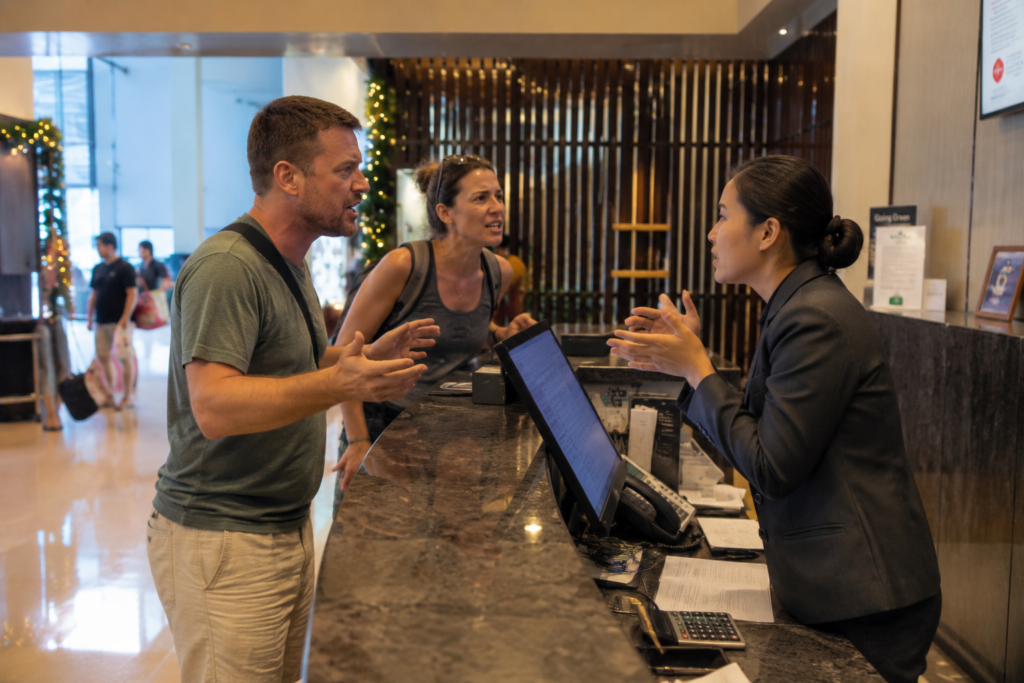
If there is one thing that consistently appeared in discussions with locals, expats, and long-term travellers, it is this: public emotional control matters enormously in Thailand.
Western cultures often reward directness and emotional expression. Thailand often values the opposite.
People repeatedly described tourists:
- screaming in hotel corridors at night
- shouting on public transport
- arguing aggressively with staff
- causing drunken scenes in restaurants
- treating shared spaces like private party zones
What fascinated me was that Thai people often still remain outwardly polite during these situations. That politeness can fool tourists into thinking the behaviour is acceptable.
But several locals explained something important: in Thai culture, creating social discomfort publicly is often viewed as immature and embarrassing — not only for the person behaving badly, but for everyone forced to witness it.
The same applies when going out at night, especially in areas where locals, tourists and expats mix. Bangkok has a very international nightlife scene, and my experience of going out in Bangkok as a foreigner was generally relaxed as long as you pay attention to the people around you.
This is why many Thai people will avoid confrontation until a situation becomes extreme.
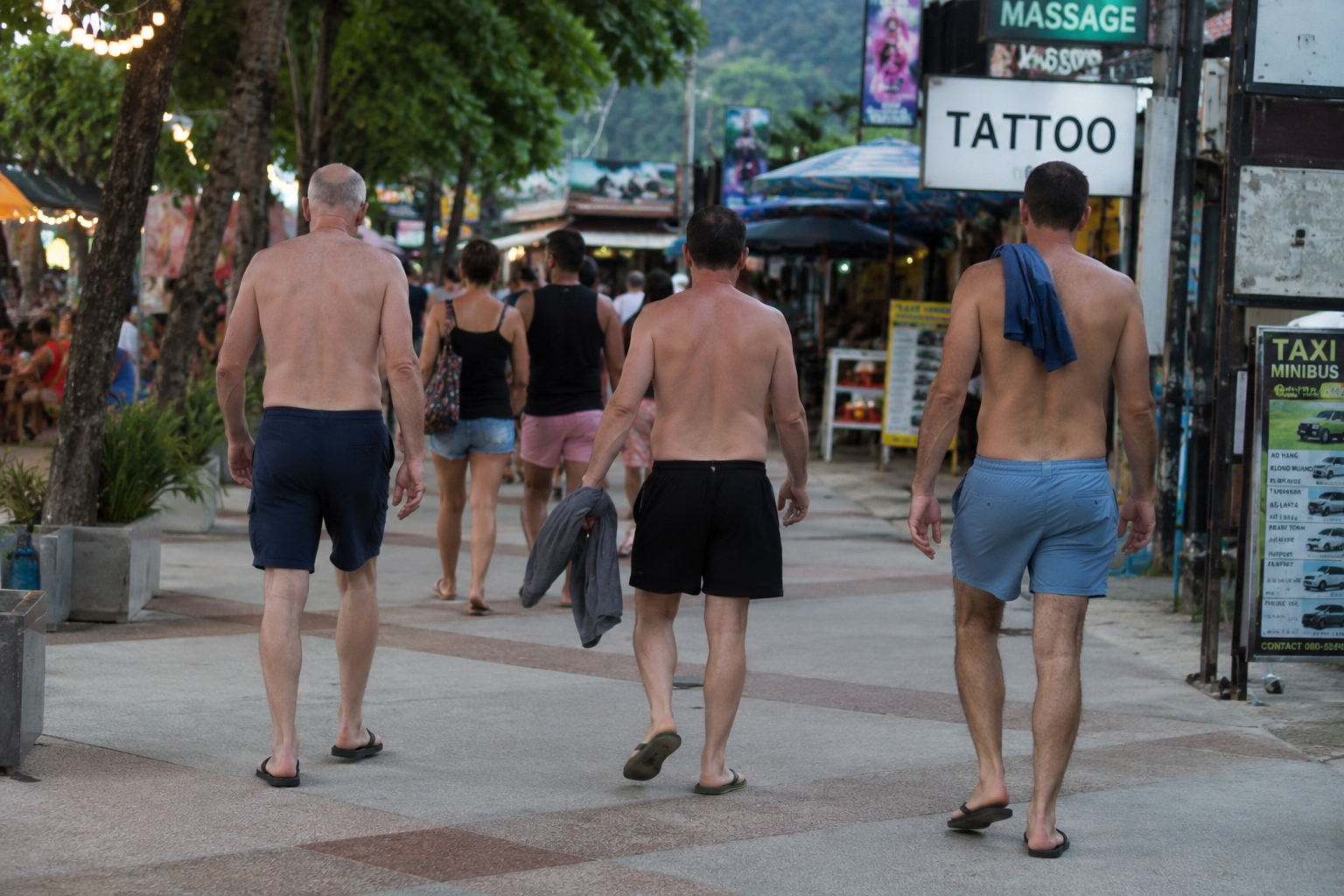
Walking Around Shirtless Outside the Beach
Before spending time in Bangkok, I honestly never realised how negatively shirtless tourists are viewed in many parts of Thailand.
In tourist-heavy areas, especially islands and beach towns, many foreigners start treating the entire country like an extension of the beach. But locals repeatedly mentioned that seeing tourists shirtless inside:
- 7-Eleven stores
- shopping malls
- restaurants
- BTS stations
- street food areas
- hotel lobbies
is considered rude and low-class.
Interestingly, Thai people rarely confront tourists directly about it. Instead, many simply exchange uncomfortable looks or quietly judge the behaviour.
The more I researched this topic, the clearer it became that Thailand places enormous importance on understanding social context. Behaviour acceptable at the beach becomes disrespectful once you move into public city spaces.
What Is Considered Disrespectful in Thailand? The Meaning Behind the “Head Rule”
Why Touching Someone’s Head Feels Different in Thailand
At first, the famous “don’t touch people’s heads” rule sounded almost ridiculous to me. Like many foreigners, my first reaction was: who even does that?
But after reading discussions from Thai locals, expats, teachers, and families living in Thailand, I realised the rule is less random than it initially appears.
In Thai culture, the head is symbolically associated with dignity, spirituality, and personal respect. The issue is not usually strangers randomly patting adults on the head. It appears more often in subtle situations foreigners barely think about:
- touching children’s hair affectionately
- playfully ruffling a friend’s hair
- touching someone’s head jokingly
- reaching over someone’s head
- treating head-touching casually in social interactions
One thing that stood out during my research was how often Thai people quietly tolerate uncomfortable behaviour rather than openly reacting to it. Several foreigners admitted they only realised later that touching a Thai child’s head had made parents uncomfortable, even though nobody directly said anything.
That silent tolerance seems to confuse many tourists.
Feet Symbolise the Opposite of the Head
The opposite side of this etiquette system involves feet.
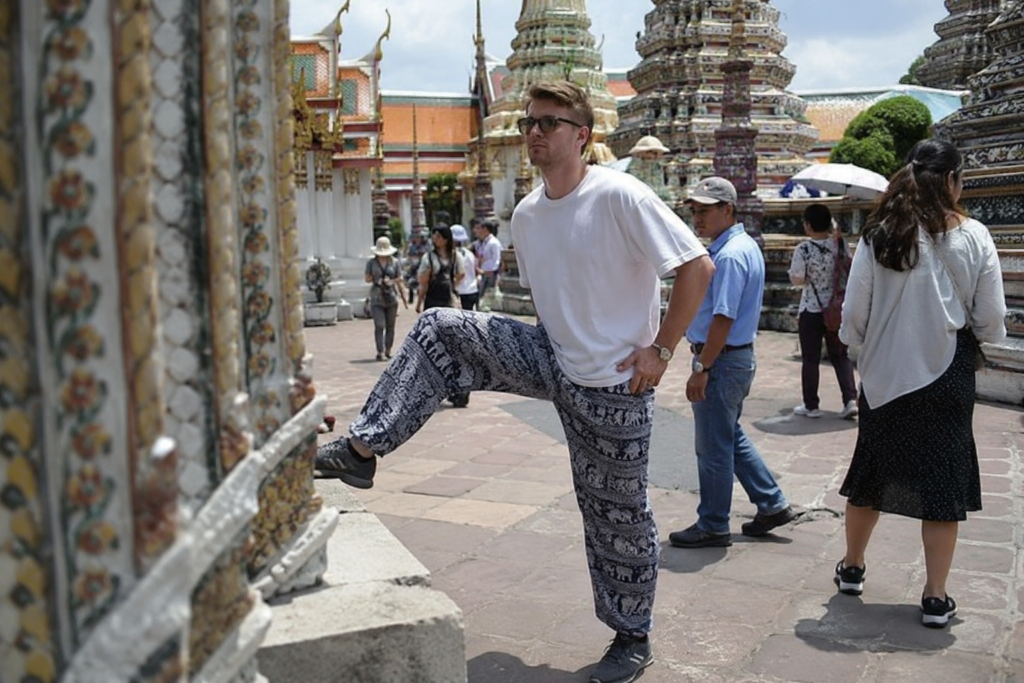
In Thailand, feet are culturally associated with dirtiness and low status. Most tourists hear the simplified version — “don’t point with your feet” — but the actual etiquette is much broader.
It also includes:
- showing the soles of your feet toward people
- stretching your legs toward Buddha statues
- putting feet on chairs or tables
- using feet to move objects
- pointing feet toward monks or elders
I noticed this especially inside temples, where Thai people often sit carefully with their feet tucked away rather than stretched outward.
To many foreigners, these details may seem symbolic or old-fashioned. But they reflect something much deeper about hierarchy, physical respect, and awareness of shared space.
What Is Considered Offensive in Thailand? Temples, Monarchy and Social Boundaries
Temples Are Spiritual Spaces, Not Instagram Sets
One thing I became increasingly aware of while living in Bangkok was how differently many tourists and locals experience temples.
For tourists, temples often become visual attractions or photography locations. For Thai people, they remain active spiritual spaces deeply connected to religion, grief, family life, and identity.
This is why seemingly “small” rules matter:
- covering shoulders and knees
- removing shoes
- avoiding loud behaviour
- not climbing sacred structures
- not posing disrespectfully near Buddha statues
Most tourists follow these rules without issue. But problems start when people treat temples like entertainment venues rather than religious spaces.
The Monarchy Is Still Extremely Sensitive
Another topic foreigners often underestimate is the monarchy.
Even tourists who know little about Thai politics quickly learn that jokes, mockery, or disrespect involving the royal family are taken very seriously in Thailand — socially and legally.
Several people explained that even stepping on money can upset locals because Thai currency contains royal imagery.
This is not one of those “funny cultural rules” tourists should test for themselves.
What Is Considered Impolite in Thailand? Small Details That Reveal Respect
Shoes, Cleanliness and Shared Spaces
Something I noticed repeatedly in discussions was how strongly Thai etiquette connects cleanliness with respect for others.
Removing shoes is not limited only to temples. Depending on the setting, shoes may also be removed in:
- homes
- small businesses
- clinics
- pharmacies
- some offices
People also mentioned behaviours many foreigners never think about, such as hanging dirty shoes outside backpacks where they brush against strangers on crowded trains.
Again, the pattern appears repeatedly: Thai etiquette is deeply connected to awareness of how your actions affect people around you.
Even Hand Gestures Work Differently
One surprisingly interesting detail I learned while staying in Bangkok involved gestures.
In many Western countries, people call someone over using one finger curled upward. In Thailand, that gesture can feel rude or overly commanding.
Instead, Thai people often gesture with:
- the whole hand
- palm facing downward
- fingers moving downward
I started noticing this everywhere — taxi drivers, restaurant staff, office workers, street vendors.
It is one of those tiny cultural details you barely notice as a tourist, but once you see it, you suddenly understand how much Thai communication relies on softness rather than dominance.
What Things Are Considered Rude in Thailand? The Bigger Cultural Reality
After analysing discussions, speaking with locals, and observing daily life in Bangkok as a digital nomad, I honestly think most Thai etiquette rules can be reduced to one central idea:
Thailand values social harmony more than personal expression.
That single difference explains almost everything.
Spending so much time working around the city also meant seeing a side of Bangkok that most short-term visitors miss. I moved between cafés, public spaces and other places to work for free in Bangkok, which gave me plenty of opportunities to observe how people behave in everyday shared spaces.
Coming from a more direct Western communication style, I noticed how differently emotional tension is handled in Thailand. Public confrontation, passive aggression, and social humiliation are often avoided completely, which reminded me of some dynamics I explored while writing about what is toxic friendship and how emotionally draining behaviour affects people socially.
Many Western societies encourage people to be loud, direct, emotionally expressive, and confrontational when necessary. Thailand often rewards calmness, patience, humility, and emotional self-control instead. A similar contrast can also be seen in the Mediterranean communication style, where expressive conversations are sometimes mistaken for anger by visitors from quieter cultures.
And this is exactly why so many tourists accidentally come across as rude without understanding why.
The real issue is rarely whether someone accidentally points their feet the wrong way or forgets a temple dress code once. Thai people are usually extremely forgiving about honest mistakes.
The bigger problem is when tourists arrive believing Thailand exists purely for their entertainment — a place where normal social rules no longer apply because they are on holiday. This kind of behaviour is often discussed in conversations about respectful tourism and cultural awareness, especially in countries where social harmony and public respect are deeply valued.
The longer I spent in Bangkok, the more I realised that understanding what is considered rude in Thailand, what is considered disrespectful in Thailand, and what is considered offensive in Thailand has very little to do with memorising strange cultural rules.
It is really about emotional awareness.
Watch how locals behave. Stay calm in public. Avoid humiliating people. Respect shared spaces. And never assume that silence automatically means approval.
FAQ
What is considered rude in Thailand?
Many behaviors considered rude in Thailand involve creating public discomfort or showing a lack of respect for others. Common examples include shouting in public, arguing aggressively, disrespecting religious spaces, walking shirtless away from beaches, touching someone’s head, or behaving in a way that disrupts social harmony.
What is considered disrespectful in Thailand?
Disrespectful behavior often includes ignoring local customs, showing anger publicly, pointing feet toward people or sacred objects, dressing inappropriately at temples, and treating Thai cultural traditions as a joke. Respect is often expressed through awareness of how your actions affect people around you.
What is considered offensive in Thailand?
Topics involving religion, Buddha images, temples, and the monarchy are among the most sensitive areas in Thai society. Jokes, mockery, or disrespect toward these institutions can be viewed as deeply offensive both socially and, in some cases, legally.
Why is public anger considered rude in Thailand?
Thai culture places a strong emphasis on emotional control and social harmony. Public arguments, aggressive confrontations, shouting, or causing scenes can make other people uncomfortable and are often seen as signs of poor self-control rather than strength.
Is it rude to walk around shirtless in Thailand?
Yes, outside of beaches and certain resort areas. While tourists often associate Thailand with beach culture, many locals consider walking shirtless in shopping malls, convenience stores, restaurants, public transport stations, and city streets to be disrespectful and inappropriate.
Why shouldn’t you touch someone’s head in Thailand?
In Thai culture, the head is traditionally associated with dignity and spiritual significance. Even seemingly harmless gestures such as ruffling a child’s hair or touching someone’s head playfully can make some people uncomfortable.
Why are feet considered disrespectful in Thailand?
Feet are traditionally viewed as the lowest and least clean part of the body. Pointing feet toward people, monks, Buddha images, or sacred objects can be interpreted as disrespectful. This is why many people are careful about how they sit in temples and religious spaces.
What should tourists wear when visiting temples in Thailand?
Visitors are generally expected to dress modestly by covering their shoulders and knees. Shoes should be removed before entering many temple areas, and behavior should remain quiet and respectful since temples are active religious spaces, not simply tourist attractions.
Can tourists accidentally offend Thai people?
Yes, but most Thai people are very understanding of honest mistakes. Problems usually arise when visitors show arrogance, entitlement, or a lack of respect for local customs rather than simply making an innocent cultural misunderstanding.
Why do Thai people smile even when they disagree?
Many foreigners misinterpret smiles as agreement or approval. In reality, Thai people often avoid direct confrontation and may remain polite even when they strongly disagree or find behavior inappropriate. A smile can sometimes reflect politeness rather than genuine approval.
What is the most important cultural rule in Thailand?
If there is one principle behind most Thai etiquette, it is respect for social harmony. Staying calm, avoiding public embarrassment, treating people politely, and being mindful of shared spaces will usually help visitors navigate Thai culture successfully.
How can tourists avoid being rude in Thailand?
The easiest approach is to observe local behavior, remain respectful, stay calm in public, dress appropriately in cultural and religious spaces, and remember that being a guest in another country involves adapting to local norms rather than expecting locals to adapt to yours.
Explore the Culture & Society Hub
Discover more stories about language, identity, traditions, social habits and the cultural details that shape everyday life around the world.
Explore the Culture & Society Hub →This article combines personal observations from travelling in Thailand, independent editorial research, and discussions from travellers, expats, and long-term visitors sharing their experiences of Thai culture and social etiquette.
Research sources included:
- Personal observations and experiences from travelling in Thailand.
- Community discussions and first-hand cultural experiences shared on Reddit by travellers, expats, and digital nomads.
- Background information on Thai culture, customs, traditions, and social norms from Wikipedia.
- Reporting and cultural analysis published by BBC.
The goal is to help travellers better understand Thai cultural expectations, avoid common social mistakes, and interact respectfully with local communities while visiting or living in Thailand.

Founder & Editor
Founder of The City Theory, writing about digital nomad lifestyle, modern city culture, remote work, travel experiences, psychology and human behaviour around the world.