How to Write a CV With ChatGPT That Actually Sounds Like You
Yes, ChatGPT can help you write a CV, but I wouldn’t ask it to create the entire document from one vague prompt. The better approach is to give ChatGPT your real work history, tell it exactly which jobs you are targeting, provide the job description, and work through the CV section by section. I recently did exactly that with my own CV while looking for a new job. It helped me see what was weak, rewrite sections and reposition my experience, but I also learned very quickly that if you give ChatGPT too much freedom, it can turn a perfectly normal career into something that sounds like a corporate press release.
Can ChatGPT Actually Write a Good CV?
It can, but there is a big difference between using ChatGPT as an editor and asking it to invent a CV for you.
If you type, “Make me a professional CV for an Account Manager job,” you will probably get something polished. You may also get phrases like “results-driven professional,” “proven track record,” “dynamic leader” and other expressions that could belong to almost anyone. Even worse, if you haven’t given enough information, AI may fill the gaps with achievements, responsibilities or numbers that sound plausible but aren’t true.
That is not how I use it.
When I was rebuilding my own CV, I already had more than ten years of experience in account management, partnerships and digital marketing. My problem wasn’t a lack of experience. My problem was deciding which parts of that experience mattered for the jobs I wanted now.
I was targeting Account Manager, Partnerships Manager and Customer Success roles. Those jobs overlap, but they are not identical. A CV that spends half a page talking about affiliate acquisition might make sense for one position and completely distract from my account management experience for another.
That was where ChatGPT became genuinely useful.
How I Used ChatGPT to Rewrite My Own CV
My old professional summary was accurate, but it tried to explain everything I had ever done. Account management, partnerships, affiliate marketing, performance marketing, publisher development, campaign analysis, SEO — technically all relevant to my career, but together they made the direction of the CV less obvious.
Instead of asking ChatGPT to “make it better,” I gave it my actual CV and explained the roles I wanted to target. I also told it what I did not want it to do: don’t invent revenue numbers, don’t add certifications, don’t turn ordinary responsibilities into fake achievements, and don’t describe me as having experience I didn’t have.
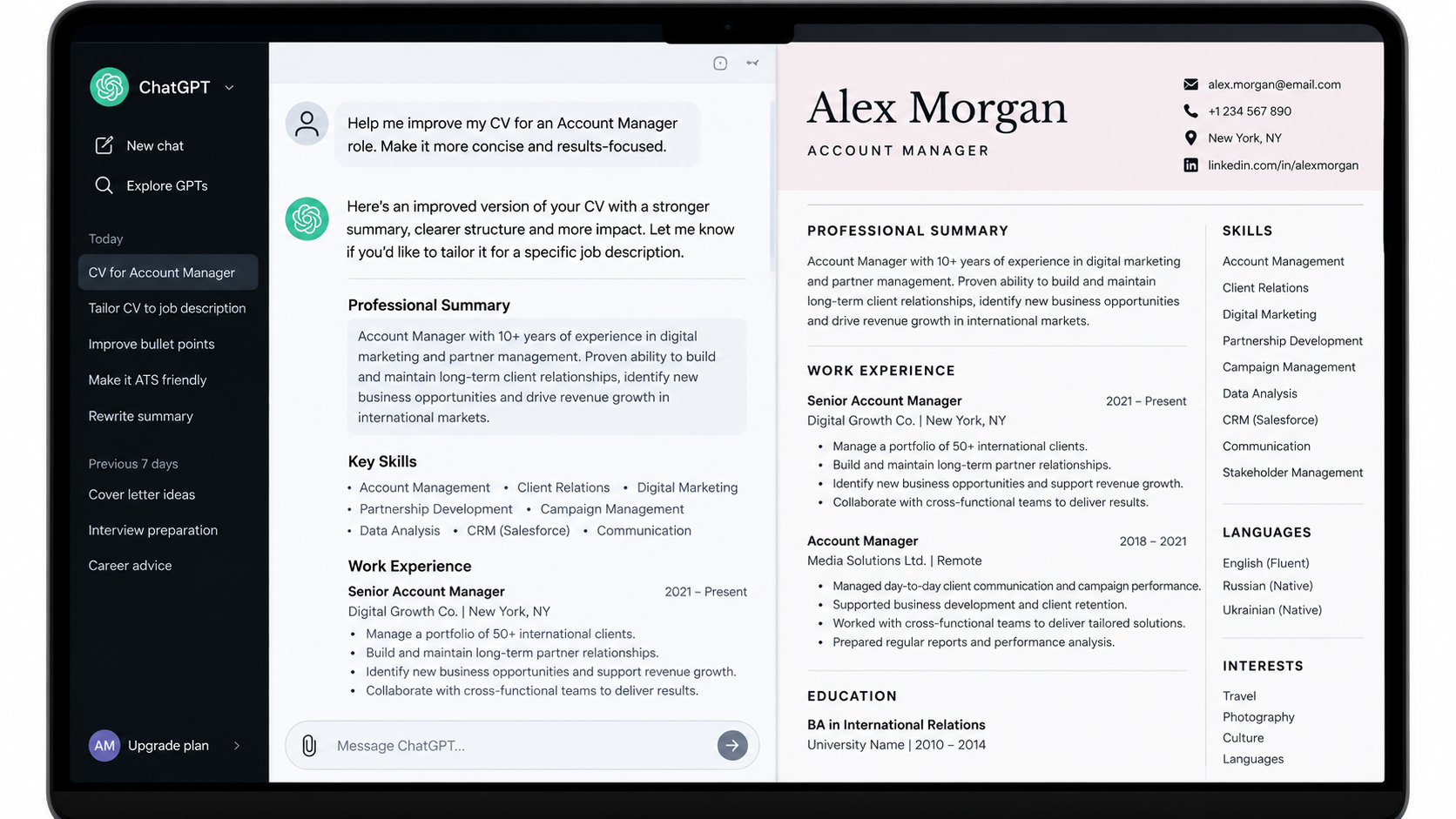
The result became much more focused. My summary could lead with account and partnership management, international clients, digital marketing, campaign performance and business development instead of trying to squeeze my entire career into one paragraph.
This is the biggest thing I learned about how to write a CV with ChatGPT: give it decisions to help you make, not permission to make up a career for you.
The same principle applies to the rest of the job search. A stronger CV can improve your chances of getting through the first screening, but it doesn’t mean sending the same document to hundreds of companies. I found that changing the overall approach to applications mattered just as much when I was trying to find a job faster rather than endlessly applying and waiting for replies.
How to Write a CV With ChatGPT Step by Step
Step 1: Give ChatGPT Your Real Career Information
If you’re wondering how to ask ChatGPT to write a CV, don’t start with:
ChatGPT needs raw material first. I would give it your job titles, company names, employment dates, actual responsibilities, tools you’ve used, education, skills and any achievements you can genuinely support.
If you already have a CV, you can start with that instead. This is also the easiest answer to how to rewrite a CV with ChatGPT: don’t start from zero when you already have ten years of information sitting in an old document.
My first prompt would look more like this:
That last instruction matters more than it seems.
Step 2: Tell ChatGPT Which Job You Actually Want
A CV isn’t your autobiography. It is a document designed to show why your experience makes sense for a particular type of job.
For example, my background can be presented differently for an Account Manager position and a Customer Success position without changing a single fact.
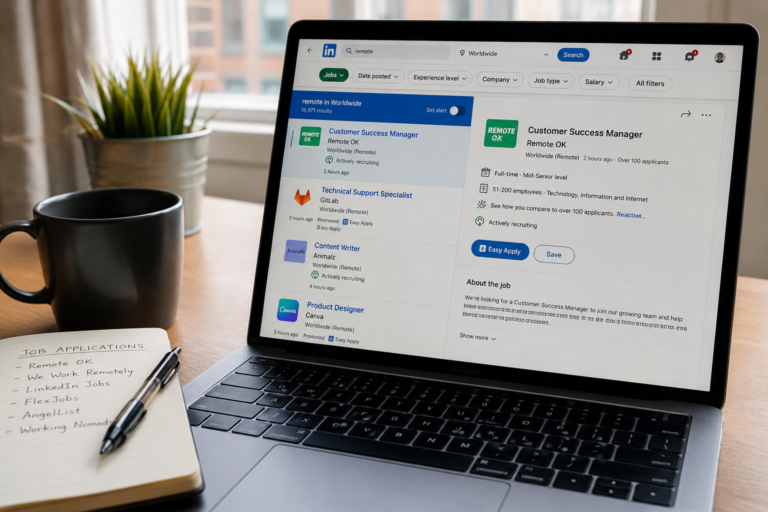
For Account Manager roles, I might emphasize client relationships, campaign performance, reporting, commercial opportunities and account growth. For Customer Success, the same career can put more emphasis on onboarding, issue resolution, ongoing communication, retention and helping clients get value from a service. This idea of tailoring isn’t limited to ChatGPT. LinkedIn’s own job-search tools are designed around helping candidates highlight relevant skills and experience for a particular application rather than presenting every part of their background equally.
This becomes even more important if you’re trying to enter a different part of the market. Someone looking for entry-level remote work opportunities shouldn’t fill a CV with impressive-sounding skills copied from job advertisements. The goal is to find the overlap between what the employer needs and what you can actually prove you’ve done.
Step 3: Give ChatGPT the Job Description
This is probably the most useful thing I now do when applying.
If you want to know how to tailor a CV to a job description with ChatGPT, paste the vacancy and ask ChatGPT to compare it against your existing CV before rewriting anything.
For example:
That final category is important. If the vacancy asks for five years of SaaS experience and you don’t have it, ChatGPT shouldn’t quietly turn something vaguely related into “5+ years of SaaS experience.”
You now know what should be emphasized and what should be left alone.
Step 4: Rewrite the Professional Summary
One of the easiest ways to spot an AI-written CV is the summary. Ask AI to “make it professional” and suddenly everyone becomes a “highly motivated results-driven professional with a proven track record of delivering exceptional results.”
Nobody talks like that.
When figuring out how to use ChatGPT to write a resume summary, I found it much better to control both the facts and the style.
Try:
You can change the priorities depending on the vacancy.
This works whether you’re researching how to write a resume with ChatGPT or a CV. The terminology changes between countries, but the editing process is essentially the same.
Step 5: Rewrite Work Experience Without Inventing Achievements
This was the part where I had to be most careful.
A weak CV often lists responsibilities:
“Managed partners.”
“Prepared reports.”
“Monitored campaigns.”
AI’s instinct is sometimes to make those sound more impressive by adding things that were never provided. Suddenly you “increased revenue by 35%,” “managed a portfolio of 50 clients” or “improved retention by 20%.”
That might look fantastic until an interviewer asks how you achieved the 35%.
If you’re learning how to use ChatGPT to rewrite work experience, explicitly protect the facts:
That is also my preferred method for how to use ChatGPT to improve resume bullet points. If you genuinely increased sales by 30%, use it. If you don’t know the percentage, don’t let AI manufacture one because resume advice says every bullet needs a number.
Step 6: Use ChatGPT to Check ATS Keywords
The question how to make a CV ATS friendly with ChatGPT sounds more complicated than it needs to be.
I don’t ask ChatGPT to “beat the ATS.” I ask it to identify relevant language that appears in the vacancy and compare it with language already present in my CV.
My prompt is:
That second group is what makes this useful.
If “Salesforce” appears in the vacancy and you’ve genuinely used Salesforce, perhaps it should be more visible. If the employer wants Tableau and you’ve never touched Tableau, repeating it three times won’t magically make you qualified.
Step 7: Clean Up the Skills Section
Skills sections easily become keyword dumping grounds.
I would give ChatGPT the job description and my existing skills, then ask:
This is particularly useful when you’re applying to several types of positions. Your master CV can contain everything, while the version you actually submit concentrates on what matters for that job.
The same approach works when applying through LinkedIn. Instead of trying to make one profile and one CV fit every possible vacancy, I prefer coordinating the language between the CV, target position and the way I use LinkedIn for remote job searching.
Step 8: Ask ChatGPT What It Invented
I wouldn’t skip this step.
After finishing the CV, ask:
Then check the list yourself.
ChatGPT is useful precisely because it can take messy information and turn it into something structured. That same ability can become a problem when it turns an implication into a fact.
A CV isn’t the place for “close enough.”
How to Make a ChatGPT CV Not Sound Like ChatGPT
The easiest way to make AI-written text sound artificial is to keep asking it to make things “more professional.”
I would remove phrases such as “dynamic professional,” “results-driven individual,” “proven track record,” “highly motivated professional” and anything involving “leveraging synergies” unless you genuinely speak like a corporate annual report.
Instead, my prompt is:
That’s essentially how to make ChatGPT resume sound human: give it your information, your vocabulary and clear restrictions instead of asking it to generate impressive language.
And then edit the result yourself.
If I read a sentence and think, “I would never say this,” it doesn’t stay in my CV.
This matters even more for people applying for new kinds of work, including remote AI-related jobs for beginners, where it can be tempting to make a CV sound much more technical than the person’s actual experience. A simpler accurate CV is much easier to defend in an interview than an impressive document describing a person who doesn’t exist.
Best ChatGPT Prompts for Writing a CV
I don’t think you need 50 clever prompts to create a good CV. Most of the time, a handful of specific prompts works better because you remain in control of what ChatGPT is changing and why.
If someone asks me what prompt to use for ChatGPT to write a CV, I wouldn’t recommend one enormous prompt that tries to create the whole document. I would use separate prompts for each job.
Here are the ones I actually find useful.
1. Start with your existing experience
2. Rewrite the professional summary
3. Improve work experience
4. Improve weak bullet points
5. Tailor the CV to a vacancy
For me, this is probably the best ChatGPT prompt for CV customization because it prevents a common mistake: treating the job description as a shopping list and copying everything into the CV.
6. Check ATS keywords
7. Choose relevant skills
8. Remove the AI voice
9. Fact-check the final CV
10. Do a final recruiter review
The important part isn’t memorizing these prompts. It is keeping ChatGPT on a short leash. I prefer asking it to analyse first and rewrite second because I can see what it intends to change before it starts producing polished sentences.
Should I Use ChatGPT for My CV?
Yes, but I use it more like an editor than a CV writer.
ChatGPT is particularly useful for spotting repetition, making long descriptions shorter, comparing a CV with a vacancy, selecting relevant skills and finding places where the language doesn’t match the position you’re targeting.
I wouldn’t use it to decide what I’ve achieved.
That distinction sounds obvious until you see a perfectly written bullet point claiming you increased revenue by 40% when you never supplied that number.
If you’re asking can ChatGPT improve my resume, the answer is yes, especially when the problem is presentation rather than experience. It can make relevant experience easier to find. It cannot turn experience you don’t have into experience you do.
Can Employers Tell You Used ChatGPT to Write Your CV?
There isn’t a reliable way for a recruiter to look at an ordinary sentence and know that ChatGPT wrote it. What they can notice is a CV that sounds generic, exaggerated or strangely disconnected from the person they’re interviewing. AI-assisted applications are already part of modern recruiting. LinkedIn’s reporting on AI-assisted job applications describes recruiters dealing with growing numbers of applications as candidates use generative AI to personalize and scale their job searches.
Imagine your CV says:
Strategic and results-driven professional with a proven track record of leveraging cross-functional synergies to deliver transformative business outcomes.
Then during the interview you explain your experience in completely normal English.
The contrast isn’t helping you.
So when people ask can employers tell if you used ChatGPT for resume writing, I think they are worrying about the wrong thing. I would worry much more about whether the CV sounds believable and whether I can explain every sentence in an interview.
My rule is simple: if an interviewer points to any bullet on my CV and asks, “Tell me about this,” I should know exactly what it means and be able to give a real example.
Is It Safe to Upload a CV to ChatGPT?
This is something I would think about before simply uploading the original document.
A CV can contain your full name, phone number, personal email, home address, date of birth and other personal information that ChatGPT doesn’t need in order to improve your work experience section. If you’re concerned about privacy, it’s also worth checking your ChatGPT data controls before uploading a document. OpenAI allows users to turn off “Improve the model for everyone,” which means new conversations won’t be used to train its models.
If your question is can I upload my CV to ChatGPT, you can work with a CV document, but I would remove unnecessary personal information first. For rewriting purposes, ChatGPT needs to know that you worked as an Account Manager from one date to another. It doesn’t need your phone number to improve that description. For an extra layer of privacy, OpenAI also offers Temporary Chat, which doesn’t appear in regular chat history and isn’t used to train its models.
This is also a good reason to keep a separate working copy of your CV. Remove information that isn’t relevant to the editing task, use that version while working on the text, and put the necessary contact information back into the final document yourself.
How to Write a CV With ChatGPT for a Job, Not for Every Job
One of the mistakes I made in the past was thinking that a strong CV should explain my whole professional history equally well.
It doesn’t need to.
If I’m applying for an Account Manager position, the recruiter doesn’t need every detail of every type of work I’ve ever done. They need to quickly understand why my background makes sense for that particular position.
That is why how to write a CV with ChatGPT for a job is slightly different from simply asking it to improve your existing document. Give it the actual vacancy and ask what parts of your genuine experience deserve more attention.
You don’t necessarily need to rebuild the CV from scratch for every application. Often I change the summary, order or wording of skills, and a few experience bullets. For a closely related vacancy, that can be enough.
The final document should still describe the same person. You’re changing the emphasis, not the facts.
What I Would Never Let ChatGPT Do to My CV
I wouldn’t let it invent metrics because “CVs with numbers perform better.” I wouldn’t add software simply because a vacancy mentions it. I wouldn’t change a job title to something I never officially did without making sure the new wording is accurate. I wouldn’t claim management experience because I occasionally helped a colleague, and I wouldn’t allow AI to turn “worked with international partners” into “managed a global portfolio of high-value enterprise clients.”
Those changes can look small on the screen, but together they create a completely different candidate.
I also wouldn’t send the first version ChatGPT gives me. I read everything, remove language I don’t like, shorten sentences and sometimes restore my original wording because it simply sounds more like me.
The goal isn’t to produce the most impressive CV ChatGPT is capable of writing. The goal is to produce the clearest version of your actual experience.
How to Make a ChatGPT Resume Sound Human
If you’re specifically searching for how to make a ChatGPT CV not sound like ChatGPT, stop asking it to make your writing “more impressive.”
Give it constraints instead.
Tell it that the language should be simple. Tell it not to use clichés. Tell it not to add adjectives just to make you sound important. Give it a maximum length. Tell it what experience you want emphasized and, most importantly, read the result aloud.
This is also my answer to how to make ChatGPT resume sound human: the final editing has to involve a human.
For example:
Too generic:
Much closer to how I would actually describe myself:
The second sentence isn’t trying nearly as hard, which is exactly why I trust it more.
The Biggest Mistake: Asking ChatGPT to Make You Look Better Than You Are
The temptation is understandable. You paste a vacancy into ChatGPT, paste your CV underneath it and ask it to create the “perfect CV for this position.”
The perfect candidate then appears.
Unfortunately, that candidate may not be you.
I get better results when I reverse the question. Instead of asking:
I ask:
That gives me something useful. Maybe I meet seven of ten important requirements. Maybe three requirements are completely outside my experience. Fine. I can emphasize the seven without pretending the other three exist.
A CV should get you into an interview, but then you have to be the person described on the page.
Would I Write My Next CV With ChatGPT?
Yes. I already have.
But I wouldn’t give ChatGPT my career and say, “Make me employable.” I would give it the facts, the vacancy and very specific instructions, then make the decisions myself.
That is ultimately how to use ChatGPT to write a CV without ending up with a document that could belong to anyone. Let it organize, compare, shorten and rewrite. Let it show you where your experience matches a vacancy. Let it point out weak bullet points and missing relevant keywords.
Just don’t let it decide who you are.
For me, learning how to improve my CV with ChatGPT wasn’t about finding a magic prompt. It was realizing that the best results came when I stopped asking AI to make my experience sound impressive and started asking it to make my real experience easier to understand.
FAQ
Can ChatGPT write my CV?
Yes, ChatGPT can help create and rewrite a CV using information you provide, but I wouldn’t ask it to generate everything from scratch. Give it your real work history and work through the summary, experience and skills separately. Check the final document for invented details before using it.
What is the best ChatGPT prompt for writing a CV?
There isn’t one universal prompt. I get better results by first giving ChatGPT my existing experience and the job description, then asking it to identify relevant experience before rewriting anything. For the final version, explicitly tell it not to invent achievements, numbers, tools or skills.
Can I upload my CV to ChatGPT?
Yes, but consider removing personal information that isn’t necessary for the task, such as your phone number, personal address or other sensitive details. ChatGPT doesn’t need those details to rewrite your professional summary or work experience.
Can ChatGPT make my CV ATS-friendly?
ChatGPT can compare your CV with a job description and identify relevant terminology and skills that may be missing. It shouldn’t be used to stuff a CV with keywords you can’t support. The useful keywords are the ones that appear in the vacancy and accurately describe your experience.
Can employers tell if I used ChatGPT for my CV?
A recruiter cannot reliably determine from ordinary CV text alone that it was written with ChatGPT. They can, however, notice generic language, exaggerated claims or a CV that doesn’t match how you describe your experience during an interview. Edit the final text until it genuinely sounds like you.
Should I use ChatGPT to tailor my CV for every job?
For jobs you genuinely want, I think it is useful to compare the CV with each vacancy. That doesn’t mean rewriting everything every time. Often the professional summary, skills and several experience bullets are enough to change the emphasis while keeping the underlying facts exactly the same.
Explore the Remote Work & Careers Hub
Discover more practical guides about remote jobs, hybrid work, career growth, burnout and the realities of building a career outside the traditional office.
Explore the Remote Work & Careers Hub →This article is based on my own experience using ChatGPT to build, rewrite, and tailor my CV for different job applications. Instead of simply asking AI to “make my CV better,” I tested different prompts for analysing my work history, comparing my experience with job descriptions, rewriting professional summaries and bullet points, identifying relevant keywords, and checking the final CV for information that AI may have added without evidence.
Sources and first-hand experience included:
- My own experience building and adapting CVs with ChatGPT for real job applications, including testing different prompts and reviewing the results for accuracy, relevance, and unnecessary AI-generated language.
- Guidance and job-search resources from LinkedIn, including information about resumes, job applications, skills, and matching professional experience to vacancies.
- Official information from OpenAI Help Center about ChatGPT and how the tool works.
The aim of this article is not to suggest that ChatGPT can create a good CV from one generic prompt. It shows the process I use to make AI work with my real experience without allowing it to invent achievements, skills, responsibilities, software, or numbers that were never part of my career.

Founder & Editor
Founder of The City Theory, writing about digital nomad lifestyle, modern city culture, remote work, travel experiences, psychology and human behaviour around the world.