
Why Are There So Many Indians in Dubai? What I See Living Here
If you have ever wondered why are there so many Indians in Dubai, the short answer is that India and the Gulf have been connected through trade and migration for generations, while modern Dubai created enormous demand for workers, professionals and entrepreneurs that its relatively small local population could never fill alone. India was close, had a huge labour and professional market, and already had commercial links with the Gulf. Short flights, higher earning potential for many professions, no UAE personal income tax, established family networks and an enormous existing Indian community then made every new wave of migration easier than the one before it.
I live in Dubai, and this is one of those things you notice very quickly when you stop seeing the city as a tourist. When I first came here, I expected Arabic and English to dominate everyday life. Instead, Hindi, Malayalam, Tamil and Urdu became part of the normal background noise almost immediately. I hear Indian languages in my building, in supermarkets, cafés, taxis, hospitals, offices and the Metro. Roughly half of my neighbours are Indian, and in Business Bay there are offices where it sometimes feels as though half the workforce is from India, particularly in IT, finance and other professional services.
That observation was what originally made me ask why are there so many Indians living and working in Dubai. The answer becomes much more interesting once you stop treating the Indian community as one single group.
There are construction workers and drivers, but there are also doctors, bankers, airline employees, software developers, accountants, teachers, managers, founders, restaurant owners and property investors. There are people sharing accommodation to save as much money as possible and people buying multimillion-dirham villas. Some arrived six months ago; others grew up here because their parents were already living in the UAE. These differences in income and lifestyle are visible everywhere in Dubai, even in something as everyday as jewellery shopping, where understanding why gold in Dubai has such a distinctive yellow colour also reveals a lot about local buying habits and the preference for higher-purity gold.
So when somebody asks why is the Indian population so high in Dubai, it is really a question about how Dubai itself was built.
How Many Indians Live in Dubai?
The first thing to clarify is that there is much better official data for the UAE than for Dubai alone.
According to the Embassy of India in the UAE, around 4.3 million Indian nationals were residing in the UAE based on 2024 data, representing roughly 35% of the country’s population. The Embassy describes Indians as the UAE’s largest expatriate community and notes that Kerala is the most represented Indian state, followed by Tamil Nadu, Andhra Pradesh and Telangana, while substantial communities also come from many other parts of India.
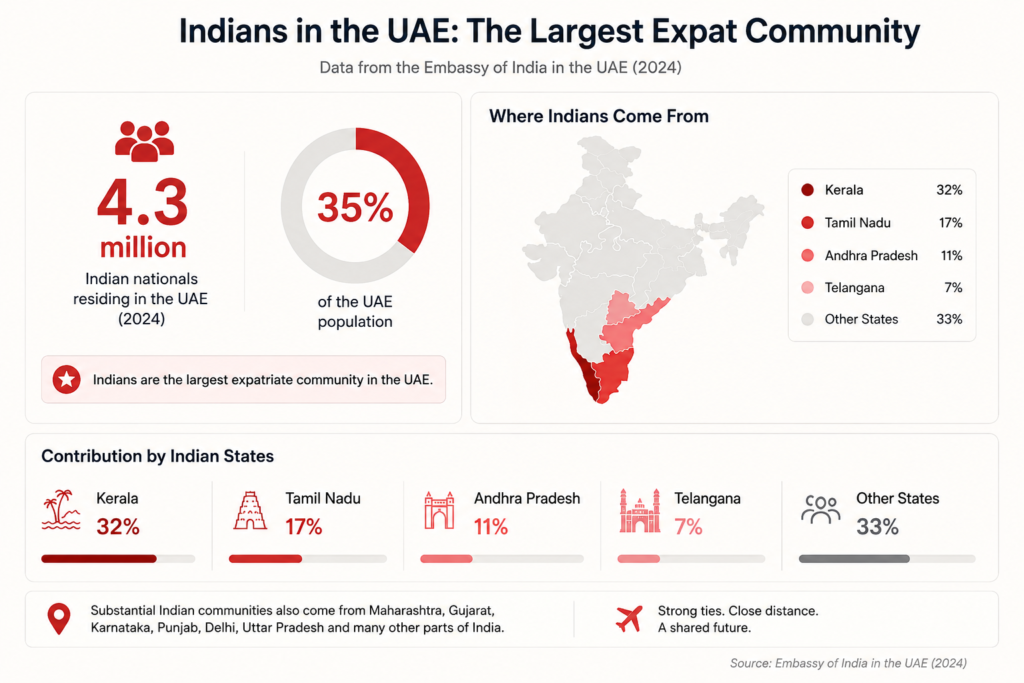
So if you search Indian population in UAE, how many Indian expats are in UAE, largest nationality in Dubai or biggest expat community in Dubai, Indians are the obvious answer.
The number for Dubai itself is less straightforward. In an interview with Gulf News, India’s Ambassador to the UAE said in 2025 that more than half of the country’s 4.3-million-plus Indian community was living in Dubai.
That explains why the percentage of Indians in Dubai feels even more striking on the ground than the UAE-wide figure suggests.
But a question like what percentage of Dubai is Indian needs some caution because population figures change quickly and nationality-by-emirate statistics are not always published in the neat form people expect. It is safer to say that Indians form by far one of Dubai’s most visible communities rather than inventing an exact percentage.
And are Indians the majority in Dubai? Not necessarily in the literal demographic sense of exceeding every other nationality combined. Dubai is extraordinarily international. But Indians are the largest single expatriate nationality and are present across such a wide range of industries and neighbourhoods that their visibility is much greater than a simple tourist might expect.
Indians Were Connected to Dubai Before the Skyscrapers
It is tempting to imagine Indian migration beginning when Dubai started constructing skyscrapers, but the relationship is much older.
Indian merchants had been trading with ports around the Gulf for centuries. The movement of pearls, textiles, spices, gold and other goods created commercial connections between Gulf settlements and ports linked to Bombay, Gujarat, Kerala and other parts of the Indian subcontinent long before anyone had heard of Downtown Dubai or Business Bay.
According to the Embassy of India in the UAE, Indian contact with the region dates back several centuries through long-standing trade and commercial links across the Arabian Sea.
This doesn’t mean today’s millions of Indian residents are simply descendants of those early traders. Most modern migration happened much later. But those historic connections matter because India was never an unfamiliar economic partner suddenly appearing during Dubai’s construction boom.
Trade routes already existed.
Business relationships existed.
Movement between the two regions already existed.
When Dubai began expanding at extraordinary speed, it therefore had a huge nearby country with which commercial and human connections were already established.
That helps answer how did the Indian community in Dubai become so large. It accumulated in layers rather than appearing in one migration wave.
Dubai Needed More Workers Than Its Population Could Provide
The next part is simply mathematics.
Dubai developed much faster than its citizen population could supply workers.
Hotels needed employees. Construction companies needed engineers and labourers. Hospitals needed doctors and nurses. Retail companies needed sales staff. Airlines needed employees. Banks needed finance professionals. Technology companies needed developers and IT specialists.
And that process never really stopped.
According to the International Labour Organization, the UAE hosts around 8.7 million migrant workers, equivalent to more than 80% of the resident population, with migrant workers making up the vast majority of private-sector employment.
This is crucial for understanding why are there so many Indians in the UAE. Indians did not enter an ordinary national labour market where foreigners were a small minority. They entered an economic model that has always depended heavily on foreign labour.
This is also why the question why are there more Indians than Emiratis in Dubai makes more sense once you understand the structure of the city. Emirati citizens are a minority within the UAE’s overall population, while Dubai’s private economy has grown around a large international workforce.
India happened to be exceptionally well positioned to supply workers across almost every level of that economy.
What Jobs Do Indians Do in Dubai?
This is where stereotypes fail badly.
If your image of Indian migration to the Gulf is limited to construction, you are looking at a much older and incomplete picture.
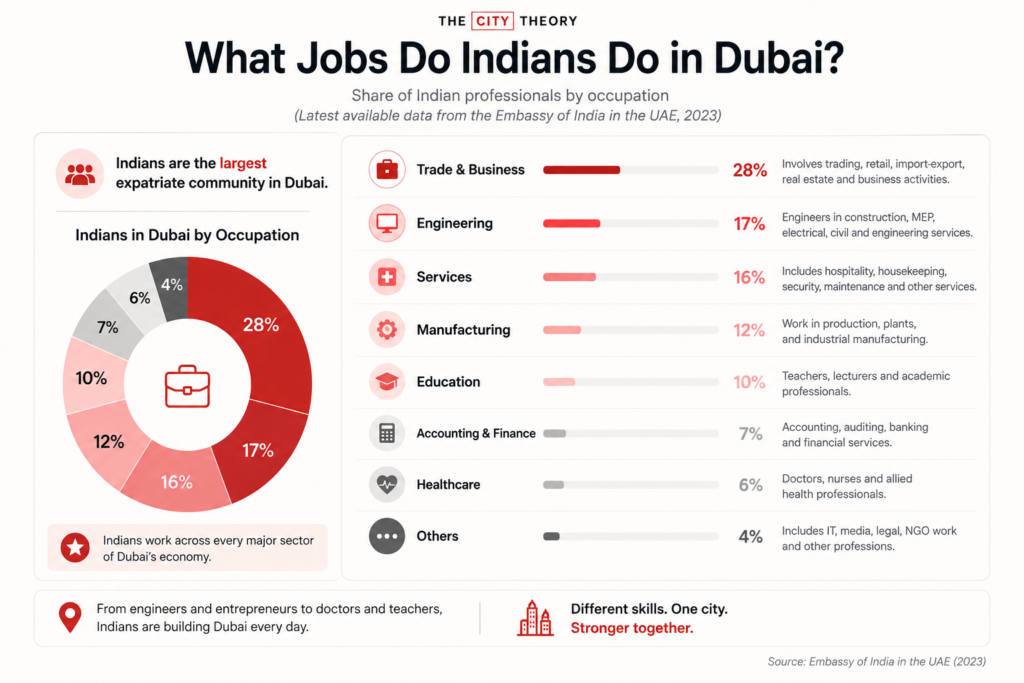
The Indian population today stretches across practically every income and professional category. In everyday Dubai, I personally notice Indian professionals particularly heavily in technology. Spend enough time around Business Bay offices and you quickly understand why. Developers, project managers, software engineers, salespeople, accountants and technical staff from India are everywhere.
But it goes much further than IT.
If somebody asks what jobs do Indians do in Dubai, the realistic answer includes banking, healthcare, aviation, hospitality, education, construction, logistics, retail, technology, engineering, management, restaurants and entrepreneurship.
That diversity is partly why Indians feel so much more embedded in Dubai than expatriate communities concentrated around one occupation.
I can encounter an Indian doctor in the morning, an Indian software engineer in an office that afternoon and an Indian restaurant owner at night. They are not living inside one isolated ethnic economy.
They are part of Dubai’s normal economy.
And for professionals thinking about moving here, that does not mean finding work is automatically easy. Dubai attracts enormous numbers of applicants, so the reality of competing for jobs in Dubai can be very different from the impression created by seeing so many expatriates already employed here.
India Is Extremely Close to Dubai
Geography is one of the most underestimated answers to why do so many Indians live in Dubai.
On a global scale, Dubai and India are neighbours.
Depending on the Indian city, many flights take only a few hours. There are frequent connections between Dubai and cities including Mumbai, Delhi, Kochi, Hyderabad, Chennai, Bengaluru and many others.
Once you live here, Dubai–India flights almost begin to feel regional.
That matters enormously.
Someone moving from India to Canada, the United States or Australia is making a very different geographical decision. Visiting parents might require an expensive long-haul flight, major planning and significant time off work.
From Dubai, going home for several days can be realistic.
The time difference is also small.
Phone calls with family don’t require coordinating completely opposite schedules. Indian television, news, sports and entertainment remain easily accessible. Business owners can continue dealing with partners or customers in India during almost the same working day.
This is the practical answer to how close is Dubai to India by flight, but the psychological effect is more important than the flight time itself: Dubai can offer the experience of living internationally without creating the same sense of distance from home.
And because this is such a heavily travelled corridor, people who travel regularly become very good at comparing routes and prices, which is where strategies for finding cheaper flights when booking late become particularly useful.
One Migrant Makes the Next Migrant’s Move Easier
This is probably one of the most important explanations that gets overlooked.
Imagine being the first person from your family to move to a completely unfamiliar country.
You have to figure out:
- where to live;
- how employment visas work;
- how much salary is reasonable;
- where to buy familiar food;
- what employer to trust;
- how transportation works;
- which school your children could attend;
- which neighbourhood fits your budget.
Now imagine your brother has already lived there for eight years.
Suddenly you have someone to answer all of those questions.
Then you arrive and later help a cousin.
A former colleague asks you about vacancies.
Your company needs another developer and asks whether you know someone.
Your children attend an Indian-curriculum school where you meet other families.
This is essentially how chain migration works.
It does not require some coordinated plan. Social networks simply reduce the cost and uncertainty of migration.
That helps explain why do Indians find it easy to settle in Dubai relative to somebody arriving from a country with a tiny local community. An Indian newcomer is entering a city where millions of people already understand the experience.
Restaurants exist.
Supermarkets stock familiar products.
Schools exist.
Religious communities exist.
Recruitment networks exist.
Professional groups exist.
Cricket clubs exist.
There are people who speak the same regional languages.
Once a migrant network reaches that scale, it begins reproducing itself naturally.
Why Are There So Many People From Kerala in Dubai?
Kerala deserves its own explanation because its relationship with Gulf migration is particularly strong.
The Indian Embassy identifies Kerala as the most represented Indian state within the UAE’s Indian population.
For decades, migration from Kerala to Gulf countries became an important economic and social pattern. Earlier migrants created family and employment networks that made subsequent migration easier, while remittances became economically important for households back home.
This is why Malayalam is one of the languages you hear constantly in Dubai.
Sometimes people who are unfamiliar with India hear it and simply assume everyone is speaking Hindi, but India’s population is linguistically and culturally enormous. A Malayali from Kerala, a Gujarati business owner, a Punjabi professional and a Tamil engineer may have completely different languages, food traditions, religions and family backgrounds.
That is why discussing why are there so many people from Kerala in Dubai is much more useful than treating “Indians” as one homogeneous population.
The Indian Community Is Not One Social Group
This becomes obvious when you actually live in Dubai.
There is no single “Indian lifestyle” here.
Some Indian workers live in shared accommodation because their priority is sending money home. Other families live comfortably in residential communities and pay for private schools. Some Indian executives earn salaries comparable to European or American professionals. Others run restaurants, supermarkets, technology companies or trading businesses. At the very top of the market, Indian entrepreneurs and investors own luxury property and major companies.
Regional differences are substantial too.
The UAE Indian community includes large numbers of people from Kerala, Tamil Nadu, Andhra Pradesh and Telangana, alongside residents from Maharashtra, Gujarat, Punjab, Uttar Pradesh, Bihar, Delhi and practically every other part of India.
Different communities bring different languages and industries with them.
This is important when answering why are there so many Indian people in Dubai, because the population did not grow through one labour channel. Dubai attracted multiple migrations simultaneously: manual workers, skilled employees, professionals, family members, entrepreneurs and investors.
The Indian community became enormous partly because it could occupy so many different parts of the economy.
Why Indian Professionals Choose Dubai Today
Today’s migration is not identical to the Gulf migration of the 1970s or 1990s.
Dubai now actively competes for international professionals, business owners and investors.
For an Indian professional, several advantages can overlap:
This is where questions such as why do Indians prefer Dubai, why is Dubai popular among Indians and why are Indians moving to Dubai have started changing.
For some migrants, the old motivation was straightforward: earn more abroad and send money home.
For a software engineer, startup founder or finance professional today, the calculation can be much more complicated. Dubai can be a career hub, tax-efficient base, business market and geographically convenient home at the same time.
The city’s growing remote-work infrastructure also matters. Professionals do not necessarily spend every day in corporate headquarters anymore, and the number of free places to work remotely around Dubai reflects how much the city’s work culture has changed.
Why Do Indian Entrepreneurs Set Up Businesses in Dubai?
The relationship works especially well for entrepreneurs because Dubai allows them to remain commercially connected to India while operating from a major international hub.
This helps explain why do Indian entrepreneurs set up businesses in Dubai, why do Indian startups expand to Dubai and increasingly why do rich Indians relocate to Dubai.
Dubai sits between Asia, Europe and Africa. Its airports connect entrepreneurs to multiple markets, while India remains close enough for frequent meetings and business trips. The city also has established Indian business networks, so a founder entering Dubai today is not beginning from zero.
The same dynamic feeds property demand. Questions such as why is Dubai popular with Indian property buyers are connected to the broader migration story: a large resident community produces demand for housing, while business owners and wealthier families increasingly view Dubai not merely as a temporary job destination but as a long-term base.
That does not mean every wealthy Indian comes for taxes, and the phrase Indians move to Dubai for tax reasons explains only part of the story. The UAE’s lack of individual income tax is undeniably attractive, but proximity, safety, business opportunities, schools, international connectivity and an established community can be just as important.
The same applies to why do Indian celebrities move to Dubai. Privacy, connectivity, property, business interests and the ability to travel quickly between India and the Gulf can all matter alongside taxation.
Why Dubai Feels Culturally Familiar to Indian Newcomers
Dubai does not feel culturally identical to India, but it can feel surprisingly familiar.
Indian food exists at every possible price point. You can eat an inexpensive dosa or biryani in a simple cafeteria and later find sophisticated Indian restaurants in five-star hotels.
And they are not limited to Deira and Bur Dubai.
I see Indian restaurants throughout JLT, Business Bay, Dubai Marina and other newer districts. The community has expanded alongside the city.
Indian schools follow familiar curricula. Bollywood releases are everywhere. Cricket matters. Diwali becomes visible across malls and businesses. Indian supermarkets and specialist food shops make it easy to cook familiar meals at home.
Hindi, Malayalam, Tamil and other Indian languages are normal sounds in everyday public spaces.
That goes a long way toward explaining why is Dubai so culturally familiar to Indians and why are Indian shops and restaurants everywhere in Dubai.
A migrant is technically moving abroad without having to abandon every familiar part of daily life.
And for someone deciding whether to remain in India or relocate, that combination creates an unusual middle ground. Questions like is Dubai better than India for work and lifestyle do not have one universal answer, because life in Bangalore, Goa or Kerala is radically different from life in Dubai, and even the realities of working remotely and staying safe in India vary enormously depending on city and lifestyle.
What Dubai offers is not simply “a better India.” It offers something structurally different: an international city located close enough to India that many migrants can maintain strong personal, professional and cultural ties with home.
Remittances Are Part of the Story Too
Another reason the Indian presence in Dubai became so established is that migration has never been only about physically relocating from one country to another. For many families, Dubai has functioned as part of a larger household economy spread across borders.
A person may work in the UAE while parents, children or extended family remain in India. Money is sent home regularly, property is bought there, education is funded there, and long-term financial plans may still be tied to India even after many years in Dubai.
The Indian Embassy in the UAE has highlighted the enormous scale of remittance flows between the two countries, which helps explain why the UAE became such an important destination for Indian migrants in the first place. The financial relationship is not temporary or marginal; it has been built into family strategies for decades.
That matters when people ask why is the UAE the top destination for Indian migrants. The answer is not just salary. It is also the fact that the migration model is already understood. Families know what it means when someone moves to Dubai for work. Banks, recruiters, airlines, schools and entire communities have developed around that movement. This broader social and economic context is also easier to understand through books that explore how Dubai developed and functions today.
For some people, the plan is still very traditional: work in the Gulf, save money and eventually return to India.
For others, the plan changes.
Five years becomes ten.
Children start school in Dubai.
A spouse joins.
A business gets established.
An apartment is bought.
At that point, a move that was originally supposed to last three years can quietly become most of someone’s adult life.
Dubai Is Close Enough to Stay Connected to India
This is one of the biggest differences between Dubai and destinations such as Canada, Australia or the United States.
India does not feel geographically distant from the UAE.
There are constant direct flights, and depending on the city, the journey can be only a few hours. Dubai airport sometimes feels less like the departure point for a major international migration corridor and more like a gigantic regional transport hub connecting dozens of Indian cities.
That changes family life.
If somebody’s parents become ill, going home does not necessarily require a 15-hour journey.
If there is a wedding, it can be possible to fly in for a few days.
Business owners can travel between both markets frequently.
Friends and relatives visit Dubai regularly.
The small time difference also means family communication stays easy. You are not calling your parents at midnight because it is morning where they live.
This logistical closeness is a surprisingly important part of why do so many Indians choose Dubai instead of Europe.
Europe may offer permanent residency routes that Dubai does not, but for someone whose emotional, professional or financial life remains strongly connected to India, being a few hours away can matter more than people realise.
Why Do Indian Families Move to Dubai?
For families, the reasons become slightly different from those of a single worker.
Safety is a major factor for many parents. So are international schools, healthcare, English-language workplaces and the possibility of having a familiar Indian social environment while still living abroad.
There are numerous schools following Indian curricula, and families can find communities connected to particular regions, religions and languages. Children may grow up in a very international environment while still being exposed to Indian festivals, food, entertainment and social networks.
This helps answer why do Indian families move to Dubai and why some remain much longer than initially planned.
At the same time, Dubai is expensive.
School fees can be substantial.
Housing costs have risen.
Healthcare and family expenses can quickly absorb what initially looked like a very attractive salary.
This is one reason why seeing a high salary advertised in Dubai does not automatically mean the person will have an extremely high standard of living. The calculation is completely different for a single professional renting a room than for a family paying for a two-bedroom apartment and two private-school places.
Not Everyone Experiences Dubai the Same Way
This is probably the most important part of the discussion.
Talking about “Indians in Dubai” as if everyone has the same experience makes no sense.
The city contains enormous differences in income and privilege.
One Indian resident may be a senior technology executive living in Downtown.
Another may be a doctor living with a family in a large apartment.
Another may run several restaurants.
Another may be a delivery rider sending most of his salary home.
Another may live in shared accommodation and see his children only once a year.
Those lives are not interchangeable.
The ILO has repeatedly documented how migrant workers across Gulf economies are heavily represented in construction, hospitality, domestic work and other lower-paid sectors. These workers can face recruitment debt, limited bargaining power, long working hours and dependence on employers for residency.
So when people ask why do Indian workers move to Gulf countries, higher earning potential may be part of the answer, but it should not be romanticised. A salary that looks modest in Dubai may still support a household back home, while the personal cost of that arrangement can be significant.
I have met people here who are clearly building comfortable international careers, and I have also seen how exhausting Dubai can be for those earning much less.
Both realities exist at the same time.
Why Do Indians Work in Dubai Despite the High Cost of Living?
Because the comparison is not always Dubai versus some imaginary perfect alternative.
People compare the job they can actually get in Dubai with the job they could realistically get somewhere else.
For an experienced engineer or IT professional, the UAE may offer better compensation, no personal income tax and access to international companies.
For somebody in hospitality or logistics, the salary may still provide more saving potential than a similar job available at home.
For an entrepreneur, Dubai may provide easier access to regional customers and investors.
The calculation varies enormously by profession.
This also explains why why do Indians work in Dubai cannot be answered with one salary statistic. A software engineer and a restaurant worker can both have perfectly rational reasons for moving while experiencing completely different versions of the same city.
Why Are Indians So Visible in Business Bay?
Business Bay is where I notice the professional side of Indian migration most clearly.
The district is packed with consulting companies, technology firms, financial services, real-estate companies, marketing agencies and regional offices. Indian professionals are extremely visible in many of them.
IT especially stands out.
Walk through office buildings during lunch hours and you hear Indian languages constantly. Developers, business analysts, technical support teams, project managers and sales professionals from India are everywhere.
This makes sense when you consider India’s enormous technology sector and English-speaking professional workforce.
Dubai companies need technical staff.
India produces large numbers of experienced IT professionals.
The distance between Dubai and major Indian technology hubs is tiny compared with the distance to North America or Europe.
Professional networks then reinforce the connection.
One engineer joins a company, recommends another person from a previous team, and eventually entire departments may contain people who previously worked together or came through overlapping professional networks.
That does not mean hiring happens because of nationality alone. It means networks become efficient recruitment channels once a community is large enough.
Why Do Indian Startups Expand to Dubai?
For Indian companies, Dubai can function as a bridge to markets that are harder to reach directly from India.
From Dubai, a company can target:
- Saudi Arabia;
- the wider Gulf;
- North Africa;
- East Africa;
- Europe;
- international investors based in the UAE.
At the same time, founders remain only a short flight from their Indian teams.
This is particularly attractive for technology, fintech, logistics, e-commerce and professional services.
So why do Indian startups expand to Dubai is partly a geography question and partly a business-infrastructure question. Dubai positions itself aggressively as a regional headquarters location, and Indian companies are close enough to take advantage of that without completely relocating their operations.
Why Is Dubai Popular With Indian Property Buyers?
Property adds another layer.
Some Indian residents buy because they already live here and expect to stay for years. Others see Dubai property as an investment. Wealthier families may also use real estate ownership as part of a broader residency strategy.
The market has become increasingly familiar to Indian buyers because the community is already enormous. There are Indian brokers, mortgage advisers, developers and buyers throughout the industry.
This makes property investment feel less foreign.
A person may already have friends who bought apartments, understand which districts are popular and know agents through personal networks.
That social familiarity lowers another barrier.
It also contributes to the newer question of why do rich Indians relocate to Dubai. For wealthy residents, the city offers a combination of international schools, luxury housing, global connectivity, safety, business opportunities and favourable personal taxation that is difficult to reproduce in one place.
Why Do Indian Celebrities Move to Dubai?
The same advantages apply to celebrities and wealthy public figures, although their lifestyle is obviously very different from that of most migrants.
Dubai offers privacy, luxury property, relatively easy access to India and strong international flight connections. Somebody working in film, sport or online media can maintain professional connections to Mumbai or Delhi while using Dubai as a base.
Taxation can matter, but it is rarely useful to reduce every wealthy person’s decision to taxes alone.
People choose places to live for combinations of reasons.
For high-income Indians, Dubai is unusual because it offers many of the advantages of an international relocation without placing them very far from India.
Why Do Indian Shops and Restaurants Seem to Be Everywhere?
Because there is enough demand to support them everywhere.
This sounds obvious, but it is another effect of community size.
When only a few thousand people from a country live somewhere, specialist businesses remain concentrated in one neighbourhood.
When millions live in the wider country, the market becomes mainstream.
That is why Indian restaurants are no longer something you only find in Bur Dubai or Deira.
They are in Marina.
JLT.
Business Bay.
Downtown.
Silicon Oasis.
International City.
And pretty much everywhere else.
The same applies to supermarkets, salons, jewellery stores, clothing shops, financial services and entertainment.
Indian culture in Dubai does not exist only in an “Indian district.” It is distributed throughout the city’s economy.
That is one of the clearest everyday answers to why are there so many Indians in Dubai: the community has become large enough that the infrastructure supporting it no longer feels specialised.
Are Indians Permanently Settling in Dubai?
This is where Dubai differs sharply from countries built around permanent immigration.
A person can live in Dubai for twenty or thirty years without becoming an Emirati citizen.
Children can be born here, attend school here and consider Dubai home while remaining citizens of another country.
Residency generally continues through employment, business ownership, investment, family sponsorship or one of the UAE’s longer-term visa categories.
So when we ask why do Indians find it easy to settle in Dubai, “settle” needs quotation marks around it.
It can be very easy to build a long-term life.
It is much harder to turn that life into the kind of permanent citizenship-based immigration available in Canada or Australia.
That creates an unusual psychological situation.
Some people know they will eventually return to India.
Others assume they will but never do.
Some children grow up in Dubai and later move to India, Europe, Canada or elsewhere because their legal relationship with the UAE is still based on residency rather than citizenship.
This temporary-permanent contradiction is part of expatriate life here.
Is Dubai Better Than India for Work and Lifestyle?
There is no meaningful universal answer.
For some professionals, Dubai offers higher disposable income, better infrastructure, safety and international career opportunities.
For others, India offers stronger family networks, lower living costs in many cities and a sense of permanent belonging that Dubai cannot provide.
The answer also depends heavily on which India you are comparing with which Dubai.
A senior professional moving from Bengaluru to Business Bay has a completely different calculation from somebody leaving a small town for a low-paid service job.
Likewise, Goa, Kerala, Mumbai and Hyderabad offer completely different lifestyles.
That is why is Dubai better than India for work and lifestyle is ultimately an individual question rather than a demographic explanation.
What Dubai clearly offers is proximity.
You can build an international career without moving halfway around the world.
For millions of Indians, that combination has been compelling enough to reshape the population of an entire city.
So Why Are There So Many Indians in Dubai?
After living here, I think the most important point is that the answer is not “because Indians like Dubai.”
The relationship is much deeper than that.
Indian merchants were connected to the Gulf before modern Dubai existed. Later, the UAE’s rapid development created huge demand for foreign workers. India was nearby, populous and already commercially connected. Early migrants built networks that helped later migrants find jobs and housing. Airlines made movement increasingly easy. Schools, restaurants, religious institutions and businesses made life more familiar. Eventually the community became so large that Dubai itself became easier for new Indian arrivals to navigate.
Then the migration pattern changed again.
Workers were joined by doctors, engineers, bankers and IT professionals.
Professionals were joined by entrepreneurs.
Entrepreneurs were joined by investors and wealthy families.
Today, Indians are visible at almost every level of Dubai society, which is why simplistic explanations about cheap labour are so misleading.
The Indian community is not something sitting separately inside Dubai.
It is one of the communities that helped create modern Dubai in the first place.
FAQ
How many Indians live in Dubai?
There is no single regularly updated official figure for Dubai alone, but official Indian government estimates put the Indian population of the UAE at around 4.3 million based on 2024 data. India’s ambassador has said that more than half of the UAE’s Indian community lives in Dubai.
Why do Indians move to Dubai?
The most common reasons include employment opportunities, higher earning potential in some professions, proximity to India, no UAE personal income tax, safety, business opportunities and an enormous established Indian community.
Are Indians the largest community in Dubai?
Indians are the largest expatriate nationality in the UAE and one of the most visible communities in Dubai. Dubai remains extremely diverse, however, so they should not be described as representing the majority of everyone living in the city without precise demographic data.
Why are there so many Keralites in Dubai?
Kerala has a decades-long history of Gulf migration. Early migration created strong family, employment and recruitment networks that made subsequent moves easier, and Kerala remains the most represented Indian state within the UAE’s Indian community.
What jobs do Indians do in Dubai?
Almost everything. Indians work in construction, hospitality, transport, retail, education, medicine, banking, aviation, engineering, IT, management and entrepreneurship. The community spans both low-paid migrant labour and some of the city’s wealthiest business owners.
Is Dubai culturally similar to India?
Not exactly, but Indian newcomers encounter a huge amount of familiar culture. Indian languages, restaurants, supermarkets, schools, cricket, films, festivals and religious communities are widely available throughout Dubai.
Do Indians pay income tax in Dubai?
The UAE does not currently impose personal income tax on individuals. Tax obligations connected to India can depend on residency status and individual circumstances, so people with complex finances should obtain professional tax advice.
Why do Indian business owners choose Dubai?
Proximity to India, access to Gulf and international markets, global air connections, established Indian business networks and Dubai’s business environment all make the city attractive to Indian founders and investors.
Where do most Indians live in Dubai?
There is no single Indian neighbourhood. Large communities historically developed around Bur Dubai and Deira, but Indian residents now live throughout areas including JLT, Dubai Marina, Business Bay, International City, Dubai Silicon Oasis and many other districts.
Do Indians plan to stay permanently in Dubai?
Some do, but permanent life in Dubai works differently from conventional immigration countries. Residents can remain for decades through work, business, property or family visas, while UAE citizenship is not the normal outcome of long-term residence.
Explore the Culture & Society Hub
Discover more stories about language, identity, traditions, social habits and the cultural details that shape everyday life around the world.
Explore the Culture & Society Hub →This article combines my own experience of living in Dubai, independent editorial research, and observations of everyday life in one of the world’s largest expatriate cities to explain why the Indian community has become such an important part of Dubai’s identity.
Research sources included:
- My own first-hand observations from living in Dubai, including daily life in Business Bay, residential neighbourhoods, public transport, supermarkets, cafés, and workplaces.
- Official information published by the Embassy of India in the UAE on the size and history of the Indian community.
- Population, migration, and community reporting published by Gulf News.
- Independent editorial research into the historical trade links between India and the Gulf, labour migration, business development, and Dubai’s expatriate economy.
The goal is to explain why Indians make up the largest expatriate community in Dubai by combining historical context, official statistics, and practical observations from everyday life while avoiding common stereotypes and oversimplified explanations.

Founder & Editor
Founder of The City Theory, writing about digital nomad lifestyle, modern city culture, remote work, travel experiences, psychology and human behaviour around the world.