

I’m the Only Single One of My Friends — Why It Feels So Lonely
If you’re the only single one of your friends, the hardest part often isn’t being single itself. It’s watching everyone else’s social life reorganise around partners while yours stays roughly the same. Weekends become couple weekends, trips require checking someone’s partner’s schedule, group dinners turn into tables of couples, and suddenly you’re the person who is usually available while everyone else has somebody who comes first. I know that feeling very well because, for as long as I can remember, relationships in my life have mostly been temporary. I had boyfriends from time to time, but nothing particularly stable or serious, and for years I didn’t think there was anything unusual about it. I had friends, work, plans and a social life, so being single was simply one part of my life rather than something I constantly analysed.
That changed because of one birthday party.
Years ago, when I was still living in my home country and working in an office, one of my colleagues invited me to his birthday. I immediately said yes because at that stage of my life I loved noisy parties. I imagined a big group of people, drinks, music and the possibility of meeting someone new. Instead, when I arrived, I realised that absolutely everybody had come as a couple. There were no other single women, no single men and nobody casually moving between different groups. I was literally the only single friend at the table, even though many of the people there were colleagues rather than close friends.
At first I tried to ignore it. Then everyone sat down for dinner, and a tiny moment happened that probably nobody else at the table even noticed. The men started pouring wine for the women sitting next to them. One man filled his girlfriend’s glass, another filled his wife’s, and then another did the same. I looked at my own empty glass and had to pick up the bottle and pour the wine myself. Obviously, pouring your own wine is not a tragedy, but in that particular moment it felt horrible. It was as if the entire table had suddenly organised itself into pairs and I was the one extra person who didn’t belong to the pattern.
I remember sitting there with a forced smile, pretending I was enjoying myself while thinking that coming had been a terrible idea. I wanted to disappear. I even felt close to crying, which surprised me because I had never considered myself particularly upset about being single before. As soon as I found a reasonable excuse, I left and went to meet my girlfriends, who happened to be at a beach club that evening. The difference in how I felt was immediate. Most of them were single too, we were laughing, moving around, meeting people and talking about anything we wanted. Suddenly I felt completely normal again, almost as if I had returned to my own tribe. The evening wasn’t ruined after all, but I remembered that dinner for years.
It was probably the first time I really understood why the sentence “I am the only single one of my friends” can feel much heavier than simply saying, “I’m single.”
Being the only single person is not always what makes you uncomfortable
For a long time I assumed my reaction at that birthday meant that I was secretly more unhappy about my relationship status than I wanted to admit. Years later, however, many of my own close friends started getting married, and something interesting happened: I did not automatically feel uncomfortable around them and their husbands.
I could spend an entire evening with a close friend and her husband, go somewhere together, have dinner or sit talking for hours without feeling like an unwanted third person. Nobody needed to make a special effort to “include the single friend.” It simply felt natural because they still spoke to me as an individual rather than behaving as if the two of them formed one unit and everybody outside that unit was background scenery.
That distinction completely changed the way I understood the problem. If you’re thinking “why am I the only single one in my friend group?”, it is easy to assume that your relationship status itself is responsible for every awkward feeling. Sometimes it isn’t. Sometimes the problem is the social dynamic created around you.
There are couples who continue behaving normally around single friends. They talk to everyone, include everyone in decisions and don’t make every conversation about their relationship. Then there are couples who effectively disappear into their own small world. They whisper to each other across the table, constantly touch each other, discuss private plans nobody else can participate in and make decisions as a pair while everybody waits. If you’re the one person without a partner in that environment, you can feel lonely even in a room full of people.
I’ve seen this happen often enough that I no longer automatically connect being the only single friend in my friend group with feeling excluded. The much more useful question is: what happens to the friendship once people become couples? I wrote separately about why some friends seem to disappear into their relationships, because the change can be surprisingly dramatic even when nobody consciously decides to end the friendship.
Everyone suddenly has someone who comes first
This, for me, is the part people don’t talk about enough. When all my friends are in relationships except me, the biggest difference is often not that they have romantic love and I don’t. It’s that almost everybody suddenly has a default person.
Before serious relationships enter the picture, arranging something can be extremely simple. You send a message saying, “Dinner Saturday?” and your friend either says yes or no. Once couples become established, that answer often changes into, “I’ll ask him,” “We’re going to his parents,” “That’s our date night,” or “We’ve already booked something for the weekend.”
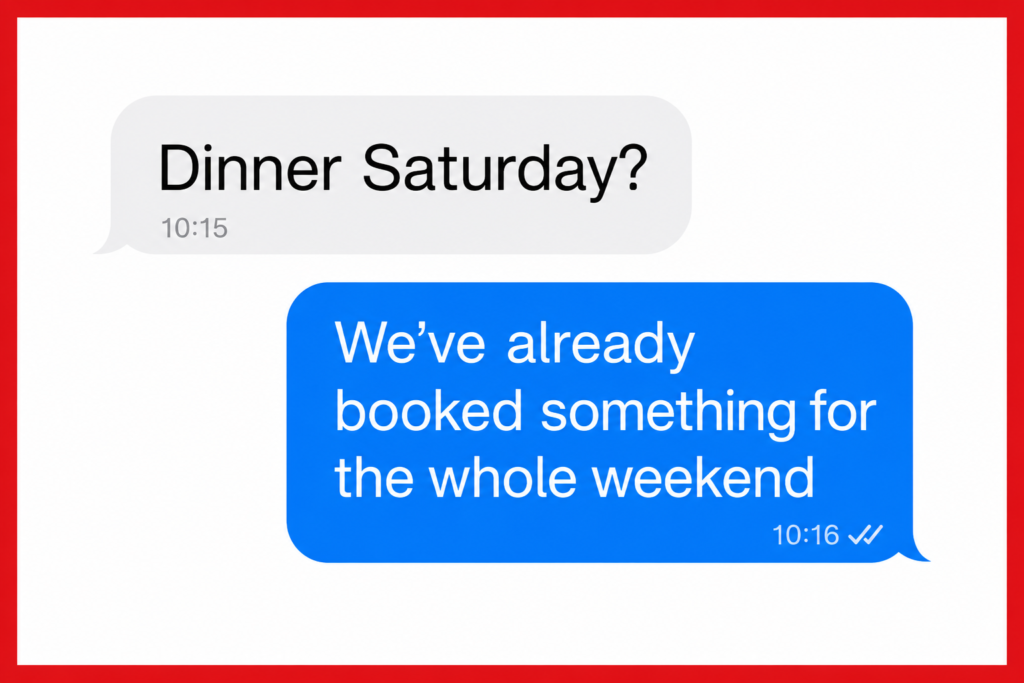
None of those answers is unreasonable. People in relationships naturally build a shared life. What changes is your position inside the social structure. You may still be loved by your friends, but you’re usually no longer the first person they make plans around.
That’s where the thought “everyone is in a relationship except me” can become painful in a way that has surprisingly little to do with romance. You start noticing that everybody seems to have somebody who automatically accompanies them to weddings, dinners, trips, Christmas plans, birthdays or random Sunday mornings. If something goes wrong, they call their partner first. If something great happens, their partner normally hears first too.
Meanwhile, you can have plenty of friends and still occasionally experience the uncomfortable feeling that you are nobody’s default person.
This is also why repeated cancelled plans can start to feel much worse once you’re the last single friend. A cancellation isn’t always simply, “Something came up.” After a while it may feel like confirmation that you’re permanently somewhere below partners, family plans and couple commitments on everybody’s priority list. There is a difference between a friend having a busy month and being the person whose plans keep getting cancelled whenever something better appears.
Your social life quietly changes too
There is another side to being single when all your friends are in relationships that I didn’t fully understand when I was younger: their relationships can indirectly change your dating life as well.
When most of my friends were single, we naturally went out more. We could decide at 9 p.m. that we wanted to go somewhere. We’d meet people through other people, go to parties we had barely planned, stay out longer than intended and end up talking to complete strangers. Nobody was organising the evening around a boyfriend or husband waiting at home.
As friends couple up, that kind of social life often slowly disappears without anyone making a deliberate decision to stop it. There are fewer parties, fewer spontaneous weekends, fewer random groups of people and fewer nights where somebody brings a friend you’ve never met before. Dinner at someone’s apartment starts replacing bars, restaurants or events, which can be very pleasant but also means your world becomes more closed.
That matters if you’re wondering why am I still single when all my friends are in relationships. Meeting someone isn’t purely a matter of attractiveness, personality or “trying harder.” The opportunities you have to meet potential partners matter enormously. Two people with exactly the same personality can have completely different dating lives if one meets twenty new people every month and the other meets two.
This is why I don’t think the advice “just stop looking and it will happen” is particularly useful. If you are working remotely, seeing the same friends and spending most weekends with established couples, the number of new people naturally entering your life can become very small. I’ve experienced the same issue while travelling and living abroad, which is why I see dating while moving between cities as partly a question of social exposure, not simply luck or dating apps.
Why am I the only single one of my friends?
If you keep asking why am I the only single one of my friends, there usually isn’t one dramatic explanation. People reach relationships through completely different combinations of timing, standards, opportunity, personality, luck and willingness to compromise.
Some people simply met their partner earlier. Some spent years in social environments where they constantly met new people. Some were very active on dating apps. Some accepted relationships that another person would have walked away from after three dates. Some had lower expectations around compatibility, while others needed a much stronger connection before committing.
And, uncomfortable as it may sound, some people stay in mediocre relationships partly because being coupled feels safer than becoming single again. Seeing everyone paired off therefore doesn’t necessarily mean everyone else has “won” at relationships while you have failed.
This was something I had to learn as more people around me got married. From the outside, a wedding or long-term relationship can look like the final answer to life. From close enough, you realise that relationships vary enormously. Some are genuinely happy, some are complicated, some survive mainly because both people are used to each other, and some end years later.
So when the thought becomes “why does everyone find love except me?”, I try not to compare my entire private life with the public status of somebody else’s relationship.
The fact that I’m the only single friend at a particular moment tells me where everybody is today. It tells me almost nothing about where any of us will be five years from now.
Being the last single friend in your 30s feels different
Being the only single friend in your 30s is harder than experiencing the same thing at 22, not because being single suddenly becomes a problem at a particular birthday but because the structure around you changes.
At 22, even friends with partners usually still have very flexible social lives. People move apartments, change jobs, go to parties, travel with friends, break up, start dating again and generally live in fairly fluid groups. By your thirties, relationships often start absorbing much more of people’s time. Couples move in together, get married, buy homes or have children, and calendars become much more complicated.
That is why being the only single friend at 30, being the only single friend at 35, or being the only single friend at 40 can create completely different practical problems even though the emotional question is similar. You may discover that the people you used to call spontaneously now need two weeks’ notice. Some disappear every weekend. Others stop travelling without their partner. Once children arrive, another layer of scheduling appears, reflecting the broader changes in friendships and social relationships across adulthood documented by the American Psychological Association.
For some people the thought changes from all my friends have boyfriends except me to all my friends are married except me, and eventually to something even more isolating: being single when all your friends have kids.
Again, that doesn’t automatically mean your friends have become bad friends. Lives change. But pretending nothing has changed doesn’t help either.
Sometimes you genuinely need to rebuild part of your social life instead of waiting for the old version to come back.
When everyone is coupled, you can start feeling like a guest in your own friendships
One of the strangest parts of being the last single friend is that you can still technically have the same friends and yet feel as if your place in the group has changed. Nobody tells you that directly. Nobody says, “You are less important now.” It happens through small things. Invitations become couple-oriented, plans are built around somebody else’s partner, conversations drift toward weddings, mortgages, children or shared holidays, and suddenly you are participating in a social life that was not really designed around you anymore.
That is why thoughts such as I feel like a third wheel with my friends can become so intense. Sometimes nobody has done anything deliberately rude, but the dynamic itself creates a strange imbalance. If you are sitting with one couple, there are three people and that can still work perfectly well if everybody behaves normally. If you are sitting with four couples and you are the ninth person, however, the atmosphere can feel completely different. People naturally turn toward their partners, share private jokes, discuss plans they made together, and you can end up floating between conversations.
This is exactly why I no longer believe the solution is simply to “be more confident.” Confidence does not magically change a room where everyone else is operating as a pair. The real question is whether the people around you know how to remain friends while being in relationships. Some do this extremely well. Others slowly turn every social occasion into an extension of couple life.
There is also a point where you have to notice patterns. If you constantly find out about dinners, trips or gatherings after they happen, then the problem may no longer be only that you are single. It may be that your social position has genuinely shifted. I have written before about what it feels like when you repeatedly realise everyone was invited except you, because that kind of exclusion becomes especially painful when you already feel like the odd one out.
Why do friendships change when friends get into relationships?
The short answer is that relationships take time, attention and emotional energy. The longer answer is that some people are simply better at balancing friendships and relationships than others.
When a friend starts dating someone seriously, they suddenly have another person’s schedule to consider. Weekends get divided between families, birthdays, errands, shared plans and couple time. This is normal. What is not inevitable is completely disappearing from friendships or expecting single friends to stay permanently available while the coupled person appears only when convenient.
I have seen both versions. Some friends get into relationships and remain almost exactly the same socially. They still call, still make plans, still show interest and still treat their friends as independent relationships worth maintaining. Other people seem to vanish almost overnight.
This is where the phrase my friends don’t have time for me since they got into relationships becomes more than insecurity. Sometimes it is literally true.
You notice it when you are always the one sending messages first. You notice it when plans are cancelled because a boyfriend suddenly became free. You notice it when every weekend is “our weekend” but they still expect you to be available when their partner is busy. You notice it when they stop asking about your life because most conversations now revolve around their own relationship.
And if several friends do this at the same time, being the only single friend becomes much harder because your entire support system can shrink at once.
Why does being single feel worse when your friends are coupled?
For me, the answer is comparison plus visibility.
When you are single among other single people, your relationship status is almost invisible. Nobody is constantly reminding you of it. You make plans in the same way, travel in the same way and usually face similar dating frustrations.
Once everyone couples up, the contrast becomes much more visible. Every dinner has pairs. Every holiday has plus-ones. Every wedding seating plan quietly reminds you who belongs to whom. People ask whether you are seeing anyone. Sometimes they try to set you up. Sometimes they tell you that you are “too picky,” usually with very little understanding of your actual dating life.
That is why I feel lonely because all my friends have partners can be true even if you are not generally lonely. You may have work, interests and social contact, but you are repeatedly exposed to one particular difference in your life.
The worst part is that you can start interpreting completely neutral moments as evidence that something is wrong with you. A friend mentions an anniversary and suddenly you remember how long you have been single. Someone books a holiday with her husband and you think about the fact that you would have to organise your own trip. Someone says, “We’re thinking about buying a house,” and your brain turns that into a comparison you never asked for.
That doesn’t mean you are jealous of their actual relationship. Sometimes you are jealous of the structure they have: someone to call, someone to travel with, someone who automatically assumes you are part of the plan.
Why do I feel jealous when my friends get into relationships?
Jealousy is one of those emotions people are embarrassed to admit, especially when they genuinely love their friends. But it is possible to be happy for someone and still feel sad about what their relationship highlights in your own life.
I have experienced that contradiction myself. You can think, “I am glad she found someone,” and at exactly the same time think, “Why is this never happening for me?” Those thoughts are not mutually exclusive.
The important part is being precise about what you are actually jealous of.
Sometimes it is the relationship itself. Sometimes it is the attention. Sometimes it is the certainty of having plans every weekend. Sometimes it is simply the feeling of being chosen.
That distinction matters because otherwise you can spend months telling yourself you desperately need a boyfriend when what you actually need is a fuller social life, more emotional connection or more opportunities to meet new people.
If all my friends have girlfriends except me or all my friends have boyfriends except me, the immediate reaction can be to treat relationships like something everybody else received and you missed. Real life is not distributed that neatly.
Some people meet someone through work. Some through friends. Some through apps. Some reconnect with an old acquaintance. Some date for years without anything serious happening and then unexpectedly meet someone within two weeks of moving to another city.
That unpredictability can be frustrating, but it also means your current situation is not evidence of a permanent outcome.
Am I going to be single forever?
This is probably one of the most frightening questions hidden underneath the search i am the only single one of my friends.
Usually, people do not literally believe they can predict the rest of their lives. What they are reacting to is repetition. If you have been single for years, had several short relationships that went nowhere and watched friend after friend settle down, the present starts feeling like a pattern that will simply continue forever.
I understand that feeling because most of my own relationships have also been temporary. When the same thing happens repeatedly, it is easy to start thinking there must be some invisible rule applying specifically to you.
But looking back, I can also see how much of dating is shaped by circumstances. There were periods when I was meeting lots of people, travelling, going out and constantly entering new social circles. There were other periods when my routine was much more closed. Unsurprisingly, those periods produced very different dating results.
So when someone asks am I going to be single forever, I don’t think the most useful response is “No, your person is coming.” Nobody can honestly promise that.
The more useful question is: is your current life creating enough opportunities for something different to happen?
If your routine consists of work, home and seeing the same three married friends every month, then changing your routine may matter more than changing your attitude.
Your friend group can accidentally make dating harder
This is one of the most practical things I have noticed.
When most of your friends are single, social circles tend to expand naturally. Somebody invites somebody. A friend brings a colleague. You meet people at a birthday, a bar, a beach club or through mutual friends. Even if you are not actively trying to date, new people keep entering your orbit.
When everyone settles into relationships, those networks can become much more closed.
Couples often socialise with other couples. Dinner becomes four people instead of twelve. Holidays become couple trips. House gatherings contain the same familiar group. Spontaneous nights out become less common.
You can therefore genuinely become less likely to meet somebody while being single when all your friends are in relationships.
This does not mean you should abandon your married friends and replace them with single people. It means you should avoid letting one social circle become your entire world.
I learned this from moving between cities and repeatedly having to rebuild my social life. If you need a wider circle, creating friendships through repeated contact rather than waiting for random chemistry is usually much more effective. Classes, coworking spaces, language exchanges, sports, regular events and familiar cafés all work better than one-off networking nights because you keep seeing the same people.
That is also the most realistic answer to how to make single friends in your 30s. You usually do not find them by searching specifically for “single friends.” You create a larger social environment where people with different lifestyles naturally appear.
How to cope with being the only single friend without pretending you love it
I don’t think the answer to how to cope with being the only single friend is convincing yourself that being single is secretly better.
Maybe you enjoy parts of it. Maybe you don’t.
You are allowed to want a relationship and still have a good life. You are also allowed to admit that certain social situations make you uncomfortable without turning that discomfort into a diagnosis of low self-esteem.
The most useful thing I have done is separate three different problems that often get mixed together.
The first is loneliness. That means you need more human contact, not necessarily a romantic partner.
The second is exclusion. That means you may need to address specific friendship dynamics or stop investing heavily in people who repeatedly make you feel secondary.
The third is lack of dating opportunities. That means you need more exposure to new people.
Those problems require completely different solutions.
If you feel lonely, spending more time around people can help. If you feel excluded, joining another dinner with the same eight couples may make it worse. If your issue is dating opportunities, adding three more married friends to your social calendar probably changes very little. In that case, exploring platforms designed for people looking for something casual may be more useful than simply trying to expand the same social circle.
Once I separated those things, being the last single friend became much easier to understand.
How to deal with being the last single friend in practical terms
If I had to deal with the situation again from the beginning, I would do several things differently.
First, I would stop attending every social event simply because I had been invited. That birthday dinner taught me something useful. Not every invitation is automatically good for you. If an evening is obviously going to be six couples having dinner and you already know that dynamic makes you miserable, you do not have to prove anything by going.
Second, I would keep friendships with coupled friends who still treat me like a friend, not an accessory. Some of the best evenings I have had were with a close female friend and her husband because they never made me feel like an extra person.
Third, I would deliberately maintain a social life outside established couples. That could mean other single friends, divorced friends, expats, travellers, coworkers or simply people who still enjoy going out and meeting others. Relationship status matters less than social openness.
Fourth, I would stop automatically being available. Single friends sometimes become the flexible person everybody calls when their partner is busy. If that starts feeling one-sided, it is completely reasonable to have your own plans.
Finally, I would pay attention to whether I am still being treated with basic consideration. If somebody regularly disappears, cancels on me or only contacts me when their partner is unavailable, I would stop explaining it away indefinitely.
Being single when all your friends are married changes the friendship, but it doesn’t have to end it
One of the biggest fears behind all my friends are married except me is that married life and single life eventually become incompatible.
I don’t think that is necessarily true.
Some of my friendships became easier once I stopped expecting them to look exactly as they had five years earlier. A married friend may not be available for spontaneous nights out anymore, but she can still be a close friend. The important thing is reciprocity.
Does she still make time for you? Does she ask about your life? Can she occasionally see you without her husband? Does she remember that your plans matter too?
If yes, the friendship can evolve without disappearing.
The problem starts when the single friend is expected to do all the adapting.
That is when being single when all your friends are married begins to feel less like a difference in lifestyle and more like social demotion.
And if you repeatedly experience that, it may be time to invest energy somewhere else rather than fighting for the exact version of the friendship that existed before.
You may need new friends, not replacement friends
This is probably the biggest practical conclusion I have reached.
When people ask how to make new friends when all your friends are married, they often feel guilty, almost as if looking for new friendships means betraying old ones. It doesn’t.
You can keep people you love and still admit they no longer meet every social need you have.
A married friend with two children may genuinely love you while having almost no interest in going out on Friday night. There is nothing wrong with her. There is also nothing wrong with you wanting someone who does.
The mistake is expecting one friendship group to provide everything forever.
I have lived in enough different places to see how useful it is to have different circles. Some friends are perfect for long conversations. Some for travel. Some for spontaneous plans. Some are people you see only occasionally but always enjoy.
You do not need one perfect tribe.
You need enough people around you that one change in someone else’s relationship status does not completely rearrange your own life.
Looking back, I realise that being single wasn’t what made that birthday dinner so uncomfortable; it was feeling like the only person who didn’t belong. If you’re thinking I am the only single one of my friends, pay more attention to whether your friendships still make you feel included and valued than to how your relationship status compares with everyone else’s.
FAQ
Why am I the only single one of my friends?
There usually isn’t one specific reason. Different timing, standards, social circles, dating opportunities and plain luck all play a role. Being the only single friend right now doesn’t mean you’re doing something wrong or that your friends have somehow figured out relationships better than you have.
Why does being single feel worse when all your friends are in relationships?
Being single when all your friends are in relationships can feel harder because your relationship status suddenly becomes much more visible. Friends also start organising weekends, holidays and everyday plans around their partners, so the loneliness may come as much from changes in your social life as from actually wanting a relationship.
How do I cope with being the only single friend?
Don’t rely entirely on one group of coupled friends for your social life. Keep the friendships that still feel mutual, but create opportunities to meet other people through hobbies, events, work, travel or regular social activities. How to cope with being the only single friend is often less about learning to enjoy loneliness and more about making sure your own life hasn’t become smaller as your friends’ relationships become more serious.
Is it normal to feel jealous when my friends get into relationships?
Yes. You can genuinely be happy for a friend while also wishing you had what they have. If you’re wondering why do I feel jealous when my friends get into relationships, try to identify what you’re actually missing: romance, companionship, attention, more social plans or simply the feeling of being someone’s first choice.
Why do friendships change when friends get into relationships?
Serious relationships take time and naturally change people’s priorities, but the amount of change depends on the person. A good friend can have a partner and still make time for friendships, while others become almost completely absorbed in couple life. The important difference is whether the friendship still feels reciprocal rather than expecting you to be available only when their partner isn’t.
Am I going to be single forever if everyone else has found someone?
Nobody can honestly predict that, and your current relationship status isn’t evidence of your future one. If everyone is in a relationship except me keeps running through your head, it can help to look at something more practical: how often are you actually meeting new people? Sometimes changing your social exposure is far more useful than assuming there must be something wrong with you.
Explore the Human Connection Hub
Discover more articles about friendship, loneliness, dating, ghosting and modern relationships in our Human Connection Hub.
Explore the Human Connection Hub →This article combines my own experience of being single while friends moved into serious relationships with independent research and first-hand discussions about loneliness, friendship, dating, and changing social dynamics.
Research sources included:
- My own experience of being single, dating, and navigating friendships as more people around me entered long-term relationships and marriage.
- Research and psychological resources on relationships, loneliness, and social connection from the American Psychological Association (APA).
- Peer-reviewed research and scientific literature available through PubMed (National Library of Medicine).
- First-hand experiences and discussions shared by people navigating being the only single person in their friendship groups on Reddit.
The goal is to explain why being the only single friend can sometimes feel so isolating, how relationships can change the dynamics of a friendship group, and what can actually help without reducing the experience to generic advice about learning to enjoy being alone.

Founder & Editor
Founder of The City Theory, writing about digital nomad lifestyle, modern city culture, remote work, travel experiences, psychology and human behaviour around the world.